Templates for Managers.
A curated set of 21 files for the person who actually has to write the review, run the one-on-one, and have the conversation — with no HR business partner to call and no per-seat platform to log into.
The hard part of managing is the writing and the conversations
Almost nothing on a manager's list is hard because the decision is hard.
By the time the review form lands you already know the rating — you have
known for months. What stops you is the blank box underneath
it, and the knowledge that whatever goes in that box will be
read by the employee, read by HR, and read again in a year by somebody
who wasn't there. So it gets filled with the words everybody reaches for
the night before the deadline: detail-oriented, great attitude, needs
to be more proactive, has real potential — sentences that can't be
checked, can't be repeated on purpose, and give the employee nothing to
do differently on Monday.
The fix is behavior-based
feedback: describe the work, not the person. A
performance-review
phrasing bank gives you 189 competency phrases (243 in all) organized by
rating level — structurally different language at Exceeds, Meets and Needs
Improvement — each printed with the specific count, date, artifact or
consequence it obliges you to produce, plus a five-slot builder that
assembles the summary paragraph. Ten of its rewrites are
10 free review
rewrites (PDF, no signup), and it's worth reading
how to write
a review that holds up and how a bank
compares to an AI review
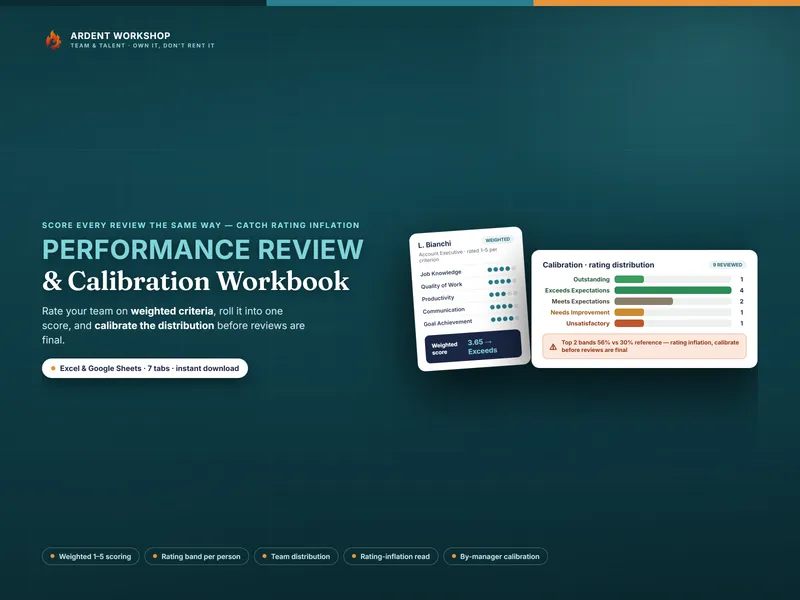
generator before review season starts. For the rating itself — weighted
criteria per role, the distribution across the team, and a
calibration
read that catches a lenient or strict rater — the
Performance
Review & Calibration Workbook is the companion file. Decide the
rating there; write the paragraph in the bank.
The paperwork is the easy half, though. The
difficult-conversations
script bank covers the fifteen conversations you actually put off — a
first performance concern, attendance, a declined raise, a
performance improvement
plan, a termination, a layoff — each branched for the four replies you
get, with the exact next line for every one, a stop-check naming when to
bring HR in before you open, and the note to write within the hour.
How to start a
performance conversation walks the first one through step by step, the
whole card for it is
the free first-performance-concern
script (PDF, no signup), and
scripts vs. an HR
consultant is the thirty-second test for which conversations need paid
advice on your facts.
When the conversation does not fix it, the next thing you need is a
record rather than another conversation. The
Performance
Improvement Plan & Corrective-Action Documentation Kit keeps two
dates on every incident — the day it happened and the day you wrote it
down — and scores the gap between them. Its plan builder derives every
check-in date from a start date and a number of weeks, and will not call
a plan ready to issue until five checks pass. Eight corrective-action
documents come as fillable PDFs and editable Word files. If you are not
sure which step the situation calls for,
verbal warning vs
written warning vs PIP is the fast version of that decision. The
kit's standards library is the part you can try first, as the free
measurable-standard
rewriter (PDF, no signup), which turns vague feedback into a standard
somebody can actually meet. What a warning or a plan must contain is set
by law and by your own employer's policy, so your HR team and a qualified
employment lawyer are the authority, not a template.
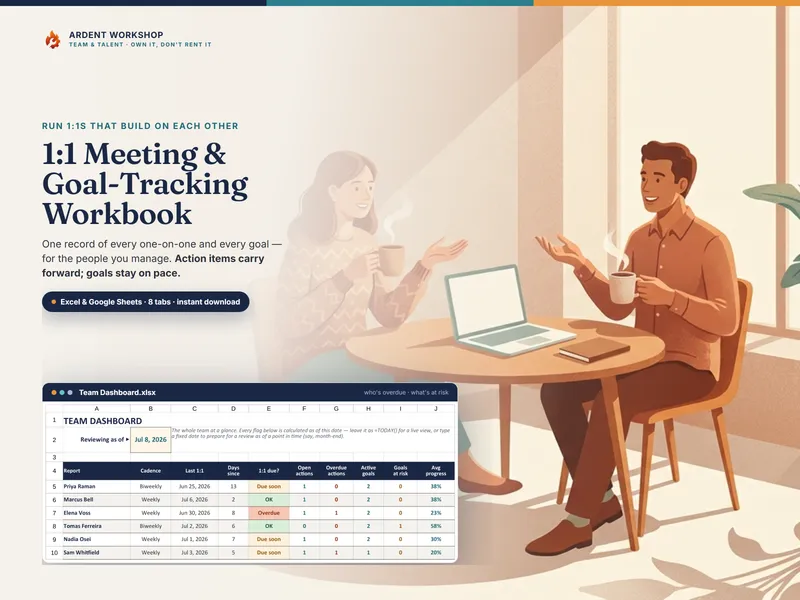
Between review cycles, the thing that makes review week a writing job
instead of an archaeology job is a running record. A
one-on-one kept in a
1:1 Meeting
& Goal-Tracking Workbook logs each meeting, carries action items
forward until they're closed, and flags who you're overdue to meet with —
four lines per person a month, and the evidence is already there in
March. Keep the meeting log where only you and HR can open it: notes on a
named person's performance are an employee record, on paper as much as in
a file. If the harder problem is what to ask once you are in the room, the
1:1 &
Coaching Question Deck is 108 printable questions across twelve
situations, each with the follow-up that makes it count; twelve of them are
free on the
twelve 1:1 questions
card sheet, and
what to ask in a
one-on-one walks through the method. If you are weighing that against a
subscription tool, see
a question deck versus a
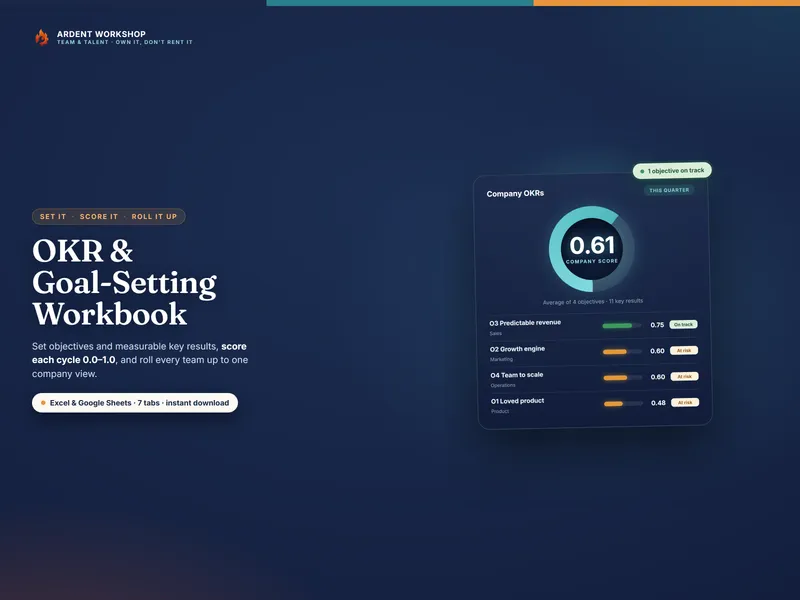
one-on-one app. Point the whole team at the same quarter with
OKRs in an
OKR & Goal-Setting
Workbook, instead of a
per-seat
performance platform.
Hiring and onboarding are the other two conversations nobody trains you
for. A structured interview
asks every candidate the same questions and scores them like-for-like, and
an
interview
scorecard & question bank ranks your slate on evidence rather than
on who interviewed best. Once the hire lands, a
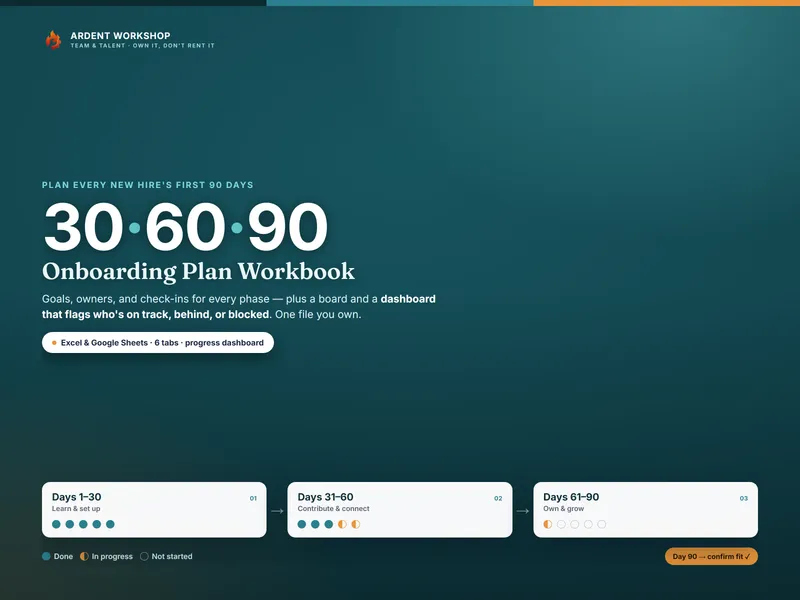
30-60-90 plan maps their first
three months into goals, owners and check-ins. And to know where your
team actually stands ability by ability — for development, promotion, or
the case for a hire — a
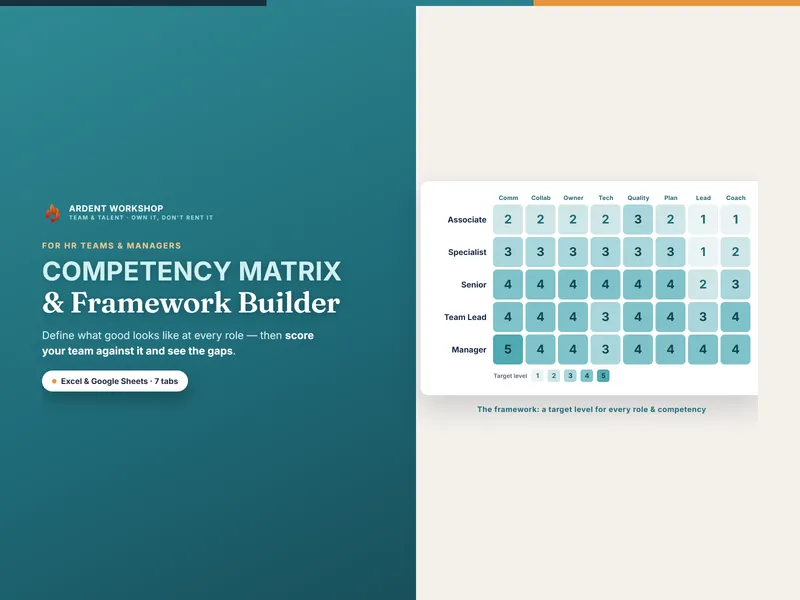
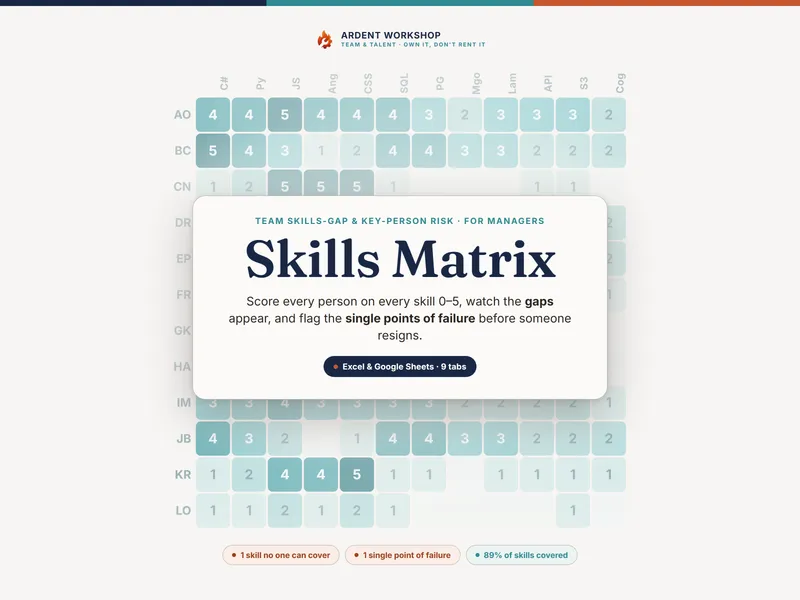
competency matrix and a
skills matrix put it on one grid,
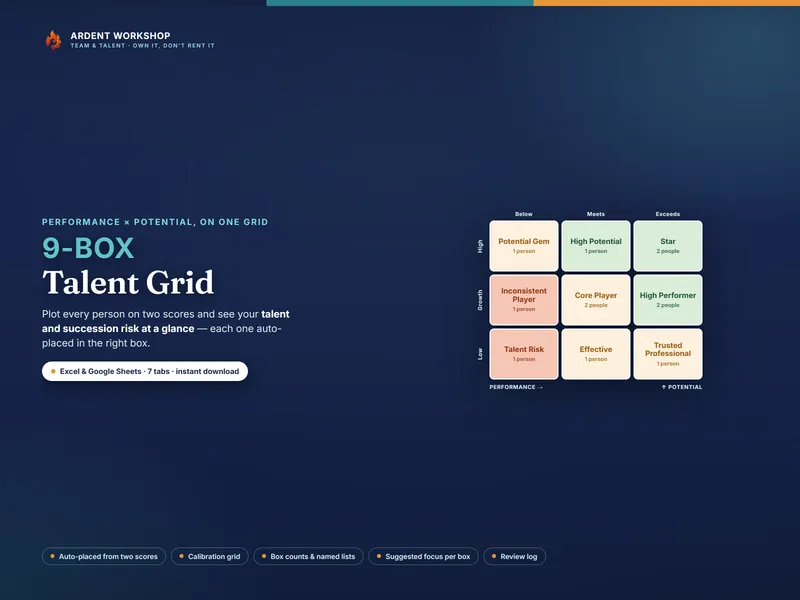
with a 9-box grid for the talent
review.
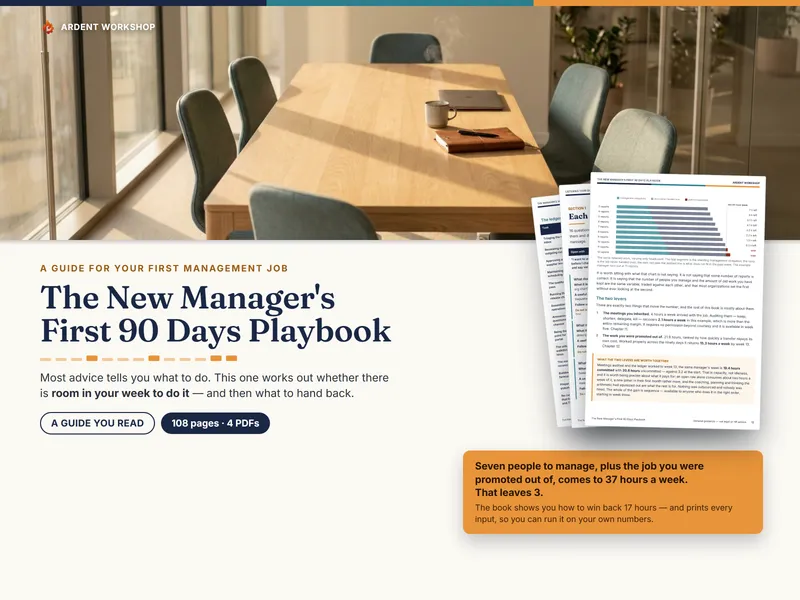
If you were promoted last month, start before any of that.
Everything above is a grid you fill in;
The New Manager's
First 90 Days Playbook is the one you read. It costs your week out
properly — every standing obligation with a minute figure, totaled against
the week you are actually paid for — and then works down what to hand back,
ranked by how fast each hand-over repays the hours it takes to teach. Plus
62 listening-tour questions, and 30 first-90-days changes already sorted
into week one, week six, day ninety, and not yours. The week-one questions are
free and ungated as the
First-Week Listening
Questions guide; there's a walkthrough of
what to do
in your first week as a manager, and it's worth reading how a written
method
compares to a
leadership course before you spend a training budget.
One caveat that matters more here than anywhere else on the
site. These are templates and general management guidance — not
legal advice, and not HR advice for your organization. What a
performance-improvement plan must contain, how much notice a written
warning requires, and what documentation supports a dismissal are set by
national, state and sometimes local law, by your own handbook and
contracts, and by any collective agreement you're party to. Take proper
advice before you write any review that will support dismissal,
demotion, a formal warning or a pay decision, or that touches a protected
characteristic, a disability or accommodation request, leave, or a
complaint an employee has raised.