The three parts, named
- 70% — challenging on-the-job experience. Stretch assignments, a harder project, a new responsibility, running something end to end for the first time — work that pushes past what the person already does comfortably.
- 20% — learning from others. Feedback, coaching and mentoring: a manager's structured feedback, a mentor relationship, shadowing someone more senior, a coaching conversation after a hard meeting.
- 10% — formal education. Courses, certifications, structured reading, workshops — useful, and the smallest share in the executives' accounts the model comes from, though it's often the part a plan over-relies on by default.
Where the numbers come from
The model traces to research in the 1980s at the Center for Creative Leadership, which asked successful executives to describe, in their own words, where their development had actually come from; Morgan McCall, Michael Lombardo and Ann Morrison reported it in The Lessons of Experience (1988). The ratio itself reached a much wider management audience through Lombardo and Robert Eichinger's 1996 book The Career Architect Development Planner, which is where the 70-20-10 shorthand took hold as a planning convention.
It's worth being plain about what that origin does and doesn't support. The ratio is drawn from executives' self-reports about their own careers — not from a controlled study measuring how learning actually happens — and the exact split was never claimed to be precise. Critics note the model lacks rigorous empirical support, and that treating 70-20-10 as an exact formula overstates what it was ever meant to prove. The useful part of the model isn't the third decimal place; it's the ordering — that stretch work and coaching usually outweigh a course, not that they outweigh it by exactly 60 points.
A heuristic, not a quota
A plan that lands on 65-22-13 in a given quarter because a stretch assignment wasn't available isn't a failed plan. What the ratio is for is catching the opposite pattern: a "development plan" that turns out to be a course-and-reading list with no on-the-job stretch and no coaching relationship attached to it at all — the plan on paper looks busy, and the actual capability doesn't move. That drift is quiet, because a course is easy to schedule and easy to check off, and a stretch assignment takes a manager actually rearranging someone's work. Nothing about the model stops a course-heavy plan from existing; it just gives a manager a fast way to notice one.
Turning the ratio into an actual plan
The model only does work once it's attached to something specific: a named competency gap, an activity typed by which of the three it is, hours or a rough time commitment against each, and a way to see the mix the plan actually adds up to rather than the one someone had in mind in January. Plans often get the intention right and lose the follow-through — the course gets booked and logged, the stretch assignment gets talked about and never formally tracked, and by the mid-year check-in nobody can say what the real split was.
Common mistakes
- Treating it as a hard formula. The research behind it is self-reported and retrospective — useful for weighting a plan, not precise enough to defend an exact percentage.
- Filling the "70" with normal workload. Doing the job is not the same as being stretched past it. If the work wouldn't be uncomfortable to hand to someone already fully capable, it isn't development.
- Skipping the "20" because it's harder to schedule. Coaching and mentoring take a manager's actual time, so they're the first thing to slip off a busy quarter — and the first thing worth protecting on purpose.
- Never checking the actual mix. A plan written 70-20-10 in January and never revisited tells you nothing about what happened. The ratio is only useful measured against the hours actually put against each type, rechecked as activities are added, dropped or finished, not against the split someone intended.
Related templates and concepts
The 70-20-10 model is the learning-plan half of an individual development plan; the other half is the competency gap it's meant to close. The Individual Development Plan (IDP) Workbook types each activity by 70-20-10, computes the actual mix from the hours planned, and flags a plan that's drifted course-heavy — for a whole team of direct reports in one file. To try the shape on one person for free, the free IDP template ships a worked-example plan with every activity typed by 70-20-10 and its actual mix worked out. The "20" — feedback and coaching — is what the 1:1 Meeting & Goal-Tracking Workbook logs cycle over cycle. See also the ILUO matrix, IDP vs performance improvement plan, and the templates for managers hub.
Templates that implement this
Build a plan that's actually weighted 70-20-10
2 templates
A ratio nobody checks drifts to whatever's easiest to schedule. The IDP workbook types every learning activity by 70-20-10 and computes the planned mix as you fill it in; the 1:1 workbook logs the coaching and feedback conversations behind the “20.”
- $19.95 Spreadsheet
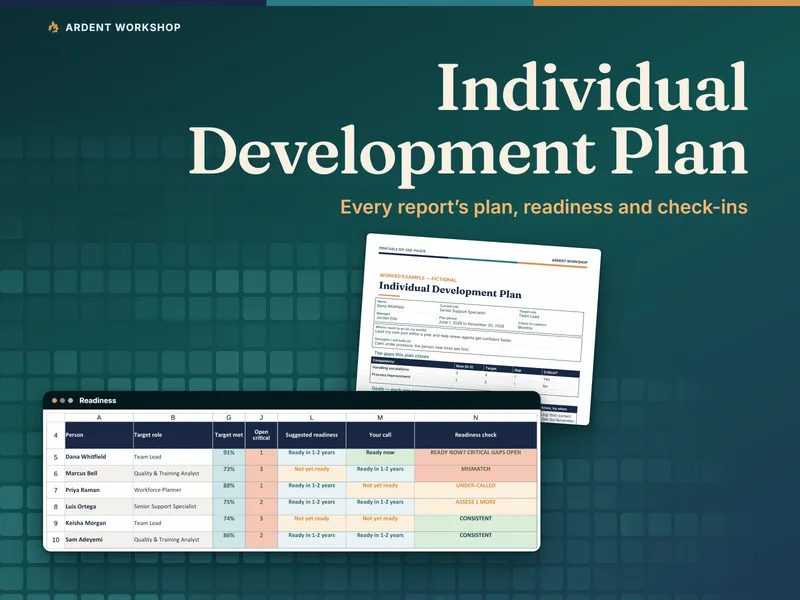
Individual Development Plan (IDP) Workbook — Team IDP Template for Excel & Google Sheets
An IDP workbook for Excel & Google Sheets — plans for up to 30 direct reports, readiness checked against evidence, and overdue check-ins flagged.
Team & TalentView details - $19.95 Spreadsheet
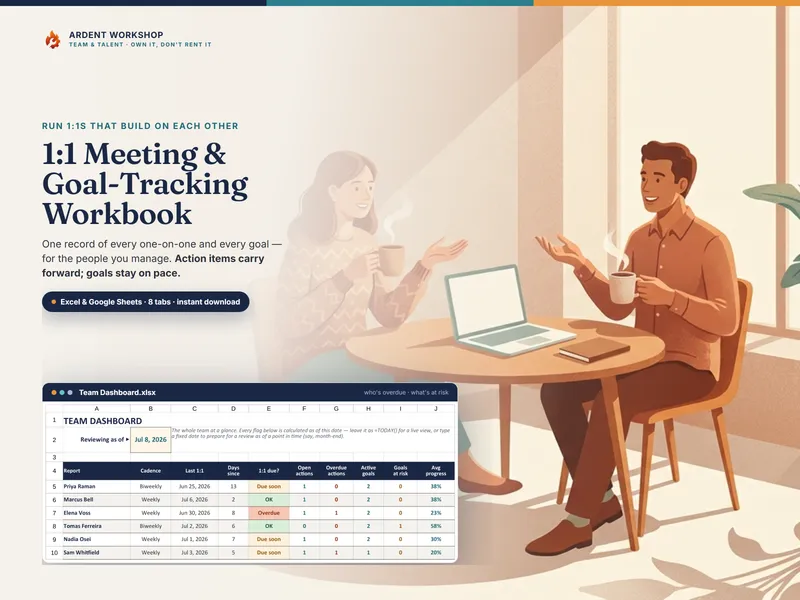
1:1 Meeting & Goal-Tracking Workbook — One-on-One & Goal Tracker for Excel & Google Sheets
A 1:1 meeting & goal-tracking workbook for Excel & Google Sheets — log every one-on-one, carry action items forward, and track goal pace across your team.
Team & TalentView details
Frequently asked questions
- Who came up with the 70-20-10 model?
- From 1980s research at the Center for Creative Leadership into how successful executives said they had actually learned their jobs, reported by Morgan McCall, Michael Lombardo and Ann Morrison in The Lessons of Experience (1988). Michael Lombardo and Robert Eichinger then put the 70-20-10 ratio into their 1996 book The Career Architect Development Planner, which is where the label became the common shorthand for it.
- Is the 70-20-10 model backed by research, or is it a rule of thumb?
- It's a heuristic, not a measured law. The original work asked executives to describe, after the fact, where their own development had come from — it was not a controlled study of how people learn, and the ratio was never claimed to be precise. Critics note it lacks rigorous empirical support, and that the split shouldn't be read as a fixed formula. Treat 70-20-10 as a planning guide for where development effort tends to pay off, not a quota any individual plan has to hit exactly.
- Does every development plan have to hit exactly 70-20-10?
- No. The numbers are a reminder of where the weight should sit, not a target to force a plan to land on. A plan that runs 60-25-15 because a stretch assignment genuinely wasn't available this quarter isn't broken. What the ratio is useful for is catching the opposite pattern — a plan that's quietly become a list of courses and reading with no on-the-job stretch or coaching in it at all.
- What counts as the '70' — the on-the-job part?
- Work that stretches the person past what they already comfortably do: a harder project, a new responsibility, covering for someone above them, running something end to end for the first time. The test is whether it would be uncomfortable to hand to someone who was already fully capable at it — if it wouldn't, it's day-to-day output, not development.
- What counts as the '20' — learning from others?
- Feedback, coaching and mentoring: a manager's structured feedback in a 1:1, a mentor relationship, shadowing someone more senior, a coaching conversation after a hard meeting. The common thread is that it comes from another person's judgment about your work, not from a course or a stretch assignment done alone.
- What counts as the '10' — formal education?
- Courses, certifications, structured reading, workshops — the material many companies default to first because it's easiest to buy and schedule. In the executives' accounts behind the model it was the smallest share, not the largest, which is why the ratio is a useful check on a plan that leans on it.