What performance calibration is
In a review cycle, each manager rates their own people first — usually against a shared set of criteria on a defined scale. Performance calibration is the step that comes next, before those ratings are final: the managers step back from individual scores and look at the shape of the ratings across the whole team, and across each other, to make sure a rating means the same thing regardless of who gave it. It is a consistency check on the ratings, not a re-scoring of every person.
The word borrows from measurement: you calibrate an instrument so its readings can be trusted and compared. Calibrating a review cycle does the same for human judgment — it aligns the raters so their numbers are comparable.
Why performance calibration matters
Ratings decide real things — pay, promotion, development, sometimes exit. If different managers apply the same scale differently, those decisions rest on who your reviewer happened to be rather than how you actually did. Two failure modes are common, and calibration is aimed squarely at both:
- Rating inflation. Scores drift upward over time because no manager enjoys handing out a low number, so the top bands fill up and the scale loses its meaning. When almost everyone is “Exceeds,” the rating no longer distinguishes anyone.
- Rater-to-rater drift. One manager runs strict and another runs lenient, so the same performance earns a different rating on different teams. That is unfair to the people under the strict rater and misleading about the people under the lenient one.
Calibration surfaces both while they can still be discussed and adjusted — before the ratings are delivered — instead of leaving them baked into decisions no one can see the seams of later.
How performance calibration works
Calibration is a comparison, not a new score. A workable version has three parts.
- Distribution vs. a reference. Plot how many people landed in each rating band across the whole team, then compare that spread to a reference shape — roughly, most people clustered in the middle bands with fewer at each extreme. The reference is a sanity check for the conversation, not a quota you force the team to match.
- A rating-inflation read. Look at the share of the team sitting in the top one or two bands and compare it to a reasonable reference — as a rule of thumb, around a third. A top-heavy result is a prompt to ask whether the ratings are genuinely that strong or the scale has drifted up — not an instruction to knock people down.
- A by-manager view. Show each manager's average rating and their top-box rate side by side. A manager whose numbers sit well above or below the rest is worth a closer look — it may reflect a genuinely stronger team, or it may be a lenient or strict rater applying the scale differently. The view starts the conversation; the managers settle it.
Then calibrate before you deliver. The whole point is that this happens while ratings are still provisional. Managers walk the distribution and the outliers together, challenge the ones that don't hold up, and adjust where the case is genuinely weak — before anyone sees their number. A rating changed in calibration is the process working, not a mistake being papered over.
Calibration vs. a single review score
A single weighted review score answers “how did this person do against their criteria?” Calibration answers a different question: “do our scores mean the same thing across the whole team?” You need both. The score gives each person a fair, structured read against the same criteria; calibration makes those reads comparable to each other. One without the other is either an inconsistent stack of forms or a distribution with nothing solid underneath it.
Common pitfalls
- Treating the reference as a quota. A reference distribution is a discussion aid — a rough shape to notice departures from. Turning it into a hard cap (“only 10% may be Outstanding”) forces managers to lower ratings that are genuinely deserved, which is its own kind of unfairness.
- Sliding into forced ranking. Forced ranking — stack-ranking people against each other and cutting the bottom slice by rule — is a different, far more contentious practice. Calibration compares distributions to keep raters honest; it does not require ranking people head-to-head or firing a fixed percentage.
- Calibrating after delivery. Adjusting a rating after the person has already seen it turns a fairness step into a walk-back. Calibrate while ratings are provisional.
- Skipping the conversation. The distribution and the by-manager view are prompts, not verdicts. An outlier manager might have a genuinely stronger team — only the discussion tells you which.
- Leaving it unprotected. Calibration data holds candid ratings of named people; keep it confidential to those who need it.
The four-line note that actually holds a rating
Calibration does not run on your review paragraphs. Read a well-written write-up aloud and the room will discount it inside a sentence. What holds up is short:
- The rating. Stated plainly, first.
- One piece of evidence with a number in it. The first number spoken tends to anchor the discussion.
- The comparison to a named peer at the same level — offered before you are asked for it.
- The counter-argument you have already considered. Saying it yourself signals you have not just written up your favorite, and it usually shortens the challenge.
Three habits are worth more than any phrasing: name the scope difference where two people share a title but not a job (and have it written down somewhere other than your own head); know your own marginal call before you walk in, so if the distribution has to move you are the one who says which rating you would change; and volunteer thin evidence — saying “what I have here is thinner than the rating suggests” costs you one rating and buys trust in all the others.
Doing it with two or three managers
Calibration is often described as a big-company ritual, and the version with an HR facilitator and a projected grid is. The small-company version is one hour with whoever else manages people, the draft ratings in a file only those managers can open, and a rule that no rating changes without a stated reason. That is enough to catch a lenient rater, and it is harder to challenge later than a set of ratings each written alone.
If you genuinely manage everyone yourself, you can still calibrate against yourself: read all your ratings for one competency together, in a single pass, rather than person by person. Most inconsistency shows up immediately.
And if the room moves a rating, write down why — not only what it moved to. The employee was not in the meeting, they are owed the reason, and you will not remember it in a week. Then write the paragraph itself with behavior-based feedback: a count, a date, a named artifact, and a consequence somebody else felt. The Performance-Review Phrasing & Feedback Wording Bank carries the calibration notes and the review wording, and how to write a review that holds up walks one competency end to end.
Where to start
Try the scoring side for free. The performance-review starter is an ungated, no-signup single-person weighted review form — no calibration, but it shows how the weighted score and rating band work.
Calibrate a whole team with the full workbook. The Performance Review & Calibration Workbook adds the whole-team rating distribution, the inflation read, and the by-manager view on top of the weighted scoring. It's the rung between a blank spreadsheet and a per-seat performance platform — own it, don't rent it.
Related templates and concepts
Calibration sits inside a review cycle built on weighted criteria, and it pairs naturally with the 9-box grid, which runs its own calibration session on performance × potential. See how the workbook compares to performance-management software, or browse the templates for HR & team leads hub for the rest of the toolset.
Templates that implement this
Templates that calibrate a review cycle
3 templates
Rate each person on weighted criteria, roll it into one score and band, then see the whole team's rating distribution, an inflation read, and a by-manager view — before any review is final.
- $24.95 Spreadsheet
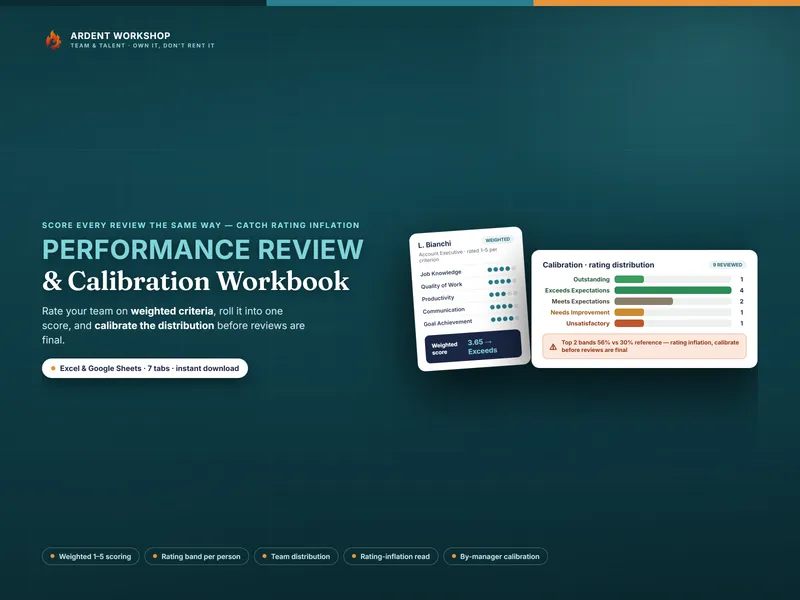
Performance Review & Calibration Workbook — Weighted Scoring & Rating Distribution (Excel & Sheets)
A weighted performance review template for Excel & Google Sheets — score your team on shared criteria and calibrate the rating distribution.
Team & TalentView details - $19.95 Mix

Performance-Review Phrasing & Feedback Wording Bank — 189 Review Phrases by Competency and Rating Level, Plus 54 for Goals, Self-Review and Calibration, Each With the Evidence It Requires
189 performance review phrases by competency and rating level, plus 54 more for goals and calibration — each naming the evidence it requires.
Team & TalentView details - $24.95 Spreadsheet
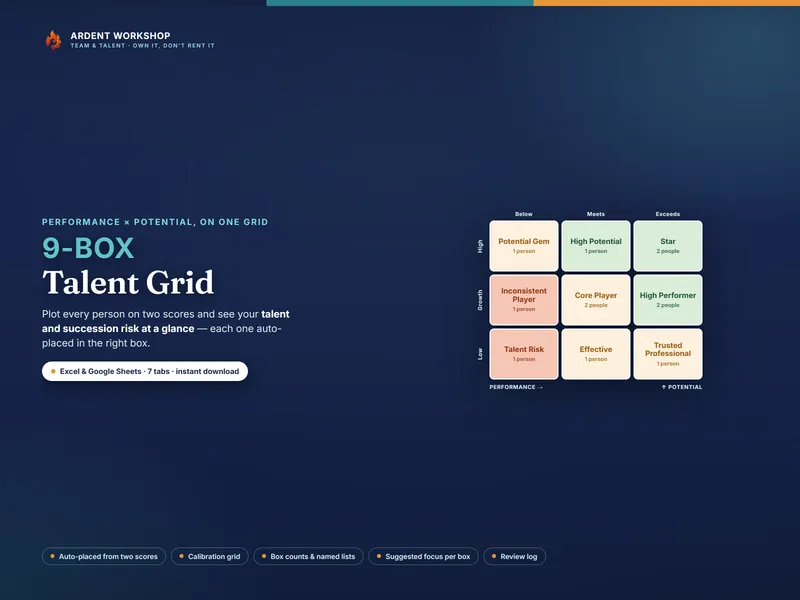
9-Box Talent Grid — Performance & Potential Matrix for Excel & Google Sheets
A 9-box talent grid for Excel & Google Sheets — score performance and potential, auto-place each person, and see succession risk on one grid.
Team & TalentView details