Picture a support manager — call her Priya — sitting down in January to write a development plan for Marcus, her strongest senior specialist. Both are hypothetical, not real people. He has told her twice that he wants to be a team lead. She opens a blank document, types Goals, and starts listing what comes to mind: a leadership course, a scheduling course, a book on coaching, “shadow me sometimes.”
It looks like a plan. It is a reading list. And the 70-20-10 model is the fastest way to see why.
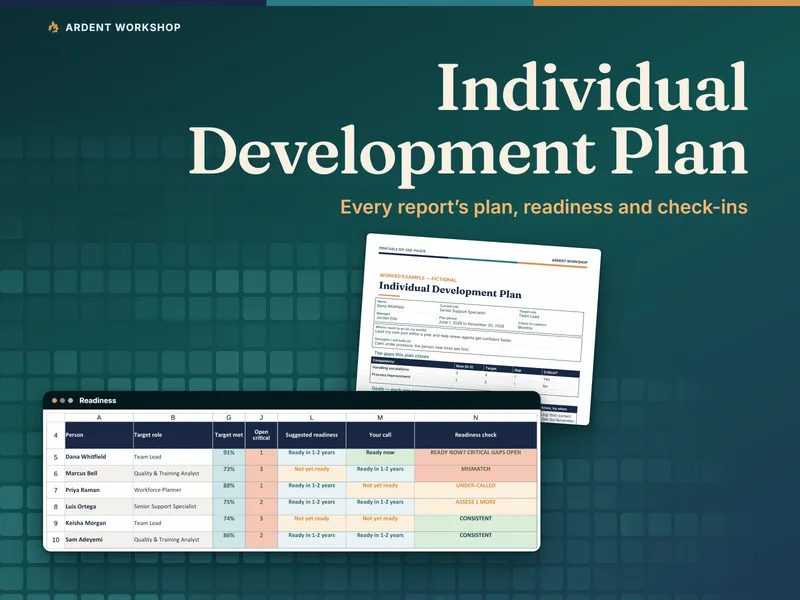
This post is a worked 70-20-10 development plan example — one hypothetical employee, one quarter, every activity typed and given hours, then checked against what actually happened by mid-quarter. The finished plan budgets 100 hours over a 13-week quarter: 70 of stretch work, 20 of learning from other people and 10 of coursework. Keeping that arithmetic straight for a whole team is what the Individual Development Plan (IDP) Workbook does: it computes each person’s 70-20-10 mix from the hours actually planned and flags a plan as course-heavy when training takes more than its share. But the method works on paper too, so here it is either way.
What is the 70-20-10 model?
The 70-20-10 model is a rule of thumb for weighting a development plan: roughly 70% of growth from challenging on-the-job experience, 20% from developmental relationships such as coaching, feedback and mentoring, and 10% from formal coursework and training. The Center for Creative Leadership describes it (opens in new tab) as emerging from more than 30 years of its research into how executives learn, grow and change.
The three parts, as this post uses them:
| Part | What it is | Typical examples |
|---|---|---|
| 70 — Experience | Stretch work the person does themselves, past what they can already do | Running a process they have only watched, owning a project, covering a harder role |
| 20 — Exposure | Learning through other people | Coaching from a manager, a mentor, shadowing, structured feedback, co-leading with someone experienced |
| 10 — Education | Formal, structured learning | Courses, certifications, workshops, books |
Where the ratio comes from, and why it is a heuristic rather than a measured law, is covered on our explainer of what the 70-20-10 model is. This post is about the part that explainer leaves to you: turning the ratio into a real plan with real hours.
The first draft: why development plans often come out course-heavy
A first-draft development plan often comes out course-heavy because courses are the only activities that arrive pre-packaged — with a name, a date, a length and a checkbox. Here is Priya’s January draft, with the hours she would have to budget for each item:
| Activity | Part | Hours |
|---|---|---|
| Leadership fundamentals course | Education | 16 |
| Online scheduling course | Education | 10 |
| Book on coaching | Education | 6 |
| “Shadow me sometimes” | Exposure | 4 |
| “Take on more responsibility” | Experience | 0 |
| Total | 36 |
Add it up and the plan is 89% Education, 11% Exposure, 0% Experience — the 70-20-10 model upside down.
Notice that nothing in the draft is wrong. Every course is relevant. The problem is the two vague lines at the bottom. “Shadow me sometimes” has no schedule, so it gets four hours by generous guess. “Take on more responsibility” has no task, no start date and no owner, so it gets zero, because a line with no hours behind it is an intention, not an activity.
That is the quiet failure the model exists to catch. A course is easy to book and easy to check off. A stretch assignment means Priya actually rearranging who does what on her team, which is harder, so it stays vague and never happens.
A 70-20-10 development plan example, filled in
A filled-in 70-20-10 plan names a specific gap, gives every activity a part and a number of hours, and adds up to roughly the ratio in hours, not in line items. Priya’s rewrite starts from the gaps between Marcus and the team-lead role, rather than from a list of available courses. She finds three:
- Workforce scheduling — he has never built the team’s weekly shift schedule.
- Handling escalations — he resolves hard tickets well, but has never owned the escalation queue or spoken to an angry customer’s executive.
- Coaching others — he helps colleagues informally, but has never run a structured coaching conversation.
Finding those gaps is its own exercise; our guide on how to spot the skills gap on your team walks through it. Once they are named, every activity has to close one of them.
| Activity | Part | Gap it closes | Hours |
|---|---|---|---|
| Build and publish the team’s weekly shift schedule, reviewed by Priya | Experience | Scheduling | 26 (2 hours a week for 13 weeks) |
| Own the escalation queue one afternoon a week | Experience | Escalations | 44 (4 hours a week for 11 weeks) |
| Weekly 30-minute debrief with Priya on that week’s escalations | Exposure | Escalations | 6 |
| Co-lead two new-hire onboarding sessions with the current lead | Exposure | Coaching | 6 |
| Monthly hour with a mentor who leads another team | Exposure | Coaching | 3 |
| Sit in on two executive escalation calls, then debrief | Exposure | Escalations | 5 |
| Online scheduling course | Education | Scheduling | 6 |
| Book on coaching, discussed in one debrief | Education | Coaching | 4 |
| Total | 100 |
That comes to 70 hours of Experience, 20 of Exposure and 10 of Education — exactly 70-20-10, because the numbers were chosen to make the example easy to read. A real plan will not land so neatly, and does not need to.
Three things changed between the drafts, and none of them is the ratio itself:
- Every line has a gap. The leadership fundamentals course disappeared, not because courses are bad, but because it did not close any of the three gaps.
- Every line has hours. “Take on more responsibility” became two concrete assignments with a weekly cadence. “Shadow me sometimes” became two specific calls and a standing debrief.
- The 20 is attached to the 70. The weekly debrief exists to turn the escalation afternoons into learning. Experience without anyone to reflect with is just more work.
What goes in the 70, the 20 and the 10
The 70 is stretch work, the 20 is people, and the 10 is anything with a syllabus. When a plan stalls at the drafting stage, it is usually because the manager cannot think of what goes in the 70. These lists are starting points for a team lead’s plan.
The 70: experience activities
CCL’s research (opens in new tab) names turnarounds, increases in job scope, horizontal moves and new initiatives among the experiences leaders learn from. At team scale, that becomes:
- Owning a recurring process the person has only watched: the shift schedule, the monthly report, the budget forecast.
- Running a meeting they currently attend.
- Covering for their manager during a week of leave, with real decisions.
- Leading a small project end to end: a process fix, a tool rollout, a new-hire cohort.
- A temporary move into an adjacent role, such as a month on the quality team.
The test for any 70 activity: could the person fail at it? If not, it is their job, not their development.
The 20: exposure activities
- A standing debrief with the manager, tied to a specific 70 activity.
- A mentor outside the reporting line. A mentorship program tracker helps when several pairings run at once.
- Shadowing a specific conversation, followed by a five-minute “what would you have done?”
- Structured feedback after a stretch moment. The SBI feedback model keeps it specific.
- Co-leading with someone who already does the job well.
The 10: education activities
- A course aimed at one named gap, not a general “leadership” course.
- A certification the target role actually requires.
- A book, assigned with a debrief so it gets read.
How to check the 70-20-10 mix at mid-quarter
Checking the mix means re-adding the hours that actually happened, by part, and comparing them with the plan. Plans often drift, and when they do, the drift tends to run toward Education.
Back to the example. Six weeks in, Priya totals what Marcus has actually done:
| Part | Planned by week 6 | Actually done | Actual share |
|---|---|---|---|
| Experience | 32 | 24 | 53% |
| Exposure | 9 | 5 | 11% |
| Education | 5 | 16 | 36% |
| Total | 46 | 45 |
Two escalation afternoons were canceled during a ticket surge. The debriefs slid with them, because there was nothing to debrief. Marcus, wanting to keep moving, finished the scheduling course early and added a second one on his own.
The total hours look healthy: 45 against 46 planned. Only the split shows the problem. The plan has drifted from 70-20-10 to roughly 53-11-36, and it drifted toward Education for a common reason: courses do not get canceled by a busy week.
The fix is not to tell Marcus off for taking a course. It is to protect the Experience line. Priya moves the escalation afternoon to a quieter day and makes the debrief recurring on her calendar, whether or not there was an escalation that week. One honest table at week six is what makes that call possible. Without it, the drift would only show up at the end of the quarter, when it can be graded but no longer fixed.
Doing this for one person on paper takes a few minutes. Doing it for eight direct reports is where a hand-built document stops scaling. That is what the computed mix and the course-heavy flag in the IDP Workbook are for: update the hours as activities are dropped, added or finished, and each person’s mix recomputes.
How to tell whether the plan worked
A 70-20-10 plan worked if the gaps closed, not if the hours were spent. The ratio measures inputs. An individual development plan exists for the outcome.
So at the end of the quarter, Priya goes back to the three gaps and asks one question about each: is there evidence?
- Scheduling: Marcus has published 13 weekly schedules. Were the last few usable without Priya’s corrections? That is evidence.
- Escalations: He owned the queue for most of the quarter. Did he handle an executive call on his own by the end? If not, the gap is still open, however many hours went in.
- Coaching: He co-led two onboarding sessions. Has he run a coaching conversation solo yet? Probably not, so that goal carries into next quarter, with a new 70 activity behind it.
That is also the honest check on readiness. “Ready for team lead” is a call a manager makes. It should agree with the evidence, and when the call runs ahead of the evidence, the evidence should win. Whether Marcus then gets the role, or the team hires externally, is a separate decision; our guide to whether to promote from within or hire externally covers it.
Common Questions About Using the 70-20-10 Model
Does a development plan have to hit exactly 70-20-10?
No. The ratio is a rule of thumb for weighting a plan, not a quota. A quarter that lands at 62-24-14 is fine. A quarter that lands at 10-10-80 is a reading list, and that is the pattern the ratio exists to catch.
Should you measure the 70-20-10 split in hours or in activities?
Hours. Counting activities makes a one-hour webinar weigh the same as a ten-week stretch assignment, which flatters exactly the plans that need correcting. Hours are rough, but they are proportional to the effort each activity actually takes.
Is normal day-to-day work part of the 70?
Only if it stretches the person past what they can already do. Work you could hand to someone already fully capable is their job, not their development. The test is whether the person could fail at it.
How often should you review a 70-20-10 plan?
At least once mid-quarter, against the hours that actually happened. A mid-quarter check catches drift while there is still time to correct it, and a plan reviewed only at the end of the quarter can only be graded, not fixed.
The plan is the arithmetic
The 70-20-10 model does not make a development plan good. Naming the gaps, giving every activity hours and checking the real mix halfway through does. The ratio is what tells you, in one glance, whether the plan you wrote is the plan you are running.
If you manage more than a couple of people, the Individual Development Plan (IDP) Workbook runs plans like this for up to 30 direct reports in one file you own. Each goal is tied to the gap it closes, each person’s 70-20-10 mix is computed from planned hours, and overdue check-ins and stalled goals are flagged on one dashboard. It works in Excel and Google Sheets, with no seats and no subscription.