There’s a particular kind of quiet that falls over a team the morning the right person is out.
Picture an operations manager — or picture your own job, on a Tuesday. A client needs their account migrated, the monthly numbers are due, and the one person who knows how both of those actually work texted at 6 a.m.: out sick. Not “working from home” sick. Gone-for-the-week sick. And you realize, standing at the coffee machine, that nobody else in the building can do either thing without her.
She’s your best employee. She’s reliable, she’s fast, she never drops a ball. And that is exactly the problem.
Here’s the reframe most managers never make: your most dependable person is usually your team’s largest concentration of risk. Not despite being good — because of it. The better someone is, the more work quietly routes to them, the more knowledge collects in their head, and the more your operation comes to depend on a single human showing up. The strength and the fragility are the same fact, viewed from two sides.
The name for that fragility is the bus factor, and once you can see it, you can’t unsee it.
What is the bus factor?
The bus factor is the minimum number of people who would have to suddenly disappear before a task, project, or whole operation grinds to a halt. The morbid shorthand: how many team members could get hit by a bus before the work stops? A bus factor of 1 means one person — one resignation, one sick week, one vacation — is all that stands between “running fine” and “stalled.”
The term comes out of the open-source software world. In 1994, a developer on the Python mailing list reportedly asked what would happen to the language if its creator, Guido van Rossum, “were to be hit by a bus” (Wikipedia: Bus factor (opens in new tab)). The phrase stuck because it named something everyone felt and nobody measured. It’s also called the truck factor or lottery factor — same idea, slightly cheerier delivery.
The scale is simple, and it only runs one direction:
- Bus factor of 1 — a single point of failure. One person holds the knowledge alone.
- Bus factor of 2 — a backup exists, but the bench is thin.
- Bus factor of 3+ — genuine resilience. The work survives a departure.
Lower is fragile; higher is safe. And the uncomfortable finding is that low is the norm. A 2016 study of 133 popular open-source projects found that 65% had a bus factor of 2 or lower (opens in new tab) — and fewer than 10% had a bus factor above 10. That research looked at code, but anyone who has run a small team, a kitchen, a production line, or a back office already knows the pattern holds far beyond software. Most of what keeps your operation running depends on one or two specific people. You’ve just never written it down.
Why your most reliable employee is your biggest risk
Your best employee is your biggest risk because reliability concentrates knowledge, and concentrated knowledge is fragile. It’s a feedback loop, and it runs quietly in the background of every well-meaning team.
It starts as a kindness. Someone is good at a thing, so you give them the thing. They get better, so you give them the harder version. When something urgent comes up, you route it to the person who’ll get it right — which is them again. Over a year, without a single bad decision, you’ve built an operation where the critical path runs through one office chair.
This is the “hero” dynamic, and it feels like good management right up until it isn’t. The hero says yes. The hero stays late. The hero “just handles it.” And because they handle it, nobody else ever learns to — so the dependency deepens every month they stay, which makes their eventual absence more expensive, not less.
The cruel part is that the dependency is invisible while it’s working. A bus factor of 1 produces zero symptoms as long as that one person keeps showing up. Everything looks healthy. The numbers are good. Then they take the job offer, or the maternity leave, or the long-overdue vacation, and the whole arrangement reveals itself at the worst possible moment. You don’t discover a single point of failure gradually. You discover it all at once.
If you’ve recently watched a strong performer hand in their notice and felt the floor tilt, you already understand this in your gut. (We wrote a whole companion piece on the early-warning version of it: how to spot the skills gap on your team before someone quits.) The bus factor is the same problem measured before the resignation — while you can still do something about it.
How to find your team’s bus factor in 20 minutes
You find your bus factor by mapping tasks against people and counting how many names sit under each task. Any task with one qualified name is a bus factor of 1 — a single point of failure hiding in plain sight. It is genuinely a 20-minute exercise, and it’s uncomfortable in a useful way.
Here’s the method:
- List your critical tasks down the side. Not every task — the ones that, if they stopped for a week, would cost you money, customers, or compliance. Payroll, key-account handling, the thing the machine does, the report leadership actually reads.
- List your people across the top.
- For each cell, mark capability honestly — and be strict about what “can do it” means. The bar is can run it alone, unsupervised, today. “Watched someone do it once” doesn’t count. “Could probably figure it out” definitely doesn’t count.
- Count the qualified names per task. That count is the task’s bus factor.
- Flag every 1 on a critical task in red. That’s your work list.
Run that on a hypothetical four-person operations team and you get something like this:
| Critical task | Who can run it alone | Bus factor | Risk |
|---|---|---|---|
| Monthly payroll run | Maya | 1 | 🔴 Single point of failure |
| Key-account escalations | Maya | 1 | 🔴 Single point of failure |
| Production line setup | Dev | 1 | 🔴 Single point of failure |
| Client onboarding | Maya, Sam | 2 | 🟡 Thin coverage |
| Invoicing | Sam, Priya | 2 | 🟡 Thin coverage |
| Inventory reconciliation | Maya, Dev, Priya | 3 | 🟢 Well covered |
Look at who shows up. Maya — the reliable one, the one you’d never worry about — is the sole owner of three critical tasks and is on two more. She isn’t a risk because she’s weak. She’s a risk because she’s strong, and you’ve quietly routed half the operation through her. The grid makes visible what the org chart hides: your resilience and your dependency live in the same person.
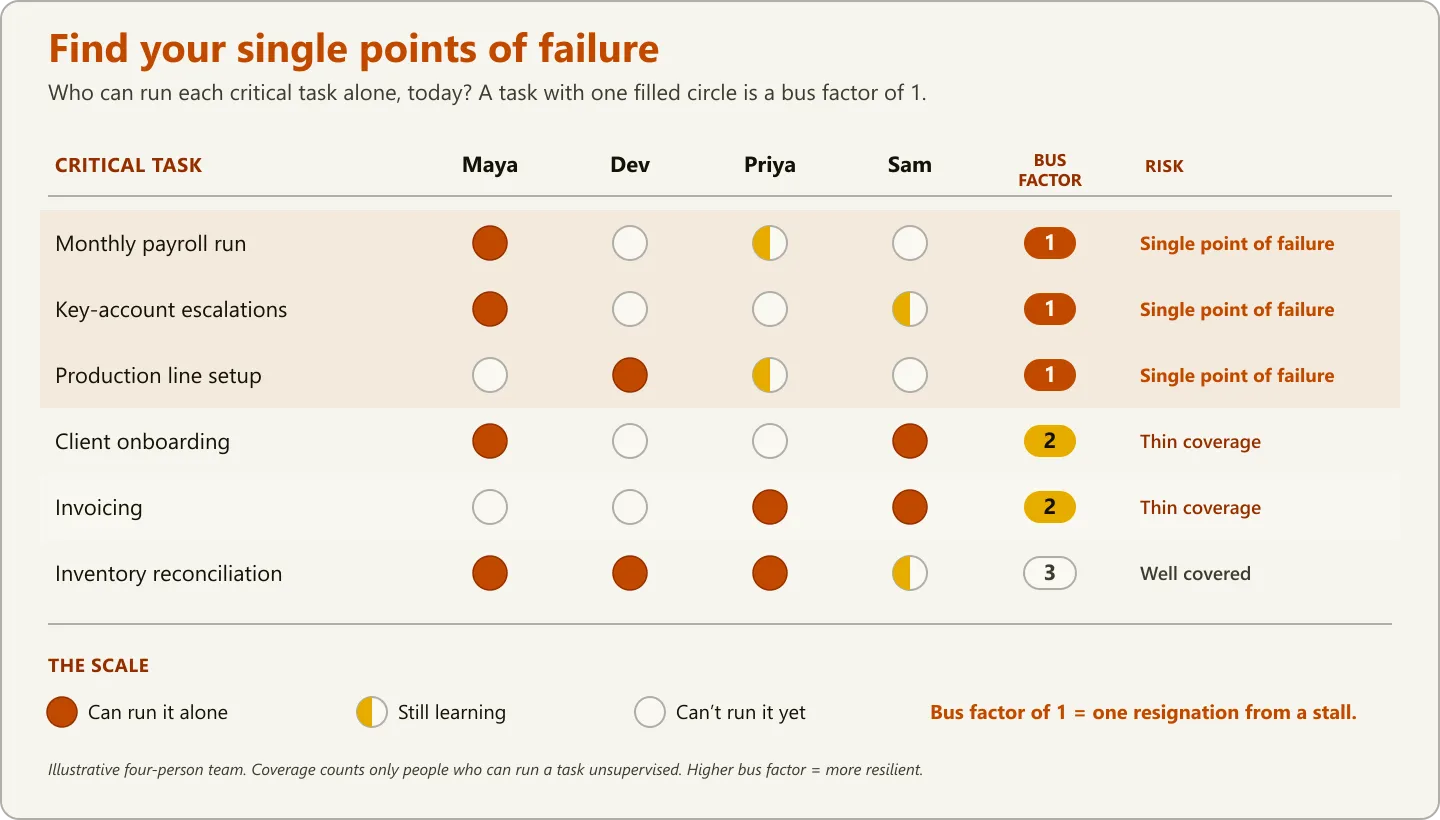
The grid also tracks a state that the bus-factor count alone hides: who is partway there. In the example above, Priya is still learning payroll and production-line setup, and Sam is part-trained on key-account escalations and inventory reconciliation. That half-built coverage doesn’t count yet — a task is only covered once a second person can run it unsupervised — but it shows you where the next 1-to-2 is closest.
A grid like this is exactly what a Training & ILUO Skills Matrix is built to produce automatically — it puts people against tasks, colors each cell by skill level (including who’s still in training), counts coverage per task, and flags the single points of failure for you, so the audit takes the time it takes to type names rather than the time it takes to build a spreadsheet from scratch. If you’d rather sketch it by hand first, the free single-station starter board shows the method on one task before you roll out the full grid.
What a low bus factor actually costs
A bus factor of 1 is cheap right up until it’s catastrophically expensive, which is what makes it so easy to ignore. The cost doesn’t show up on any monthly report — until the person leaves, and then it shows up everywhere at once.
Replacing the person is the visible part, and it’s not small: SHRM estimates the cost of replacing an employee runs from 50% to 200% of their annual salary (opens in new tab), climbing toward the high end for senior and specialized roles. But the recruiting fee is the least of it. The expensive parts are the ones the grid above predicts:
- The work simply stops. A bus-factor-1 task has no fallback. While the seat is empty, payroll is late, the key account goes unmanaged, the line doesn’t get set up. There’s no “we’ll cover it” because there’s no one who can.
- The knowledge walks out the door. Your best people don’t just do tasks — they hold the undocumented exceptions, the workarounds, the “oh, for that client you always have to…” The same SHRM analysis describes a departing top performer who had to be replaced by three new hires to cover what she’d handled alone. That’s the bus factor of 1 sending its invoice.
- The remaining team absorbs the shock. Everyone else picks up the slack, badly and resentfully, which is how a single departure turns into a second and a third.
None of that is a hiring problem. It’s a coverage problem, and you can fix coverage long before anyone resigns.
How to raise your bus factor without grinding to a halt
You raise your bus factor by deliberately turning your most dangerous 1s into 2s — and you do it in priority order, not all at once. The goal is not for everyone to do everything. It’s for every critical task to have at least two people who can run it alone. Cross-training the whole team on everything is its own kind of waste; the point is targeted redundancy where a failure would actually hurt.
Work it in this order:
- Rank by criticality times fragility. A bus-factor-1 task that’s also business-critical (payroll, the thing customers see) is your first cross-training job. A bus-factor-1 task that barely matters can wait or stay a 1 forever. Don’t treat every red cell as equally urgent — a gap analysis that scores where you are against where you need to be keeps you from spreading the effort thin.
- Name a “second” for each top-priority task and put a real date on getting them to unsupervised, not just “exposed.”
- Have the hero teach, then step back. The transfer only counts when the second person does it alone, with the expert deliberately not in the room. Watching isn’t learning; doing under your own steam is. One person who can run a task but can’t teach it is its own quieter risk — the bench can only shrink, never grow.
- Document as a byproduct, not a project. Nobody reads the 40-page wiki. But a one-page checklist written by the second person as they learn is gold, because it captures exactly the steps a newcomer trips on.
- Make it a standing review, not a heroic one-time push. Coverage decays — people leave, tasks change, skills go stale. A quarterly fifteen-minute look at the grid keeps the picture honest. Some teams log key-person dependency right alongside their other operational threats in a risk register, which is exactly where it belongs: it’s a risk like any other, it’s just wearing a friendly face.
Done this way, raising your bus factor doesn’t require freezing the business to “do training.” It’s a few hours a month, aimed at the handful of cells that would actually ruin your week.
The mistakes that keep teams fragile
Most teams that try to fix this still stay fragile, because they make one of a few predictable errors:
- Confusing documentation with redundancy. A written procedure is not a second person. If the doc has never been executed by anyone but the author, your bus factor is still 1 — you’ve just written the single point of failure down.
- Cross-training everything. Spreading every skill across every person dilutes everyone and protects nothing in particular. Redundancy is a targeting exercise, not a blanket.
- Treating it as a one-time audit. The grid you build today is accurate today. Six months and one departure later, it’s fiction. The value is in revisiting it.
- Punishing the hero. The goal is not to make your best person less valuable — it’s to make them less load-bearing, which is a gift to them too. Heroes burn out precisely because they’re the bus factor for too much. Building their bench is how you finally let them take a real vacation. (If you’re also trying to read who on the team is ready to grow into more, a nine-box talent grid pairs naturally with the coverage view.)
The takeaway
The bus factor reframes a question managers usually get backwards. The question isn’t “who are my best people?” — you already know that. The question is “what happens to this operation when each of them is gone for a week?” Ask it task by task, and the single points of failure light up immediately: they’re the columns with one name, and that name is usually your most trusted employee’s.
You don’t fix it by hiring more or by hoping no one leaves. You fix it by making coverage visible and then deliberately building a second person behind every critical task — turning quiet 1s into resilient 2s, in priority order, a little each quarter. The strongest teams aren’t the ones with the most heroes. They’re the ones where any single hero can disappear for a week and the work barely notices.
That’s not a knock on your best people. It’s the highest compliment you can pay them — that you valued what they built enough to make sure it outlasts any one chair.