What an insurance adjuster actually wants
After a covered loss, your insurance carrier sends an adjuster to document what was damaged or stolen. The faster you can hand them a structured list, the faster (and more fairly) the claim settles. A working home inventory captures, at minimum:
- Description. Item name and a sentence or two of identifying detail.
- Room. Where it lived in the house.
- Category. Electronics, furniture, jewelry, clothing, kitchen, etc. Most policies cap coverage per category.
- Make and model. Critical for electronics, appliances, power tools, anything with a serial number.
- Serial number. The single most-requested field at claim time. Take five minutes with a phone and write them down.
- Purchase date and price. Or "best estimate" if the receipt is gone — your inventory is better than the carrier's blank worksheet.
- Receipt or photo evidence. A flag column or a link to a folder.
Beyond insurance — the other reasons
- Estate planning. When a relative dies, the executor has to inventory the home anyway. Doing it once, in life, saves weeks of guesswork later.
- Moving. Movers price by weight and complexity. An inventory gives you accurate quotes and a way to verify what arrived.
- Renting / Airbnb. Hosts need a damage baseline for every guest stay.
- Tax records. Some major purchases (home office equipment, energy-efficient appliances) qualify for deductions or credits. Your inventory is the source of truth.
- Decluttering. Counterintuitively, listing what you own makes it easier to part with — the inventory is a forcing function for "do I really have three rice cookers."
How to build one in an afternoon
- Pick a tool — spreadsheet, app, or a Word document. Spreadsheets are best because the totals and category counts roll up automatically.
- Walk room by room with a phone. Photograph each item with the serial number visible where possible. Group items in the photo to save time.
- Type the entries while the photos are fresh. The "memory tax" of delayed entry is the reason most home inventories never get finished.
- Capture purchase price for anything over $200, and at least a best-guess for everything else. Don't perfectionism your way into abandoning the project.
- Store a copy off-site. A home inventory only stored on the computer that burned in the house is no inventory at all. Cloud storage or a copy with a relative are both fine.
- Update annually — December is a natural rhythm — and after any major purchase.
What "replacement cost" vs. "actual cash value" means
Two terms you'll see on your homeowners or renters policy that change how an inventory should be valued:
- Replacement cost (RCV). What it would cost today to replace the item with a new equivalent. Your inventory's "what I paid" doesn't matter as much; what matters is what a new one costs now.
- Actual cash value (ACV). Replacement cost minus depreciation. A 10-year-old laptop is worth a fraction of what you paid. Your inventory's purchase date matters a lot here.
Check your policy. If you have ACV coverage, ask your agent what RCV would cost — the difference is often modest, and the payout difference after a total loss is substantial.
Common mistakes
- Skipping serial numbers. The single most common regret. Five minutes per electronic device, once, saves hours at claim time.
- Storing it only on a home computer. The thing protecting your stuff has to survive whatever destroyed your stuff.
- Listing items but not photographing them. Adjusters take photos seriously; written descriptions less so.
- Building it once and never updating. Two new TVs and a stand mixer later, the inventory undercounts your household by five figures.
- Trying to inventory everything. The 80/20 is capturing high-value categories (electronics, jewelry, furniture, appliances). Don't burn out logging spatulas.
Related templates and concepts
Home inventories pair well with other household systems — see the templates for new parents, templates for homebuyers, and templates for personal finance hubs. Many households build their first inventory right after closing on a new home or moving with small children.
Templates that implement this
Templates that build a home inventory
3 templates
Track items by room and category, log serial numbers and purchase details, and let the total household value roll up automatically as you fill in the rows. The same inventory also comes inside the New-Homeowner Bundle, with five more home products and a first-year Command Center.
- $14.95 Excel
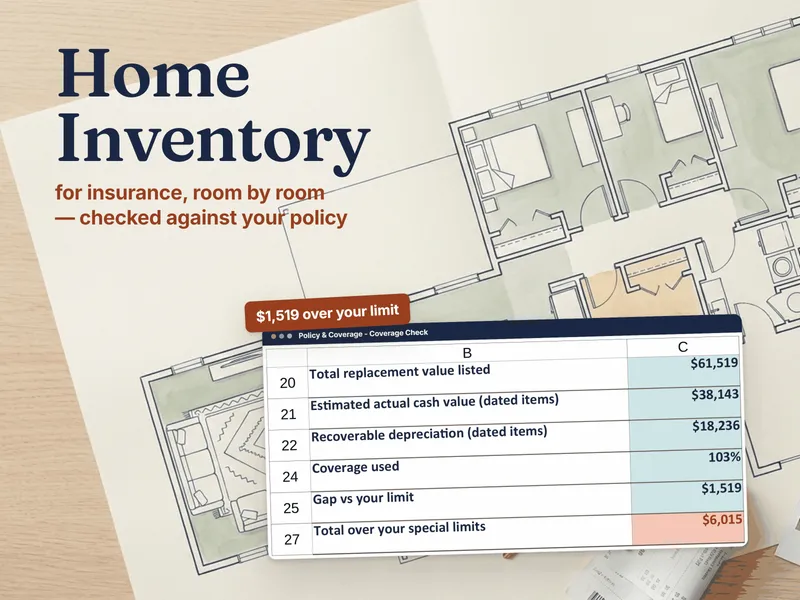
Home Inventory Spreadsheet for Excel — Room-by-Room Insurance Inventory with Proof Score, Coverage Check, Estimated ACV & Claim Worksheet
Excel home inventory for insurance: log what you own room by room, score your proof, check it against your policy limit and build a claim schedule.
Life AdminView details - $14.95 Sheets
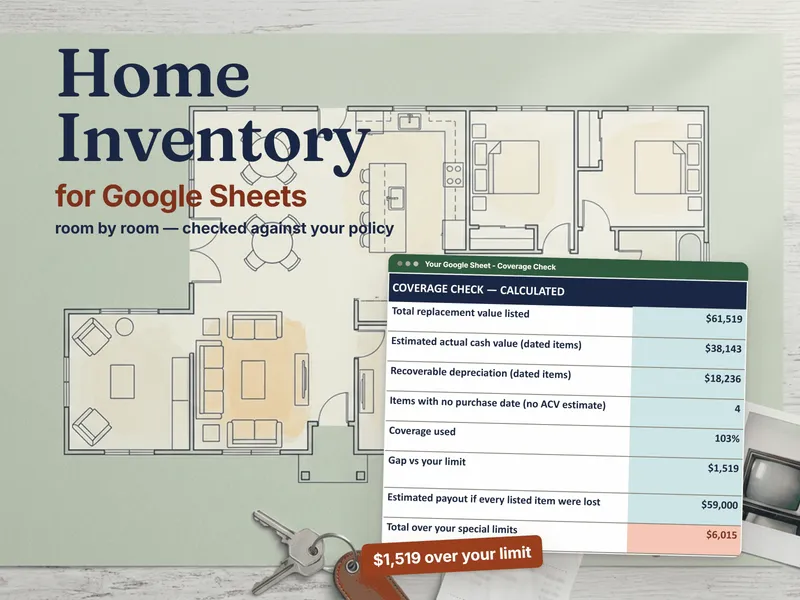
Home Inventory Google Sheets Template — Room-by-Room Insurance Inventory with Proof Score, Coverage Check, Estimated ACV & Claim Worksheet
Google Sheets home inventory for insurance: list what you own room by room, score your proof, check it against your policy and build a claim schedule.
Life AdminView details - From $49.00 Bundle
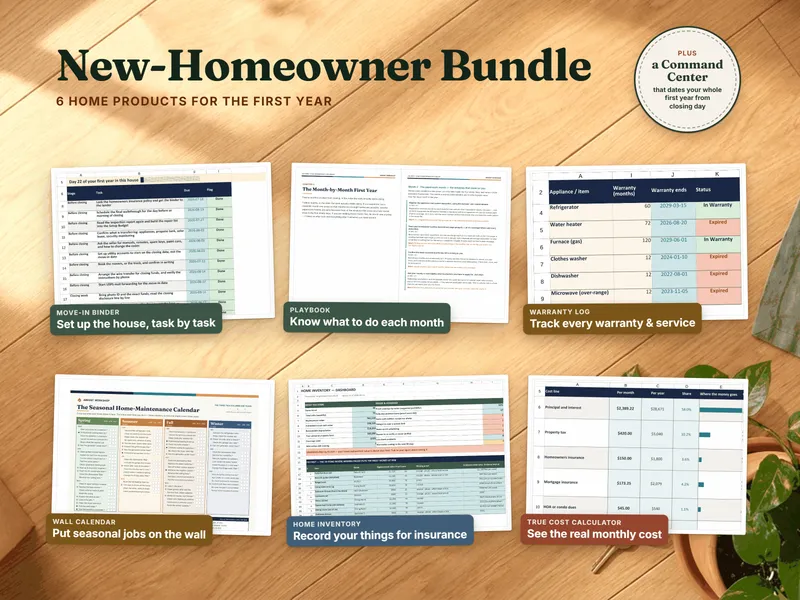
The New-Homeowner Bundle — 6 Home Products + a First-Year Command Center That Dates Your First Year (Excel + Google Sheets + PDF)
Six new-homeowner products in one bundle, plus a Command Center that turns your closing date into a dated first-year plan, deadlines and a money check.
Life AdminView details