The end-of-quarter review is the moment every OKR team looks forward to. The board is green, every key result reads 1.0, and the team that set the goals hit all of them. It feels like the system worked.
But here’s the hard truth about how to score OKRs: on a stretch goal, a perfect 1.0 is usually a warning sign, not a win. It means the goal was set where the team already knew it would land. OKR scoring is the practice of grading each key result from 0.0 to 1.0 by how far it moved from its starting value toward its target, then averaging those grades upward into objective, team and company scores. The grade itself is (current − start) ÷ (target − start), capped between 0.0 and 1.0, and almost everything that goes wrong with OKRs goes wrong in that last, deceptively simple averaging step.
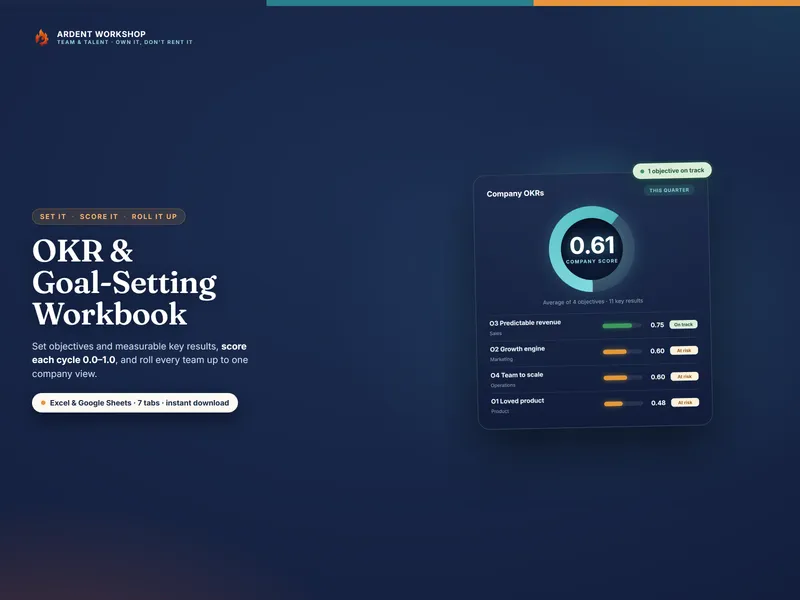
Many teams get the math right and the interpretation wrong. They average a committed launch with a moonshot, they move targets mid-quarter, or they score by gut feel because the arithmetic across twelve key results and four teams is tedious. If that arithmetic is the part you keep skipping, the OKR & Goal-Setting Workbook scores every key result from three numbers and rolls them up to one company view automatically. The method below works either way, and it matters more than the tool.
New to the method itself? Start with what an OKR is — this post assumes you already have objectives and key results written and need to grade them.
What an OKR Score Means on the 0.0–1.0 Scale
An OKR score is a number from 0.0 to 1.0 that says how much of a key result’s planned movement actually happened. 0.0 means the metric never moved from where it started; 1.0 means it reached the target. Google, one of the best-known users of the method, describes it the same way in its re:Work guide to setting goals with OKRs (opens in new tab): OKRs “are usually graded on a scale of 0.0 to 1.0, 1.0 meaning the objective was fully achieved.”
The score measures outcome, not effort. A team that worked nights and moved signups by ten scores the same as a team that coasted and moved them by ten. That is deliberate — the score exists to tell you whether the plan worked, so the next plan can be better.
How to Score a Key Result, Step by Step
Every numeric key result is scored with one formula:
Score = (Current − Start) ÷ (Target − Start), capped between 0.0 and 1.0.
- Label the OKR committed or aspirational before the cycle starts, and do not change the label at the review (see committed vs. aspirational below).
- Record the start value — where the metric stood on the first day of the cycle, before any work began.
- Record the target value — the number that would count as fully achieving the key result.
- Record the current value — at each check-in, the latest real measurement of the metric.
- Apply the formula and cap the result: anything below 0.0 scores 0.0, anything above 1.0 scores 1.0.
- Average the key results under each objective to get the objective score, then roll objectives up in separate committed and aspirational averages.
Here is how that plays out across the four kinds of key result most teams write. The numbers are illustrative.
| Key result | Start | Target | Current | Score |
|---|---|---|---|---|
| Grow weekly trial signups | 400 | 1,000 | 820 | (820 − 400) ÷ 600 = 0.70 |
| Cut monthly customer churn | 6.0% | 4.0% | 5.0% | (5.0 − 6.0) ÷ (4.0 − 6.0) = 0.50 |
| Run 3 customer workshops | 0 | 3 | 2 | 2 ÷ 3 = 0.67 |
| Launch the new pricing page | not live | live | not live | 0.00 |
Scoring a key result that should go down
The same formula scores a metric you want to shrink — you do not need a second one. When the target is lower than the start, both the top and the bottom of the fraction go negative, and the negatives cancel. Churn moving from 6.0% to 5.0% against a 4.0% target is half the planned drop, and the formula returns 0.50. The common mistake is to score it as “current ÷ target” (5.0 ÷ 4.0 = 1.25), which rewards churn for being higher than the goal.
Scoring a yes/no key result
A yes/no key result can only score 0.0 or 1.0, which makes it nearly useless mid-quarter. “Launch the new pricing page” reads 0.0 for twelve weeks and then jumps to 1.0 — or doesn’t. Nothing in between tells you it is in trouble. Two fixes:
- Split it into milestones — copy approved, page built, tested, live — and score the count: 2 of 4 done is 0.50.
- Replace it with the outcome the launch was for — “raise trial-to-paid conversion from 8% to 11%” — which moves continuously and says whether the launch mattered.
Google’s internal playbook makes the underlying rule explicit: “It must be possible to objectively assign a grade at the end of the quarter” (Google’s OKR Playbook, via What Matters (opens in new tab)). If two people could grade the same key result differently, rewrite it before the cycle starts, not at the review.
Why 0.7 Is the Target Score, Not 1.0
On an ambitious OKR, 0.7 is the score you are aiming for. Google’s re:Work guide (opens in new tab) puts it directly: “The sweet spot for OKRs is somewhere in the 60-70% range,” and “if someone consistently fully attains their objectives, their OKRs aren’t ambitious enough.”
The logic is about where you set the target, not how hard you work. A goal you are certain to hit tells you nothing — you would have hit it without writing it down. A goal set far enough out that 70% of it is a genuinely good quarter forces the team to find a different way of working, and the 30% you missed is information about what is actually hard.
That is the reality check in the title. A team that scores 1.0 on every aspirational OKR for three quarters running is not executing brilliantly; it is setting targets it already knows it will reach. The fix is the next cycle’s targets, not a reprimand — and the same guide is explicit that “low grades should be viewed as data to help refine the next OKRs.”
Committed vs. Aspirational OKRs Score Differently
There are two kinds of OKR, and the 0.7 rule only applies to one of them. This is the distinction many teams skip, and it is the one that makes scores mean something.
- Committed OKRs are promises — goals the team agrees will be achieved, with schedules and resources adjusted to deliver them. Shipping the compliance update before the regulator’s deadline is committed.
- Aspirational OKRs are stretch goals — how the team would like the world to look, without yet knowing exactly how to get there. Doubling organic signups is aspirational.
Google’s OKR Playbook (opens in new tab) sets a different expected score for each: “The expected score for a committed OKR is 1.0; a score of less than 1.0 requires explanation for the miss, as it shows errors in planning and/or execution.” By contrast, “aspirational OKRs have an expected average score of 0.7, with high variance.”
| Aspect | Committed OKR | Aspirational OKR |
|---|---|---|
| What it is | A promise the team will deliver | A stretch toward a desired future |
| Expected score | 1.0 | 0.7 on average, with wide variance |
| A 0.5 means | A missed promise — explain it and fix the plan | A real but partial result — normal for a stretch |
| A 1.0 means | The job | Possibly a target set too low |
| If it falls short | Escalate early, before the due date | Keep it on the list next cycle |
Label every OKR as committed or aspirational before the quarter starts, and never change the label at the review. The playbook lists “Failing to differentiate between committed and aspirational OKRs” as its first trap. Fixing the label up front also closes a quieter loophole: a team allowed to decide afterwards which goals were stretch goals can simply decide that the missed ones were.
How to Roll Key Result Scores Up to the Objective and Company
An objective’s score is the average of its key results, and the company view averages the objectives — committed and aspirational separately, as the second guardrail below explains. For example, an objective with key results at 0.70, 0.50 and 1.00 scores (0.70 + 0.50 + 1.00) ÷ 3 = 0.73.
Averaging is honest about the total and dishonest about the parts, so two guardrails matter:
- Read the key results, not just the objective. That 0.73 looks on track, yet one of its three key results is at 0.50. An easy key result at 1.0 can mask a hard one going nowhere — which is usually the one that mattered.
- Keep committed and aspirational OKRs in separate averages. A committed objective at 1.0 and an aspirational one at 0.4 average to 0.70 — a “perfect” quarter on paper that hides one stretch goal stalling badly. Report two numbers: committed delivery (should be 1.0) and aspirational reach (should hover near 0.7).
Reading a score in the middle of the quarter
A mid-quarter score only means something next to how much of the quarter has passed. At week 6 of a 13-week quarter, about 46% of the time is gone. On a committed key result, which should finish at 1.0, a score of 0.45 is roughly on pace; one at 0.15 needs a plan this week, not at the review. On an aspirational key result, where 0.7 is the expected finish, the pace is lower: about 0.7 × 46% ≈ 0.32. One way to read a final aspirational score is to sort it into three bands — on track (0.7 to 1.0), at risk (0.4 to under 0.7) and off track (below 0.4); a committed OKR is simply 1.0 or a miss. The bands only fit the end of the cycle, when the full time has elapsed, which is why an aspirational 0.32 at week 6 is on pace even though it would be off track as a final score.
Five OKR Scoring Mistakes That Make the Numbers Lie
- Scoring on effort or feeling. “We worked really hard on this, call it 0.8.” The score is arithmetic on a measured number. If there is no number, the key result was written wrong.
- Moving the target mid-quarter. Lowering a target in week 9 turns a 0.5 into a 1.0 and erases the one lesson the cycle produced. If a target was genuinely wrong, record the original score, then set a new key result for the next cycle.
- Grading people instead of goals. Google’s re:Work guide is plain that “OKRs are not synonymous with employee evaluations.” There is a practical reason as well: once a score can cost someone money, targets tend to drift down to sure things. Performance belongs in a separate conversation — see the alternatives to annual performance reviews teams are adopting instead.
- Dropping an aspirational OKR that scored low. The playbook warns that dropping one for lack of progress “disguises persistent problems of prioritization, resource availability, or a lack of understanding of the problem/solution.” Carry it forward, rewritten if needed.
- Rounding to the band. “At risk” is a label; a final aspirational 0.42 and 0.68 both carry it, and they are very different quarters. Keep two decimals in the record so the quarter-on-quarter trend — the most useful thing OKRs show — survives.
Common Questions About OKR Scoring
Is a 0.7 OKR score good?
On an aspirational OKR, yes — Google’s OKR Playbook sets 0.7 as the expected average score for aspirational OKRs, and Google’s re:Work guide puts the sweet spot for OKRs in the 60 to 70% range. On a committed OKR, no: a committed goal is expected to reach 1.0.
What should a committed OKR score?
A committed OKR should score 1.0. Anything less is a missed promise that needs an explanation, not a respectable stretch result. If a team can see mid-quarter that it will not land the 1.0, the time to say so is then.
Should OKR scores affect bonuses or performance reviews?
No. Once a score can cost someone money, people tend to set goals they know they will hit, and the 0.7 target stops meaning anything. Grade the goal, not the person — and if you need a view of the people, that is a different tool, like the 9 box talent grid.
Score Honestly, Then Set Better Targets
The score is not the point of OKRs; the next cycle’s targets are. A team that labels each goal committed or aspirational up front, scores every key result from a real start, target and current value, and reads the quarter as two numbers — committed delivery and aspirational reach — learns something every quarter. A team that rounds to green learns nothing.
If you want the scoring, the roll-up and the check-in log in one file you own rather than another per-seat subscription, the OKR & Goal-Setting Workbook does exactly this in Excel and Google Sheets. Or start smaller with the free single-team OKR starter sheet and write your first set by hand.
Still weighing a dedicated goal-tracking app instead? The OKR template vs. goal-tracking software comparison covers when one is worth it.