It is the third time this week. You walk past the bench and the air is wrong — two people working eighteen inches apart, neither one looking up, both of them just slightly too busy to speak. Nothing has been said out loud. Nothing needs to be. You already know which two.
Your instinct is to file this under chemistry. When two employees don’t get along, the received wisdom is that some people mesh and some people don’t, and the manager’s job is to keep the ones who don’t from setting the place on fire. So you plan a conversation about tone, about professionalism, about how we’re all adults here.
Here is the reframe: most of what looks like a personality clash between two employees is a design flaw in the work, not a defect in the people. Two people whose jobs touch at an undefined edge will generate friction the same way two gears without clearance generate heat. You can lecture the gears about attitude for as long as you like. The heat is coming from the fit.
That distinction matters because it changes what you do on Monday. If it is chemistry, your only moves are mediation, separation, or waiting it out. If it is structure, you have a fixable problem with a written answer. The honest shape of that work: about a week to diagnose, an afternoon to write the fix, and a month to confirm it held.
When two employees don’t get along, diagnose before you mediate. Check whether the friction clusters at one moment in the workflow, whether it survives swapping one of the two people out, and whether either of them is in conflict with anyone else. If the answers point at the workflow rather than the person, the fix is a written seam: one sentence defining where each job ends, one named owner per contested call, one shared information channel, and a review date two to four weeks out. If you already know it is structure, skip to the fix.
The Short Answer: What to Do When Two Employees Don’t Get Along
- Diagnose first. Run three cheap tests over about a week to work out whether the friction comes from the workflow or from one person’s conduct.
- Talk to each of them separately. Same four questions, same day, each told you are asking the other. A joint meeting first produces performances, not facts.
- Fix the seam. Write one sentence per handoff, name one owner per contested decision, rebalance the load using a real count, give both the same information at the same time, and book a review date.
- Escalate only if the tests point at conduct. If the friction does not cluster, survives a substitution, and one of the two clashes with others too, it stops being a pair problem and becomes a performance conversation with one person.
Why “They Don’t Get Along” Is Usually a Structure Problem
A seam is the place where one person’s job ends and another person’s begins. Every pair of roles that touch has one: the order handed from the front counter to the bench, the quote handed from the estimator to the installer, the file handed from the designer to whoever ships it.
A seam is either defined or it is not. When it is defined, both people know exactly where their responsibility stops, who makes the call when the two of them disagree, and how information crosses the gap. When it is undefined, both people improvise across it dozens of times a week — and every improvisation is a small negotiation that one of them loses.
Enough small losses feel exactly like being disliked.
This is why conflict so often looks personal to the people inside it and structural to everyone else. The employee doesn’t experience “our handoff is ambiguous.” They experience “he keeps doing this to me.” The adjective arrives before the analysis, and by the time it reaches you it has hardened into a character judgment about a person rather than a description of a process.
It is also why running a formal process so often fails to settle anything. Research published in September 2024 by the CIPD (opens in new tab), the UK-based professional body for HR and people development, drew on two 2024 surveys — 2,009 senior HR decision-makers and 5,496 UK workers — and found that of the employees who had experienced conflict in the previous 12 months, only 36% said it had been fully resolved. The approaches employers most often said their organizations had used in that period were formal ones: disciplinary action (43%) and grievance procedures (41%).
Two caveats on those figures, both worth stating plainly. The samples are UK-weighted, and formal routes are far more codified in the UK — the Acas Code of Practice on disciplinary and grievance procedures (opens in new tab) is taken into account if a case reaches a UK employment tribunal, and US at-will employment imposes no equivalent. So read 43% and 41% as evidence of how heavily a formal-procedure culture leans on formal procedures, not as a prediction of what your shop does. What travels is the gap underneath: running the procedure and feeling resolved are not the same thing anywhere. Formal procedures are good at establishing what happened. They are not designed to redraw a boundary between two jobs.
There is a second finding worth sitting with. Around three-quarters of employers (75%) said line managers would resolve conflict effectively — but nearly half (49%) also admitted managers can cause conflict in their teams (CIPD, September 2024 (opens in new tab)). Both things are true at once, and they are true for the same reason: the manager is the person who defines the seams. When the seam is vague, the manager built the vagueness.
Four Structural Causes Behind Team Conflict
When two people who work next to each other stop getting along, the cause is usually one of four things — and each one has a different fix.
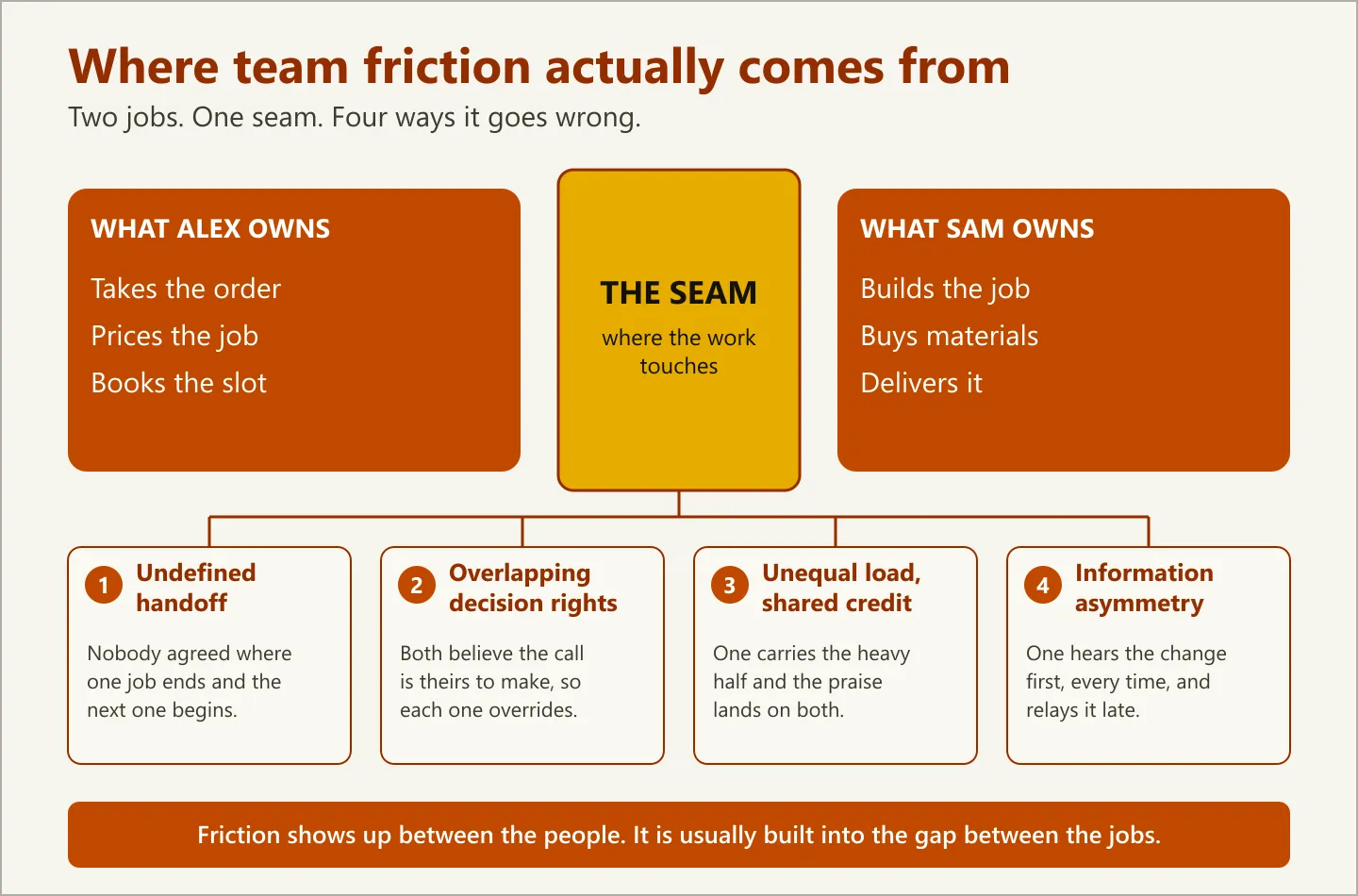
Picture two jobs that touch. Alex takes the order, prices the job and books the slot. Sam builds the job, buys the materials and delivers it. Neither is confused about their own half. The seam is everything between “booked” and “started” — and that narrow strip, not either person, is where almost every argument they have will originate.
-
Undefined handoff. Nobody ever agreed where one job ends and the next begins. Each person has a private definition, the two definitions differ at the edges, and that narrow strip of disagreement is where every argument happens. The tell is a dropped ball that both people can honestly explain away.
-
Overlapping decision rights. Two people each believe a particular call is theirs to make — how much to charge for a rush job, which order to run first, whether a batch is good enough to go out. Both are acting in good faith. Both are overriding each other. Neither is wrong, because nobody ever said.
-
Unequal load with shared credit. One person carries the heavier half of a shared responsibility and the recognition lands on both of them equally. This one curdles slowly and quietly, and it is the hardest of the four to hear about directly, because saying it out loud sounds like bragging.
-
Information asymmetry. One person consistently hears about changes first — because they open the shop, or take the calls, or sit closer to you — and relays them late, partially, or not at all. The other person is permanently one beat behind and experiences it as being deliberately kept out.
Here is how each one sounds when it reaches you, and what it is actually telling you:
| What you hear | What is usually broken | The structural fix |
|---|---|---|
| “I thought she had it.” / “That was never my job.” | Undefined handoff | Write one sentence defining when the first job is finished and how the second person is told. |
| “He redoes everything I do.” | Overlapping decision rights | Name a single owner for that specific call, in writing, and tell both of them. |
| “I’m carrying him.” | Unequal load, shared credit | Measure the actual split with numbers, then rebalance the work or split the credit. |
| “Nobody tells me anything.” | Information asymmetry | Pick one channel where changes are posted, and post them there for both at once. |
Notice what none of these fixes involve: getting two people to like each other. You are not in the friendship business. You are in the business of making two jobs fit together well enough that liking each other becomes optional.
How to Tell a Structure Problem From a Personality Problem
Before you fix anything, run three tests. They take a week and cost nothing.
-
Does the friction cluster? Write down the last five incidents with times attached. Structural friction clusters — it happens at the Friday handoff, or during morning prep, or every time a rush order comes in. Personal friction is evenly distributed, showing up in the break room and the parking lot as readily as at the bench. A tight cluster is close to a diagnosis on its own: whatever happens at that moment is the thing to fix.
-
Does it survive a substitution? Put a third person into one of the two seats for a week — cover, cross-train, rearrange a shift. If the friction persists with a different human in the chair, the problem lives in the seat, not the person. If it evaporates, you have learned something too. No one to swap in? Substitute across time instead: did this friction exist before one of them took this seat, and did whoever held it previously have the same trouble?
-
Is either of them in conflict with anyone else? If one of the two clashes with three different colleagues, you do not have a pair problem, you have an individual problem that happens to be visible in this pair. That is a different conversation, and the second half of this post covers it.
Two of the three tests you can actually run pointing at structure means fix the structure first. It is faster, it is reversible, and it does not require you to make a judgment about anybody’s character that you may later have to defend.
Talk to Each Person Separately Before You Talk to Them Together
Bring both people into a room together as your opening move and you will get a performance. Each one plays to you, positions carefully, and says the version of events that survives being contradicted. You will leave with two polished narratives and no facts.
Separate conversations first, joint conversation later — and only if you still need one. Ask each person the same four questions, in this order:
-
“Walk me through the last time this went badly. What was the actual sequence?” You are after events, not adjectives. “He was rude” is an adjective. “I asked at 2pm, he said he’d get to it, at 4pm it wasn’t done” is a sequence, and sequences are where seams show up.
-
“Where do you think your job ends?” Ask both people this and compare the answers afterwards. In a genuine structural conflict, the two answers will not line up — and the gap between them is very often the exact width of the problem.
-
“What would have to change for this to stop costing you time?” This reframes the conversation from grievance to design. It also reveals something useful: someone who cannot name a change, only a person, is telling you something.
-
“What do you think they would say if I asked them the same question?” The answer is diagnostic. Someone who can fairly reconstruct the other person’s case is still solving a problem. Someone who cannot — or who answers with motive rather than reasoning — has moved from disagreement to story, and stories are much harder to unwind.
Hold both conversations the same day if you can, and tell each person that you are having the same conversation with the other. Asymmetry here is corrosive: whoever finds out second concludes you were briefed by the first.
If knowing how to open a conversation like this is the part that stalls you, the Manager’s Difficult Conversations Script Bank carries the actual wording for it — opening lines, follow-up probes, and the phrases that keep a conversation on behavior instead of character.
How to Fix the Seam Between Two Employees’ Jobs
The fix is almost always writing, and it is almost always shorter than you expect. Work through this list:
- Write one sentence per handoff. The format that works: “X is finished when [specific, checkable condition], and Y is told by [specific method].” Not “communicate better.” A condition and a channel.
- Name one owner per contested decision. Every call that both people thought was theirs gets exactly one name attached to it. The other person gets a defined input — consulted, informed, or neither — but not a veto.
- Rebalance the load with numbers. Impressions of who does more tend to flatter whoever is doing the estimating, in both directions. Count something real for two weeks — jobs completed, hours, units, callouts — and let the count set the split. A tally sheet taped to the wall does this fine. If the imbalance is about hours rather than piece counts, the Team Capacity and Utilization Planner nets each person’s booked hours against the hours they actually have, so “who is carrying more” stops being a matter of opinion.
- Give both people the same information at the same time. One channel, one moment, both names on it. In practice this tends to do more for resentment than any conversation about tone.
- Set a review date before you leave the room. Two to four weeks out, on the calendar, told to both. A fix nobody checks reads as a fix nobody meant.
Then put it somewhere permanent. A seam definition that lives only in your memory is a seam definition that expires the next time you are off for a week — which is precisely when it gets tested. This is the case for keeping the boundary in a document you own rather than in a workflow you rent from a platform: it is three lines in the same place you keep everything else about how the shop runs, it survives a software subscription lapsing, and a new hire can read it on day one. If you have never built that document, how to write an operations manual walks through it, and this is one of the best possible reasons to start.
The takeaway: define the seam, name the decision, equalize the information, and book the review. When it works, it works not because anything was said about the relationship, but because there is nothing left to negotiate fifty times a week.
When It Really Is a Behavior Problem
Sometimes you run the tests and structure is not the answer. The friction does not cluster, it survives a substitution, and one of the two has a history with other colleagues. At that point you are no longer redesigning a seam. You are addressing one person’s conduct, and the rules change.
Three things change specifically:
- It stops being a pair conversation. Conduct is between you and one employee. Continuing to frame it as “you two need to sort this out” is unfair to the other person and makes the record incoherent later.
- You describe behavior, not character. “You raised your voice in front of a customer on Tuesday” is actionable and checkable. “You have a bad attitude” is neither, and it is the sentence that gets managers into trouble. The distinction has a name — see behavior-based feedback for how to phrase it consistently.
- You start writing things down contemporaneously. Dates, what was said, what was agreed, what happens next. Not because you are building a case, but because the version written on the day is the only one that stays accurate.
And one thing changes outside your control: what you are required to do before disciplining or dismissing someone varies by country, state and jurisdiction. Check what yours requires — or ask someone who knows it — before the second conversation, not after.
From there it follows the same path as any other performance issue: a clear expectation, a stated consequence, a review date, and escalation only if the expectation is not met.
Progressive discipline is the framework those ladders are usually built on, and if the opening line is the part you are stuck on, we have a step-by-step walkthrough of how to start a performance conversation.
The letters that go with each rung are worth drafting before you need them; the HR Letters and Employment Document Template Pack covers the standard set. And if the underlying issue turns out to be capability rather than conduct, that is a different ladder entirely — how to manage an underperforming employee is the version where the person is trying and missing.
One caution. The fact that structure was not the whole answer does not mean it was none of the answer. Fix the seam anyway. A badly designed handoff makes a difficult person harder to manage and gives them a legitimate grievance to hide behind — remove it, and what remains is unambiguous.
What Not to Do When Two Employees Clash
Four common responses that make things worse:
- Don’t carry messages between them. The moment you become the channel, you have replaced their broken seam with yourself, and you now own every future translation. It feels like de-escalation. It is actually a permanent job you have just hired yourself into.
- Don’t schedule them apart as the solution. As a temporary cooling measure it is fine. As a policy it quietly costs you every bit of flexibility you have — you can no longer build a schedule, cover a sick day, or plan a vacation week without routing around a rule you never wrote down. A vacation coverage plan for a small team becomes almost impossible to build once two names can’t share a shift.
- Don’t appoint a third employee as the referee. Asking a colleague to smooth things over, relay context, or “keep an eye on it” drags a third person into a problem that was not theirs and makes them responsible for an outcome they cannot control.
- Don’t discuss one with the other. Not even sympathetically, not even to build rapport. Whatever you say will be repeated, and it will be repeated in the version that is least favorable to you.
Common Questions About Managing Conflict Between Two Employees
Should I make two employees who don’t get along work together anyway?
Pair them on a defined task with a defined handoff and a defined decision owner, and let the structure carry the interaction — but only after you have fixed the seam. What you are asking for is a working relationship, not a warm one. The alternative, separating them permanently, is a coverage decision disguised as a conflict decision, and it costs you flexibility for as long as they both work there.
What if one employee raises the conflict and the other says everything is fine?
Treat that gap as data, not as proof that one of them is lying. The person who says nothing is wrong is often the one whose job absorbs the ambiguity comfortably — they get to make the call, so the overlap never costs them anything. If one of their two answers about where the job ends is expansive and the other is narrow, you have found your seam without anyone having to accuse anyone.
How long should I give a structural fix before escalating?
At the review, ask one thing: did both of them actually follow the new rule? If they did and the friction is unchanged, the structure was not the cause, and you move to the conduct conversation instead. Give it two to four weeks before that review — long enough that a new handoff rule gets tested by a real busy week, short enough that nobody concludes you dropped it.
The One Question to Ask When Two Employees Don’t Get Along
Before the mediation, before the script, before anyone gets called into an office: ask both people where they think their job ends, and compare the answers.
If the two answers overlap or leave a gap, you are looking at the cause. Draw the line, write it down, name who decides, and book a date to check. Most of the time that is the entire intervention — and the relationship that looked unfixable turns out to have been a boundary that nobody had ever drawn.