Walk into any senior leadership offsite and, at some point, someone will pull up a three-by-three grid with names scattered across nine boxes. People in the top-right corner get talked about in hushed, excited tones. People in the bottom-left get talked about carefully, with the door closed. That grid is the 9-box talent grid, and it quietly drives who gets promoted, who gets developed, and who gets managed out at a huge number of companies.
The 9-box grid is a talent-review tool that maps every person on your team onto a three-by-three matrix by two things at once: their performance in their current role and their potential to take on a bigger one. Many employees never see it, and plenty of managers have heard the term without ever having built one. So let’s pull back the curtain — where it came from, what each box means, and how to run your own review without the mistakes that turn a useful tool into an HR liability.
What is the 9-box grid?
Each axis — performance (how well someone delivers in their current role) and potential (how likely they are to succeed in a bigger or broader role) — is scored low, moderate, or high. Where a person’s two scores intersect drops them into one of nine boxes, from “underperformer” in the bottom-left to “star” in the top-right. That’s the entire structure — and if the bare definition is all you came for, that’s what a 9-box grid is. The rest of this post is how you actually run one.
The point isn’t to rank people from best to worst. It’s to see your whole team’s capability and risk on one page, so you can make deliberate decisions about who to invest in, who to retain at all costs, and who needs a hard conversation. A ranked list tells you the order. The grid tells you why someone is where they are — and that “why” is what determines the right move.
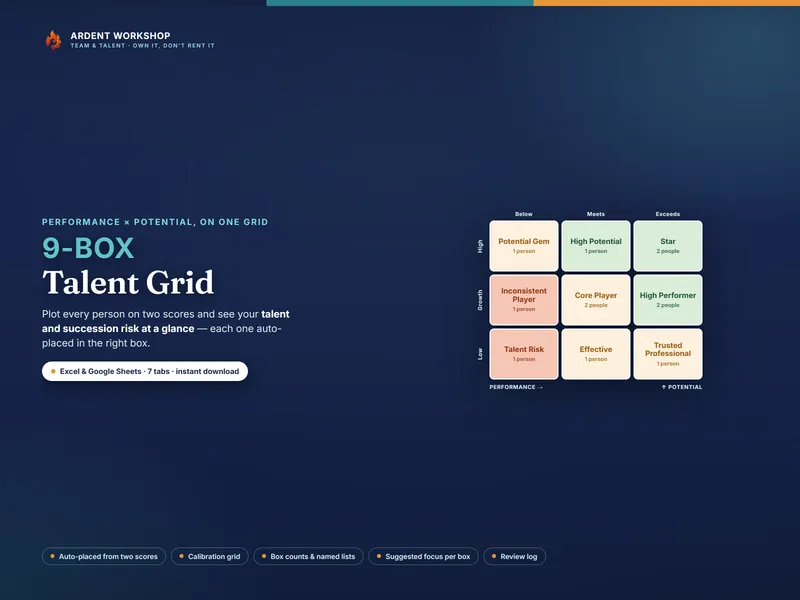
Building one is mostly bookkeeping: two scores per person, a rule that turns those scores into a box, and a live count in each cell so you see the shape of the team instead of a list of names. The 9-Box Talent Grid workbook does that part — enter a performance score and a potential score, and it places the person, counts every box, and lists who is in each one. The method matters more than the tool, though, so the rest of this post is the method.
Where the 9-box grid actually came from
Here’s the part most people don’t realize: the 9-box grid wasn’t invented for managing people at all. It was created by McKinsey in 1970 and used by GE (opens in new tab) to compare business units and decide where to invest capital — one axis for market attractiveness, the other for competitive strength.
Somewhere along the way, HR borrowed the framework. The logic mapped almost perfectly: swap “market attractiveness” for an employee’s potential and “competitive strength” for their current performance, and you have a portfolio view of your people instead of your business units. The same question drives both versions — where do we put our limited time, money, and attention to get the biggest return?
That origin story matters because it explains both the grid’s strength and its biggest danger. It’s a resource-allocation tool. Used that way, it’s clarifying. Used as a judgment of human worth, it’s corrosive. We’ll come back to that.
The two axes: why performance and potential are not the same thing
The single most common mistake with the 9-box grid is treating performance and potential as one measurement. They are not. Performance is about the past; potential is about the future.
- Performance answers: How well has this person delivered in their current role over the last 6–12 months? It’s evidence-based and relatively easy to assess — you have results, projects, and outcomes to point to.
- Potential answers: How likely is this person to succeed at a bigger, broader, or more complex role? It’s a prediction, which makes it harder and more bias-prone. Signals include how fast they learn, how they handle ambiguity, whether they lift the people around them, and whether they actually want more scope.
A top salesperson can be a high performer with low potential — brilliant in the role, no desire or aptitude to manage. A new hire can be a low performer with high potential — not yet productive, but obviously going to be excellent. Collapse those two people into “good” and “bad” and you’ll make exactly the wrong decision about each one.
The nine boxes, explained
Here’s the full grid. Performance runs across the bottom (low to high); potential runs up the side (low to high). The top-right box is your highest-leverage talent; the bottom-left is your most urgent problem.
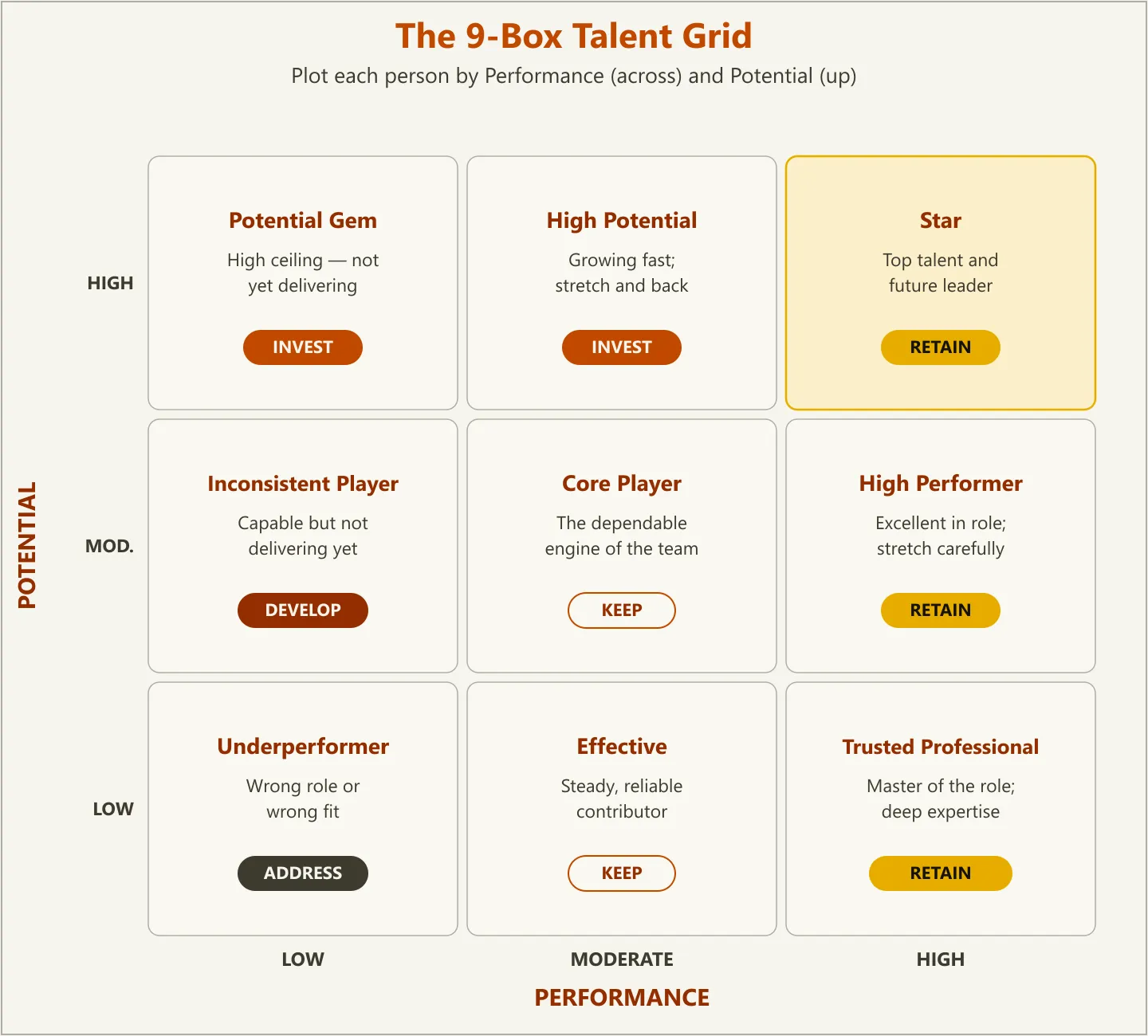
Each box implies a different move. Here’s what each one signals and what to actually do about it:
| Box | What it signals | The move |
|---|---|---|
| Star (high / high) | Top performer with real room to grow — a future leader | Retain hard, give visibility, plan their next role before they ask |
| High Performer (high perf / mod. potential) | Excellent in the current role, limited stretch right now | Reward and retain; stretch carefully, don’t force a promotion |
| Trusted Professional (high perf / low potential) | A deep expert at the ceiling of their role | Reward, retain, and protect the knowledge they hold |
| High Potential (mod. perf / high potential) | Growing fast, not yet at full output | Invest: stretch projects, mentoring, a clear development path |
| Core Player (mod. / mod.) | The dependable engine of the team | Keep engaged; offer small stretches and steady recognition |
| Effective (mod. perf / low potential) | Steady, reliable contributor | Keep; recognize consistency, don’t over-manage |
| Potential Gem (low perf / high potential) | High ceiling, not yet delivering | Invest: diagnose what’s blocking output — onboarding, fit, clarity |
| Inconsistent Player (low perf / mod. potential) | Capable, but results are uneven | Develop: clarify expectations and coach closely |
| Underperformer (low / low) | Wrong role or wrong fit | Address directly: re-role, performance plan, or part ways |
Notice that five of the nine boxes are “keep and grow” stories, not exit stories. The grid gets a bad reputation as a firing tool, but most of your team will land in the middle and upper boxes — and those are the people the grid helps you stop taking for granted.
What actually happens in a talent review
Behind the closed door, a real talent review is less about the grid and more about the conversation the grid forces. Here’s the sequence that commonly plays out:
- Managers plot their people privately. Each manager places their team on the grid before the meeting.
- Placements get challenged — this is called calibration. Leaders compare grids across teams and argue. “You have three stars? Show me why this person is a star and that one is only a high performer.” Calibration is the entire point: it’s where one manager’s generous scoring gets pulled back into line with everyone else’s.
- The top-right and bottom-left get the most airtime. Stars and high-potentials get retention and succession plans. Underperformers get action plans. The middle — your core players — often gets skipped, which is its own mistake.
- Decisions get attached to names. Promotions, raises, development budgets, stretch assignments, and exits all flow from where people landed.
This is also where the grid connects to succession planning — making sure you’re not one resignation away from a crisis. And many organizations are dangerously exposed here: in the 2023 Gartner Board of Directors Talent Survey, only 51 percent of directors said their company had a written succession plan (opens in new tab) for even the current CEO. If the top of the house is that unprepared, it’s reasonable to assume the layers below it are no better off. A 9-box review is one of the simplest ways to surface that risk before it becomes an emergency — which is the same instinct behind catching a skills gap on your team before someone quits.
How to run your own 9-box review
You don’t need an enterprise HR platform to do this. You need a clear head, evidence from the last review period, and an hour of honesty. Here’s the process.
Step 1: Define your two axes in plain language
Before you plot anyone, write down what performance and potential actually mean for your team. Performance is usually results over the last 6–12 months. Potential is the realistic likelihood of doing bigger or broader work next — not “are they nice,” but “can they handle more.” Vague axes produce a useless grid.
Step 2: Rate each person on both axes separately
Score every team member low, moderate, or high on performance, and separately on potential. Force yourself to use evidence from the whole period, not just the last thing they did. Rating the two axes independently is what keeps a recent win or a recent miss from dragging both scores in the same direction.
Step 3: Plot everyone on the grid
Place each person in their box based on the two scores. Do it privately first. Resist the urge to spread people evenly across the grid — real teams cluster, and that clustering is information.
Step 4: Calibrate with a second perspective
Have another manager, or your own manager, review your placements. This is the most important step and the one solo managers skip. A second set of eyes catches recency bias (“they just nailed one project”), the halo effect (“they’re great at presenting, so they must be great at everything”), and plain favoritism. If you can’t calibrate with a person, calibrate against the evidence: for each placement, ask what specifically would have to be true for this person to be one box higher or lower?
Step 5: Turn each box into an action
A grid that doesn’t change what you do next week was a waste of an hour. Assign every person a concrete move — invest, retain, develop, keep, or address — and put a date on the follow-up. The grid is a starting point for decisions, not the decision itself.
The mistakes that quietly wreck a 9-box review
The 9-box grid fails in predictable ways. Avoid these and you’ll get most of the value:
- Treating it as a ranking. It’s a map, not a leaderboard. The whole reason there are nine boxes instead of one list is that why someone is where they are changes what you should do.
- Confusing performance with potential. Covered above, and worth repeating because it’s the error that produces the worst decisions — promoting a brilliant individual contributor into a management role they’ll hate and fail at.
- Labeling the person instead of the moment. Boxes describe a person right now, in this role. They are not permanent identities. A “potential gem” who gets the right coaching becomes a star; a star who burns out slides. Re-plot every cycle.
- Letting one loud opinion drive placement. Without calibration, the grid just encodes a single manager’s bias and gives it a veneer of objectivity. That’s worse than no grid at all.
- Telling people their box. Almost no good comes from telling someone “you’re a core player” or “you’re an inconsistent player.” Use the grid to drive actions the person experiences — a stretch project, clearer expectations, a development plan — not labels they resent.
- Doing it once and filing it. A talent review is a rhythm, not an event. The grid is only useful if you revisit it and check whether last quarter’s actions moved anyone.
From grid to action: making it a system you own
The grid is the easy part. The hard part is everything it points to — the development plans, the skills you’re missing, the people you can’t afford to lose. That’s where a one-time exercise has to become a system you actually maintain.
A few tools make that durable instead of a sticky-note memory:
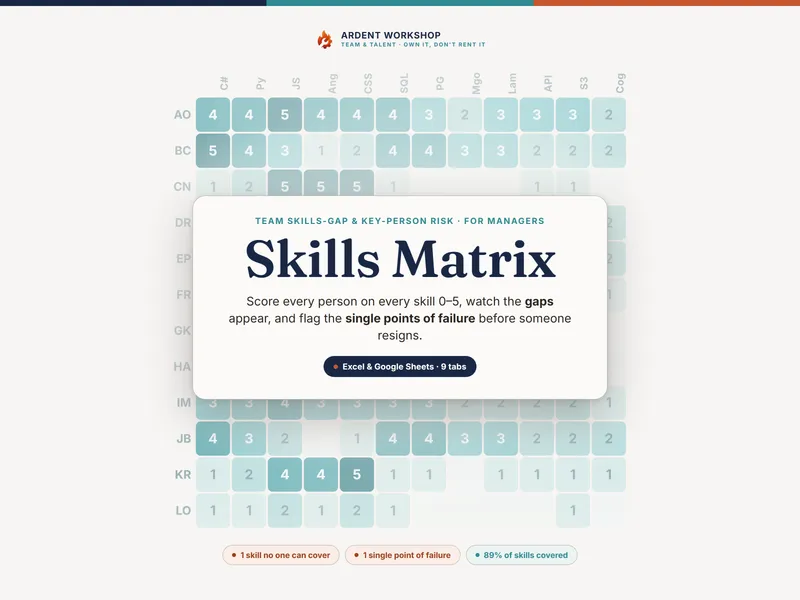
- A skills matrix turns “high potential” from a gut feel into evidence. When you can see exactly which capabilities each person has and at what depth, your performance and potential scores stop being vibes and start being defensible.
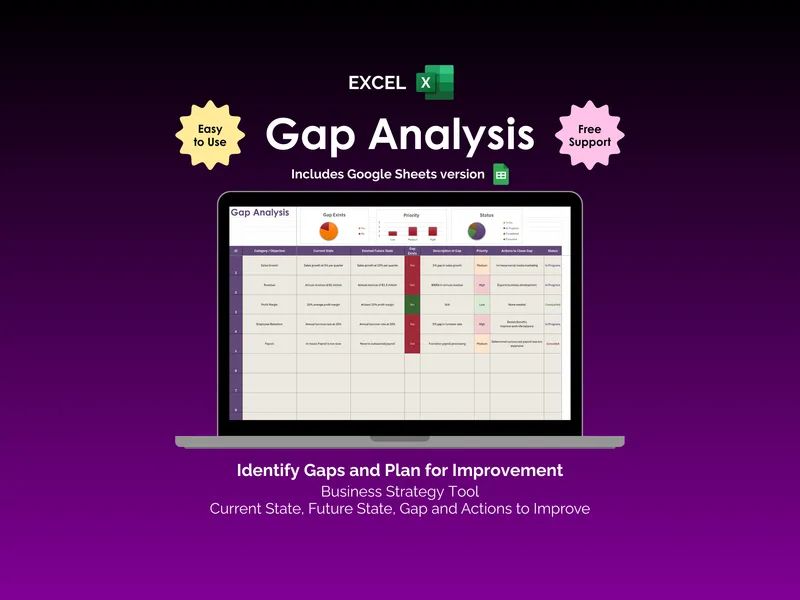
- A gap analysis takes the development moves from your grid — the high-potentials and potential gems — and maps the specific distance between where they are and where you need them. It’s the bridge from “invest in this person” to “here’s the plan.” (If you’re hiring rather than developing to fill those gaps, the same thinking drives skills-based hiring.)
- A risk register, pointed at people rather than projects, captures the flight risk the grid surfaces. It’s a general-purpose register you configure yourself, not an HR-specific tool — so you add a talent category and log each star or trusted professional with no backup as an entry, with the resignation as the risk and the mitigation as the action. That is enough to force a plan before a departure becomes a fire drill.
The advantage of running this in workbooks you own, rather than a rented platform you’ll be billed for monthly and locked out of if you cancel, is that the history stays yours. Last year’s grid sitting next to this year’s is where the real signal lives — who moved, who stalled, and whether your investments actually paid off.
Common Questions About the 9-Box Grid
What are the nine boxes in a 9-box grid?
The nine boxes are the intersections of three performance levels with three potential levels. Reading the high-potential row across: Potential Gem, High Potential, Star. The middle row: Inconsistent Player, Core Player, High Performer. The low-potential row: Underperformer, Effective, Trusted Professional. Each box carries its own recommended action, from retaining hard at the top right to addressing directly at the bottom left. For each box defined on its own terms, without the review process around it, see what a 9-box grid is.
What is the difference between performance and potential?
Performance is about the past; potential is about the future. Performance measures how well someone has delivered in their current role over the last 6-12 months, using evidence you can point to. Potential is a prediction of how likely they are to succeed in a bigger, broader, or more complex role. Scoring the two together is the single most common mistake with the grid, because it collapses two people who need opposite decisions into the same box.
Should you tell an employee their 9-box rating?
Almost no good comes from telling someone their box. Use the grid to drive actions the person experiences — a stretch project, clearer expectations, a development plan — rather than labels they resent. The grid is an internal planning tool, not a feedback instrument.
How often should you run a 9-box review?
Run it on a cycle rather than once, and re-plot everyone each time — an annual or twice-yearly cadence is a reasonable default, tied to whenever you already do development planning. A box describes a person right now, in this role — it is not a permanent identity. The value comes from setting this cycle’s grid next to the last one and seeing who moved, who stalled, and whether the investments you made paid off.
Do you need software to run a 9-box grid?
No. A 9-box review needs two honest scores per person, a rule that turns those scores into a box, and a second set of eyes to calibrate against. A free 9-box starter grid is enough to plot a single team by hand, and a spreadsheet you own keeps last year’s grid next to this year’s — which is where the signal about your own judgment lives. Where a platform starts to earn its license fee is a separate question, covered in 9-box grid vs. talent management software.
The takeaway
The 9-box grid endures because it does one thing exceptionally well: it forces you to look at performance and potential separately, on one page, for your whole team at once. That single shift — past versus future, results versus runway — is what turns “who’s good and who’s bad” into a real plan for who to invest in, retain, develop, and address.
Build it honestly, calibrate it with another set of eyes, attach an action to every name, and revisit it every cycle. Do that, and the grid stops being an HR ritual and becomes the clearest one-page view of your team’s capability and risk you’ll ever have.