A common way for first-line managers and small-company HR teams to run development for a team is one IDP form per person — filed after the conversation and forgotten until the next one — or a per-seat performance platform that holds the whole team’s plans behind a login. The Individual Development Plan (IDP) Workbook runs the whole team from one file: up to 30 direct reports, each with a target role, goals tied to a real competency gap, a check-in cadence, and a readiness call checked against the evidence.
It’s a workbook you own, not a subscription you rent. Rate each person against their target role’s competencies, and the workbook works out the gap, links every goal to the gap it closes, computes each person’s 70-20-10 learning mix from the hours actually planned, and flags what needs you first on one Dashboard — overdue check-ins, stalled goals, uncovered critical gaps, and budget burn.
What is an individual development plan?
An individual development plan is a structured plan for closing the gap between where someone is now and the role they’re aiming for — target competencies, the goals that close them, and how progress gets reviewed. Where a typical IDP template covers one person, this workbook builds that plan for every direct report you manage, in one file, instead of one form per person with no roll-up.
How does the readiness check work?
You pick each person’s readiness on the Team tab — the workbook doesn’t decide it for you. Readiness checks that call against the evidence: how much of the target role’s competency level has actually been met, and whether any critical gap is still open. When your pick runs ahead of the evidence, it’s flagged MISMATCH — or READY NOW? CRITICAL GAPS OPEN when you called someone ready now with a critical gap still open; when a person is under-called against strong evidence, UNDER-CALLED; and where competencies are still unrated, ASSESS n MORE (n is the number of unrated competencies). Readiness rolls up into a bench for every target role (who could step in now, in 1-2 years, or not yet, by the evidence), and it’s an input to a conversation — never a promotion, pay, or disciplinary decision on its own.
How do check-ins keep goals from stalling?
Log a dated check-in after every development conversation on Check-ins, and each line works out the gain (or lack of one) since last time — FIRST, GAIN, NO CHANGE, or SETBACK. The next check-in due date comes straight from each person’s cadence and is flagged OVERDUE the moment it slips, and a goal with no gain logged for 45 days is flagged STALLED — so “filed and forgotten” shows up on the Dashboard instead of at the next review.
How does the gap-to-goal link work?
Rate each person 0–5 against their target role’s competencies on Gap Assessment — 300 rows across the team — and the gap, whether it’s critical, and its priority are looked up for you. Every goal on the Goals tab (150 rows) picks a person and a competency and inherits that gap, so a goal can’t drift from what it’s actually meant to close. A critical gap with no live goal against it is flagged UNCOVERED – CRITICAL; a goal sitting on a gap that’s already closed is flagged NO GAP.
How does the 70-20-10 check work?
Log each learning activity on Learning Plan as Experience, Exposure, or Education, with hours, cost, and a quarter. The workbook adds up the hours and computes each person’s actual 70-20-10 mix — a decades-old planning rule of thumb, not a measured law — and flags a plan where courses take more than their share (COURSE-HEAVY), stretch work on the job falls short (LOW STRETCH), or learning from other people is missing (LOW EXPOSURE), so a course wish-list gets caught before it ships as “development.”
What’s inside
- Team — up to 30 direct reports: current and target role, aspiration, check-in cadence, and your readiness call.
- Competency Library — each target role’s competencies, target levels, and which are critical.
- Gap Assessment — 300 rows rating current level against the target, with gap, criticality, and coverage.
- Goals — 150 rows, each tied to the gap it closes, with progress and flags.
- Learning Plan — 70-20-10 activities by hours, cost, and quarter.
- Check-ins — dated progress per goal, gain or stall.
- Budget — the team’s learning budget by quarter, person, and type.
- Readiness — evidence-checked readiness calls and the bench per target role.
- Dashboard — the whole team on one screen, worst first.
- How It Works and Read Me — the 0–5 scale, every flag explained, and where to start.
- Three PDF guides — a 12-page Start Here guide, a 10-page Development Conversation Guide with a 36-question bank across 6 stages, and a 5-page printable IDP One-Pager the employee keeps.
Works in Excel, Google Sheets, and LibreOffice
One .xlsx that opens in Microsoft Excel and LibreOffice Calc — or, for Google Sheets, open the included one-click link and click Make a copy for a ready-made native version, no importing and nothing to rebuild. It ships pre-loaded with a fictional worked example team of 6 people across 4 target roles, 28 competencies, and 17 goals, so every flag reads clearly on open. Start on the Dashboard, then follow the 20-minute setup in the Start Here guide to clear the example and load your own team.
Own it, don’t rent it
This sits between a one-person-per-file IDP form — free, but with no team roll-up and no gap-to-goal link — and a per-seat performance platform, a recurring bill that holds your team’s plans behind a login. It’s the structure you keep: one owned file, no seats and no monthly fee, that doesn’t cost more when you add another report. See how an IDP compares to a formal improvement process in IDP vs. performance improvement plan.
Try the free version first
Planning for one person? The free Individual Development Plan template is a one-tab Excel plan and a printable one-pager, opened on the same fictional example — profile, goals and a 70-20-10 learning plan that works out the actual mix from the hours. It holds one person, with no competency scoring, no goal-to-gap link, no readiness check, no check-ins and no dashboard.
Use it alongside
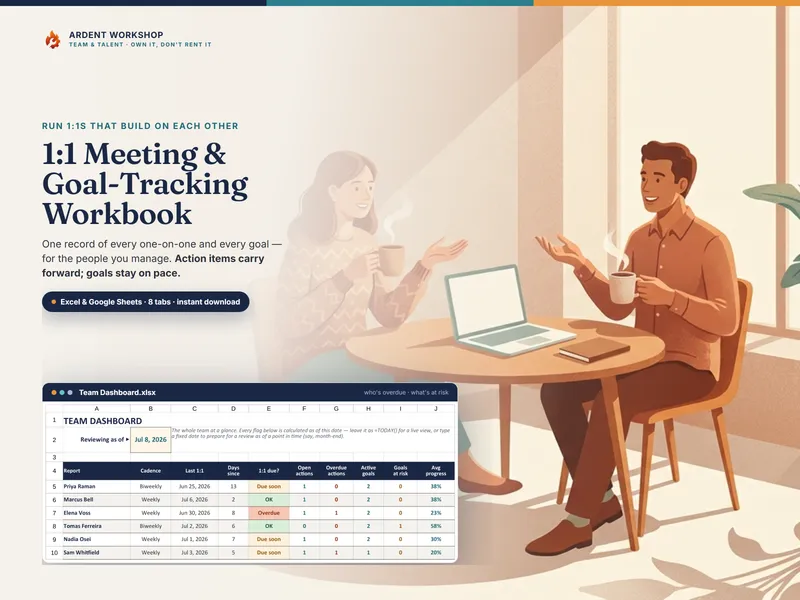
- 1:1 Meeting & Goal-Tracking Workbook — for the meetings themselves.
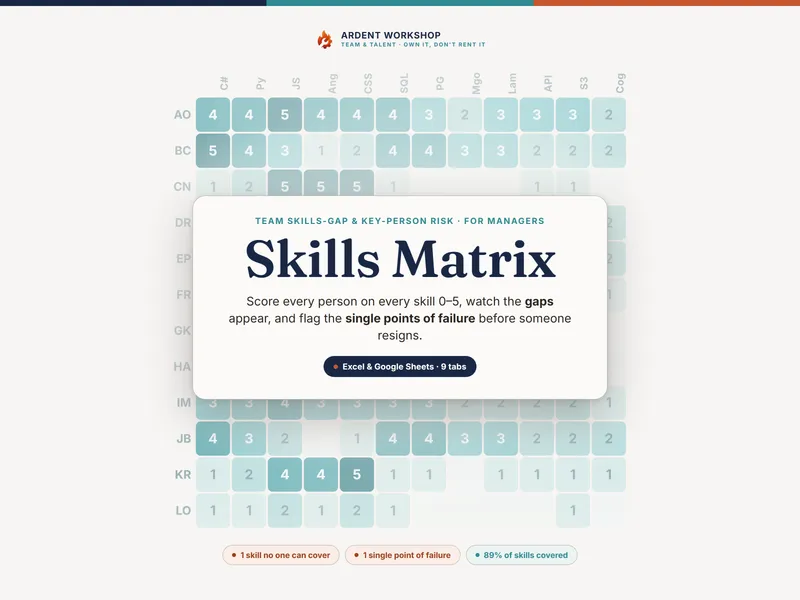
- Skills Matrix — a team-wide competency view.
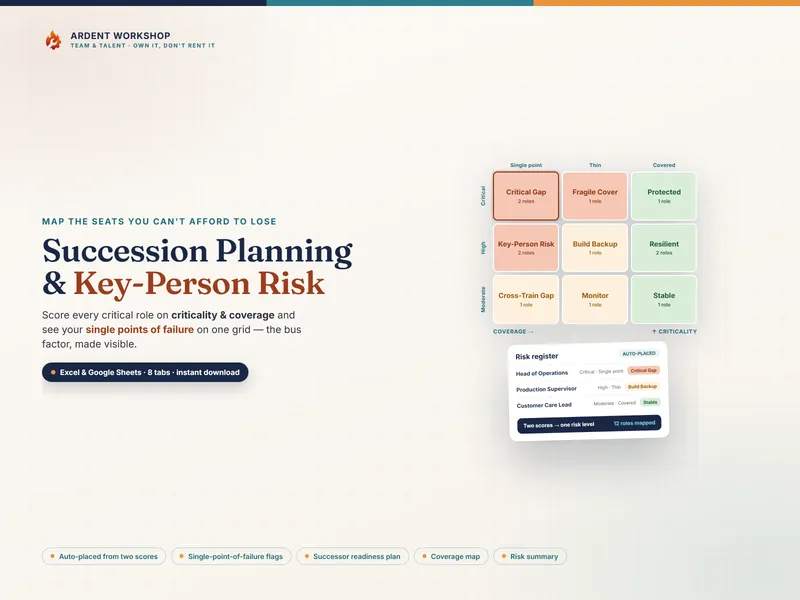
- Succession Planning & Key-Person Risk — plan cover for the roles that matter most.
- One-on-One & Coaching Question Deck — questions for the conversation itself.
What this is — and what it isn’t
The Individual Development Plan (IDP) Workbook is a development-planning aid — not HR or legal advice, and not a promotion, pay, or disciplinary system. Readiness suggestions are an input to a conversation, never the decision itself, and 70-20-10 is a planning rule of thumb, not a measured law. The example company and everyone in it are fictional. A development plan holds personal notes about named people: keep it private to those who need it, and handle it the way your own privacy policy and local employment law require.