The short answer: gather four kinds of evidence first — a count, a date, a named artifact, and a downstream consequence — then write language that could only belong to the rating you are giving, assemble the summary in five slots (claim, evidence, impact, growth edge, forward commitment), and read it back as three different readers before you submit it.
Review season is not an assessment problem. Ask a manager in February who their strongest people are and they can tell you in a sentence; ask them in March to write it down in a way that survives being read back, and the cursor sits in the box.
This walkthrough takes one competency for one person from blank box to finished paragraph — the same method the Performance-Review Phrasing & Feedback Wording Bank is built on. The employee below, Priya, is invented — and so are the company, its clients, its projects and every number on this page. Nothing here is legal advice or HR advice for your organization.
Step 1 — Fill the evidence sheet before you choose a word
The temptation is to start typing and see what comes out. Don’t. Start with the four kinds of evidence, because they decide whether anything you write afterwards can survive a question:
- A count. How many items, over what period, and how many came back.
- A date. When something was known, when it was said, when it was last discussed.
- A named artifact. The document, the order, the file — named so it can be found later.
- A downstream consequence. What the next person had to do, or didn’t have to do.
For Priya, on Quality of Work, that comes out as:
| Evidence | What I actually have |
|---|---|
| Count | 214 items delivered; 6 returned for correction |
| Pattern in the corrections | No two the same fault |
| Named artifact | The Callenbrook bench run, delivered February 9 |
| Consequence | The installation crews used them as delivered — no rework |
| Context | We were two cabinetmakers short through the spring |
That table took eight minutes with the job records open. It is now the whole review.
If a line stays blank, that is the finding. A rating you can’t evidence isn’t a weak rating, it’s the one that falls over: the employee asks “such as?”, calibration discounts it, and if a decision ever turns on the record it’s the sentence that makes the whole document look thin.
Step 2 — Say what the rating is, and let the language carry it
Review paragraphs tend to get written in the same register whatever the score, which is one reason a rating can land as a surprise. The wording itself has to carry the rating:
- Exceeds — the language has to show the standard moved. Something other people now reuse, a problem that stopped recurring, a capability somebody else gained. If your Exceeds paragraph would read fine as a Meets, it isn’t an Exceeds paragraph.
- Meets — a genuine positive finding, with a real number in it. This is the rating most of a functioning team should get, and the wording should not sound like an apology. Hedges — generally, mostly, for the most part — leave the employee reading a solid year as a warning.
- Needs Improvement — one class of problem, the count, the date it was first raised, the one specific observable change wanted, and the support being provided. Not five vague concerns and not a character verdict.
Priya is a Meets, and the evidence table says so plainly: 6 corrections in 214, none of them repeats.
Step 3 — Describe the work, not the person
One rule underneath everything: a trait is an inference you drew from something you saw, so go back to the thing you saw. This is behavior-based feedback, and it is the difference between a sentence that can be acted on and one that gets defended.
| Written the usual way | Written so it holds up |
|---|---|
| Detail-oriented. | Caught the wrong handle set on the Callenbrook schedule before it reached purchasing. |
| Sloppy work. | 9 of 148 items came back for correction, and 5 of those were the same unit-conversion error on the intake form. |
| Has a great attitude. | Took on the spring overflow when we were two people short, and told me what would have to move to fit it. |
| Has real potential. | For the next level this needs layout from a client’s own drawings; the evidence so far is internal drawings only, and the two Ferrisway units would test it. |
The right column is longer. That is not a cost — it’s the entire product. A stranger reading the file next spring learns something from the right column and nothing at all from the left.
Step 4 — Build the paragraph in five slots
A summary paragraph is not a free-writing exercise. Every one that holds up does the same five things in the same order, and the reason to assemble it in slots is that the paragraph then cannot quietly omit the two things weak ones always omit: the evidence, and the commitment.
- The claim — the pattern over the period, as behavior rather than as an adjective.
- The evidence — one named, dated, countable thing. One, chosen because you can defend it. Not three.
- The impact — who else was better or worse off. A paragraph that never leaves the individual reads as an opinion about a person.
- The growth edge — one thing to develop, present at every rating. An Exceeds with no growth edge tells a strong performer there’s nothing left to aim at; a Needs Improvement with five tells a struggling one to give up.
- The forward commitment — what happens next, with a date, and what you are providing.
Filled in for Priya:
Over the year to June 30, Priya met the standard the role requires on bench work, consistently and through a spring in which we were two cabinetmakers short. Specifically: 214 items delivered over the year, with 6 needing correction and no two of those the same fault. The effect is that the installation crews could plan around her benches without checking them first. The area to develop next is laying out from a client’s own drawings rather than from ours, which is the difference between this rating and the one above it. For the coming period we have agreed she takes the layout on the two Ferrisway units, and we’ll check it at the October review.
Five sentences. Two numbers, one date, one named job, one named consequence, one named next step with a date on it — and not a single adjective about Priya as a person.
Step 5 — Read it back as three different people
Ninety seconds, and it catches almost everything:
- The employee, today. Do I know what I did, what to keep doing, and exactly what to change? Fails on: adjectives with no example; a rating that arrives as a surprise; a concern they’ve never heard before.
- HR or your own manager, next week. Is this evidenced, consistent with the rating, and free of anything about the person rather than the work? Fails on: a verdict with no count, date or artifact; language about attitude, culture fit, or potential with nothing behind it.
- A stranger, a year from now. Can I tell what actually happened without knowing any of these people? Fails on: “as discussed”; internal shorthand; anything that only makes sense if you were in the room.
Step 6 — Know what to route elsewhere
The most important paragraph in any review method is the one about when to stop using it. Take proper HR or legal advice before you write, for:
- any rating or write-up intended to support dismissal, demotion, a reduction in hours or pay, or non-renewal of a contract;
- a performance-improvement plan or a written warning — what these must contain and how much notice they require is set locally and varies sharply;
- anything touching a protected characteristic, a disability or accommodation request, pregnancy or parental leave, sickness absence, or religious observance;
- performance concerns arising after an employee raised a complaint, made a safety or regulatory report, took protected leave, or organized with a union;
- any review used to justify a difference in pay or advancement between people doing similar work.
If you find yourself writing to build a case rather than to describe the work, the document isn’t a review, and it needs advice before it exists.
The habit that makes all of this cheap
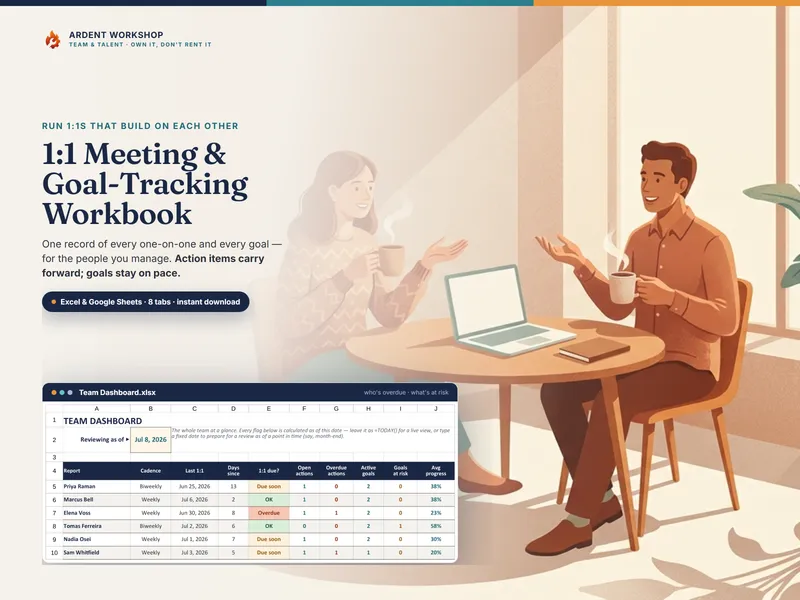
Everything above is easy in March if you did four lines a month. After each one-on-one, per person: the date, what happened, what it affected, any number attached. Ten minutes a month turns review week from an archaeology job into a writing job — and it is the same note that proves you raised a concern at the time rather than saving it for the form. Keep it somewhere only you and HR can open: a running note on a named person’s performance is an employee record. A 1:1 Meeting & Goal-Tracking Workbook is where that record lives between cycles.
For the wording itself, the Performance-Review Phrasing & Feedback Wording Bank carries 189 phrases across nine competencies at three rating levels — each printed with the evidence it obliges you to produce — plus the five-slot builder, nine print-and-fill evidence worksheets, and a spreadsheet that assembles the paragraph and flags any blank you left unfilled. Ten more rewrites of this kind — including three of the four in step 3 — are free and ungated (PDF, no signup) if you want to try the method on tonight’s review first.