Turn “who’s good at what” into one clear framework
You know your team’s strengths and gaps, roughly, in your head. A competency framework gets that picture onto one page — and this workbook builds it for you. Set the level each role is expected to reach on every competency, score each person against it, and see exactly where the gaps are, per person and across the team.
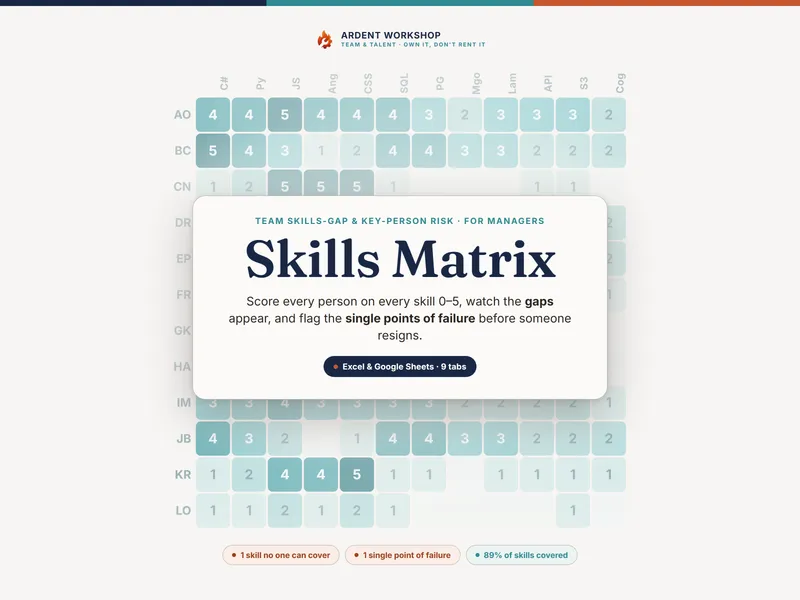
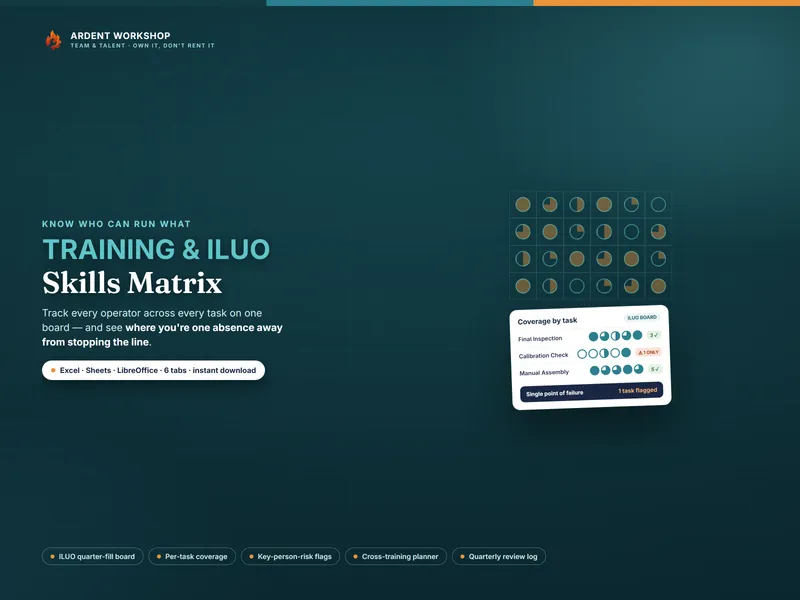
Where a skills matrix tracks “can they do the task,” a competency framework captures the broader model HR uses for reviews, progression, and development: a shared proficiency scale, a library of competencies, a target for every role, and every person scored against their own role’s bar — with the arithmetic done for you.
What good looks like at every role
The Role Framework tab is the heart of it. Roles run down the side, competencies across the top, and a target level (1–5) sits in every cell — shaded darker as the bar rises, so the whole framework reads as a heat map. Read a row for a role’s complete target profile; read a column to see how a competency deepens from junior to senior. It’s the artifact you hand someone who asks “what does the next level look like?”
Score your team — the gaps compute themselves
On the Assessment tab, pick each person’s role and rate them 1–5 on each competency. The workbook works out, for every person:
- At / above target and below target — how many competencies clear their role’s bar, and how many fall short
- Average gap — the average distance from target across everything assessed
- Status — a one-word read: Meets role, Nearly there, or Development
No comparing cells by hand. Each rating is measured against that person’s role, so a strong associate and a stretched manager are judged fairly against different bars.
See where to focus — and build a real plan
The Gap & Development tab flips the view from people to competencies: for each one, the team’s average level against the typical target, with focus areas flagged in priority order. A competency where the whole team sits below the bar — often a leadership one in a group of strong individual contributors — is better solved with a shared program than fifteen separate conversations. That’s your development plan, ranked.
Built to be used, not just filled in
- Proficiency Levels — the shared 1–5 scale, so a 3 on Communication means the same thing as a 3 on Quality.
- Competency Library — 15 competencies across Core, Functional, and Leadership, each with a plain definition and a “what good looks like” line so different managers rate the same way. Rename, add, or cut to fit your organization.
- Review Log — a dated, signed record of each review or calibration.
- Four PDF guides — how to set the levels, how to rate fairly and calibrate, how to read the gaps, and a printable pack (scale card, blank role profile, person scorecard, review sheet) for the whiteboard and the one-to-one.
Works in Excel and Google Sheets
Use the .xlsx in Microsoft Excel or LibreOffice Calc, or open the included one-click link and choose Make a copy for a ready-made native Google Sheets version in your own Drive — every dropdown, formula, and color already set up, no importing and nothing to rebuild. It ships pre-loaded with a fictional ten-person example you overwrite with your own team.
Prefer to try before you build the whole ladder? Start with the free single-role Competency Framework starter.
Own it, don’t rent it
A competency framework is normally locked inside an expensive LMS or HRIS you pay for by the seat, every month. This is the same artifact in a file you own outright — the structure that sits between a blank spreadsheet (free, but you build every formula and rule yourself) and rented HR software (powerful, but overkill and a recurring bill). Buy it once; it’s yours to keep, edit, and use across your organization.
A development tool — not a verdict
This is a framework-building and development-planning template — not HR, legal, or professional advice, and not an objective assessment of any real person. The example team and ratings are fictional. A competency level is a starting point for a conversation, not a verdict: never make a pay, promotion, or exit decision on a rating alone, and keep your people’s data confidential to those who need it, the way your own privacy policy and local law require.