Somewhere right now, a small-business owner is staring at a blank review form they downloaded three years ago, trying to remember what a five-person team did last February. They will fill in some numbers, schedule an awkward hour per person, and quietly hope nobody cries.
Here’s the shift worth naming in 2026: the annual performance review is quietly dying — and the case against it is even sharper for a small team than it ever was for a corporation. The big companies killed the annual review years ago; a lean, growing operation has less reason than any of them to keep it.
The corner bakery with three employees, the two-person agency, and the maker who just hired their first packer are all bumping into the same conclusion the Fortune 500 reached — usually without ever reading a management book. The annual review never fit a small team especially well. This piece is about why, and what a small operation can run instead.
Why the annual review broke in the first place
The annual performance review fails because it tries to do a year’s worth of feedback in a single, high-stakes hour — and the data shows it doesn’t work. According to Gallup’s research on performance reviews (opens in new tab), only 14% of employees strongly agree that their performance reviews inspire them to improve. That’s not a rounding error. That’s five out of six people walking out of the meeting unmoved.
The mechanism behind that failure is timing. The same Gallup research (opens in new tab) found that when managers give feedback weekly instead of annually, employees are:
- 5.2× more likely to strongly agree they receive meaningful feedback
- 3.2× more likely to be motivated to do outstanding work
- 2.7× more likely to be engaged at work
And yet Gallup finds that nearly half of employees (opens in new tab) hear from their manager only “a few times a year or less.” The annual review isn’t just one flawed meeting — it’s often the only meeting, which is why it carries a weight it was never designed to hold.
Now scale that problem down. On a team of 200, the annual review is bureaucratic overhead. On a team of five, it’s absurd theater. Everyone already knows who’s carrying the shift and who keeps mislabeling the shipments. Freezing that shared, obvious reality into a formal once-a-year verdict — often tied to a raise decision made months earlier — adds friction without adding information.
The enterprise exodus was the warning shot
Small teams didn’t invent this shift. They’re catching up to a wave that broke a decade ago.
Back in 2012, Adobe scrapped its stack-ranking annual review for a system it called the “Check-in” — frequent, informal, lightweight conversations between managers and employees. The results, reported by Forbes (opens in new tab), became the case study everyone cited: voluntary attrition dropped roughly 30%, and the company clawed back most of the 80,000 manager hours a year it had been sinking into reviews — the equivalent of nearly 40 full-time employees doing nothing but paperwork.
Deloitte’s own leaders, writing in Harvard Business Review, described reinventing the company’s performance management (opens in new tab) — replacing the annual appraisal with fast “snapshots” a team leader completes after each project. GE — the company that practically invented forced ranking — scrapped it for continuous, app-based check-ins (opens in new tab).
The lesson small operators are taking from this isn’t “copy Adobe’s software.” It’s simpler and more useful: the giants proved that killing the annual review didn’t lower performance — it raised it. If a company with well over ten thousand employees can run without a formal calendar-driven appraisal, a 7-person shop certainly can.
What small teams actually do in 2026
Here’s what’s replacing the annual review on small teams this year. Notice that “do nothing” isn’t on the list. The teams getting this right didn’t abandon performance management — they unbundled it. The annual review tried to be a feedback session, a development plan, a rating, and a pay negotiation all at once. Split those apart and each one gets easier.
Continuous performance management is the umbrella term for this: replacing the single annual event with an ongoing rhythm of short conversations, always-current records, and a much lighter formal review. Five moves define how it looks on a small team.
1. The 15-minute check-in replaces the 60-minute verdict
The workhorse of 2026 is the recurring one-on-one — weekly or every other week, 15 minutes, no form required. It’s where a manager catches a problem the same week it happens instead of saving it for a December ambush. The Gallup multipliers above are the entire argument: frequency, not formality, is what moves the needle. A quick “how’s it going, what’s in your way” every Monday beats a polished annual essay every time.
2. Capability gets tracked continuously, not rated once a year
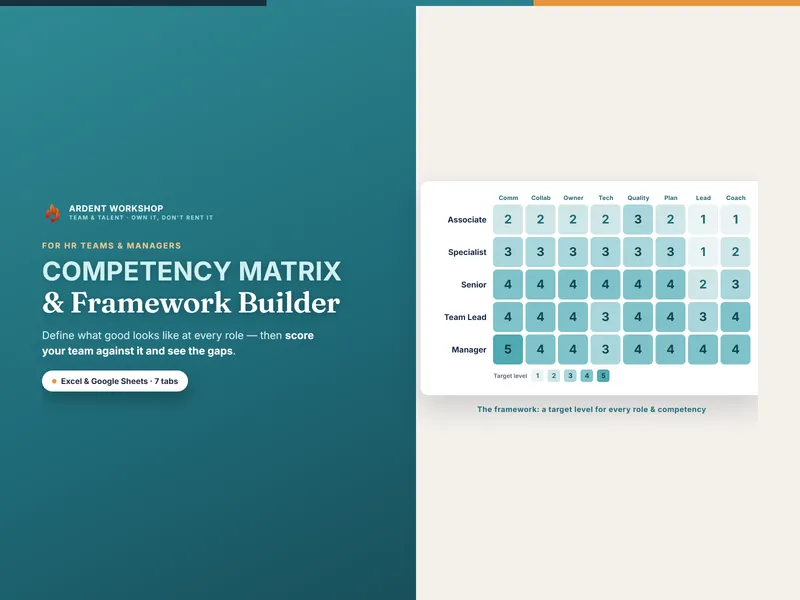
Instead of inventing a performance score from memory each December, more small teams keep a living map of who can do what. A skills matrix — a simple grid scoring each person on each critical task — turns “how’s Sam doing?” from a gut feeling into a visible record you update as people learn. It also surfaces the scarier question a small team can’t afford to ignore: what happens if the one person who knows the wholesale accounts leaves? Keeping that grid current is exactly how you spot a skills gap before someone quits, and a tool like the Skills Matrix Template or the Competency Matrix & Framework Builder does the tracking for you.
3. Reviews follow the work, not the calendar
Deloitte’s “snapshot after each project” idea scales down beautifully. A caterer reviews after the wedding season, not on a random date in January. An agency debriefs after each launch. The performance conversation happens while the work is fresh and the lesson is obvious, which is the only time feedback actually sticks.
4. The pay conversation gets its own room
One of the quiet reasons annual reviews go badly is that people can’t hear “here’s how to grow” while they’re waiting to hear “here’s your raise.” Small teams are increasingly separating the two — a growth conversation on one cadence, a compensation decision on another. When money isn’t on the table, the feedback stops feeling like a negotiation and starts feeling like coaching.
5. One structured review survives — but it’s a summary, not a surprise
This is the part people miss. Killing the annual review doesn’t mean killing all structure. Most teams that get this right still hold one deliberate, documented review a year — for raises, promotions, and a paper trail. The difference is that it’s a recap of a year of honest check-ins, not a bombshell. Nothing in it should be new.
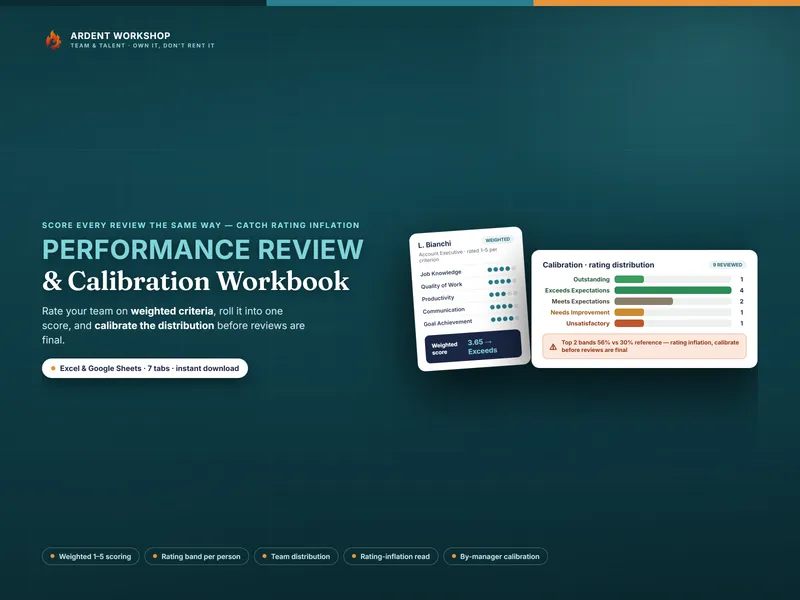
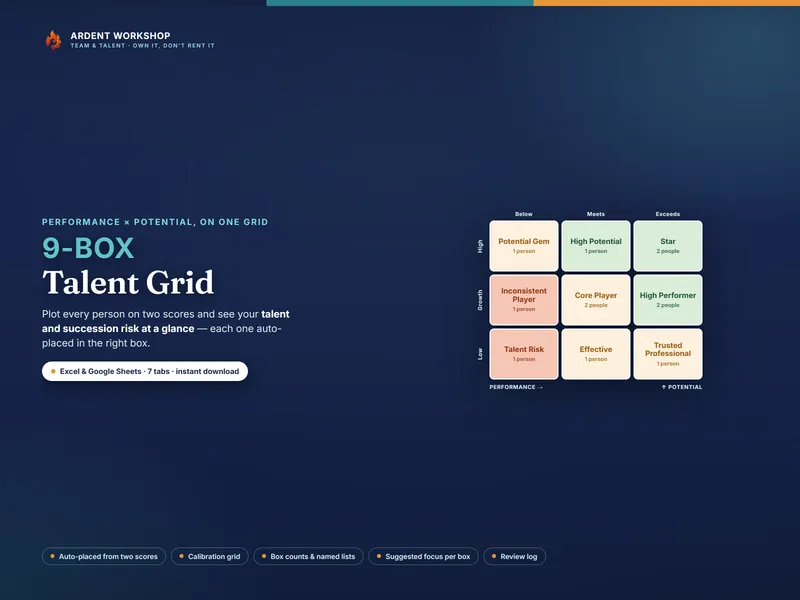
That’s where a bit of formal scoring still earns its keep. A Performance Review & Calibration Workbook lets you rate everyone against the same criteria and sanity-check the distribution so you’re not accidentally giving everyone a “4.” And when you want to look past this year’s output to who’s ready for more, a 9-Box Talent Grid plots performance against potential — the same succession lens that maps your whole team on one page.
Here’s the before-and-after at a glance:
| Dimension | The old annual review | The 2026 continuous approach |
|---|---|---|
| Frequency | Once a year | Weekly/biweekly check-ins + one yearly summary |
| Feedback timing | Months after the fact | The same week the work happens |
| Performance record | Reconstructed from memory | A living skills grid, always current |
| The formal review | A high-stakes surprise | A no-surprises recap of the year |
| Pay + growth | Tangled into one tense hour | Deliberately separated |
| Prep time | Hours of backfilled paperwork | Minutes, because the records already exist |
Where performance management is heading
The direction of travel is clear: performance management is becoming something you do all year in small doses, not something you dread once a year in a big one. For small teams, that shift is mostly upside — less paperwork, better retention, and feedback that actually lands.
There’s a catch worth being honest about. Continuous feedback only works if you actually keep the records. The whole system leans on having a current picture of who can do what and what was said when — and the moment that lives only in your head, you’re back to reconstructing a year from memory every December.
This is where small teams have a real choice. You can rent a per-seat performance-management app with quarterly pricing and features built for a 500-person HR department — overkill and a recurring bill for a team of six. Or you can own the system: a set of connected workbooks that hold your skills grid, your check-in notes, and your one structured yearly review, sitting right between a blank spreadsheet you’d have to build from scratch and software you’d rent forever. For a growing shop, “own it, don’t rent it” isn’t just cheaper — it’s structure that stays yours as the team changes.
If you’re building that system, a couple of pieces round it out: a Training-Needs Analysis Workbook turns the gaps your skills grid exposes into an actual development plan, and a Cross-Training & Coverage Planner makes sure no single person stays a single point of failure.
The whole system, in three parts
The annual performance review isn’t dying because feedback stopped mattering. It’s dying because we finally figured out that cramming a year of it into one hour was the problem. A steady rhythm of short conversations beats one big performance verdict every time — and a small team, nimble and allergic to pointless paperwork, is exactly where that trade-off is most obvious.
You don’t need a corporate HR department to make the switch. You need just three things:
- A weekly 15 minutes — the recurring check-in where problems surface the same week they happen.
- A place to keep the record — a living skills grid and your check-in notes, so nothing lives only in your head.
- One honest yearly summary — a no-surprises recap for raises and promotions.
That’s the whole system — and in 2026, there’s less reason than ever for a small team to keep dreading the alternative.