In the next 20 minutes you can build a structured interview scorecard: one page that tells you what you are rating, what a good answer sounds like, and — when the last candidate walks out — which one actually won.
Here is why it’s worth the 20 minutes. When you hire for a small shop, you interview three or four people across two weeks, in between everything else. By the time you sit down to decide, you aren’t comparing candidates — you’re comparing your memories of them, and memory tends to reward whoever was most recent, most charming, and most like you.
A scorecard fixes that with paper.
What is a structured interview scorecard?
A structured interview scorecard is a one-page rating sheet that lists the job-related competencies you are hiring for, a fixed 1-5 scale for each, and a weight that says which ones matter most. Every candidate gets the same questions in the same order, and gets scored on the same sheet.
That’s the whole idea. The US Office of Personnel Management defines a structured interview (opens in new tab) as one that measures “job-related competencies of candidates by systematically inquiring about their behavior in past experiences and/or their proposed behavior in hypothetical situations,” and notes that, generally speaking, structured interviews “ensure candidates have equal opportunities to provide information and are assessed accurately and consistently.”
It’s also the best interviewing tool you have. A 2022 re-analysis of decades of personnel-selection research (opens in new tab) in the Journal of Applied Psychology found that “structured interviews emerged as the top-ranked selection procedure” — in a paper that revised most hiring methods’ track records downward.
How to build a structured interview scorecard in 20 minutes
1. List four to six competencies (5 minutes)
Open the job — not the job ad, the job — and, on a blank sheet, write down what this person actually does in their first two weeks. Then turn that into four to six competencies, named as things a person does, not traits they have.
“Reliable” is a trait. “Follows a written process without supervision” is a competency. You can rate the second one.
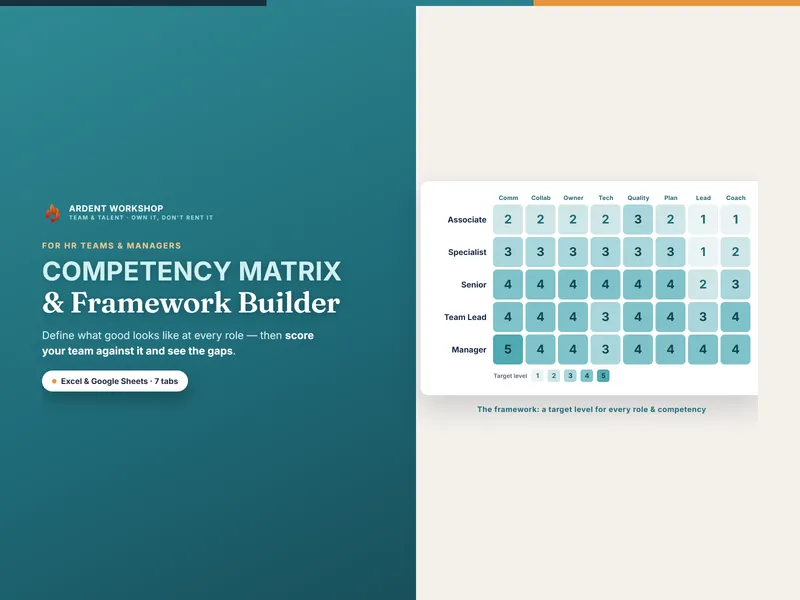
Four to six, because three is too coarse to separate two good candidates and nine turns a conversation into a form. If your team already has a competency list, pull straight from it — then the interview and the training plan speak the same language on day one. If it doesn’t, that list is worth starting on its own: a skills matrix or a competency framework outlives any one hire.
2. Weight them (2 minutes)
Mark each competency ×3 (must-have — you would not hire without it), ×2 (important), or ×1 (nice-to-have). The absolute numbers don’t matter. The ratio does: weighting is what stops a candidate from winning on charm points they scored in your least important row.
3. Write one question per competency (8 minutes)
One question each, written down before the first interview. Two formats work:
- Behavioral — “Tell me about a time a customer order went wrong. What did you do?”
- Situational — “You’re alone in the shop and two rush orders land at once. Walk me through your next hour.”
Ask every candidate the same questions in the same order. Follow-up probes can go wherever the conversation goes — the core questions can’t.
4. Anchor the 1-5 scale (5 minutes)
This is the step everyone skips, and it is the one that makes the scorecard work. For each competency, write one line for what a 1 sounds like and one line for what a 5 sounds like. Without anchors, a 4 just means whatever you felt that afternoon. Everything between interpolates: a 3 is a real answer with no specifics in it, a 2 sits closer to the 1 than the 5. Anchor your must-haves first — if the clock beats you, the ×1 rows can wait.
For example:
| Competency | Weight | A 1 sounds like | A 5 sounds like |
|---|---|---|---|
| Follows a written process unsupervised | ×3 | Describes improvising because “that’s how I’ve always done it” | Names a checklist or SOP they followed and where they flagged an exception |
| Handles a customer complaint | ×3 | Blames the customer or escalates immediately | Describes what they said, what they offered, and what they changed after |
| Works a rush without dropping quality | ×2 | Talks about speed only | Describes a triage rule — what gets cut first and what never does |
| Learns a new tool quickly | ×1 | Says “I’m a fast learner” and stops there | Names a specific tool, how long it took, and how they know they learned it |
That’s the whole scorecard — four rows a stranger could score the same way you would.
5. Score during the interview, not after (0 extra minutes)
Circle a number while the candidate is still talking. Scores written from memory that evening are just your gut wearing a number.
If two of you interview together, score independently and compare sheets before you talk about the candidate out loud. The moment one person says “I loved her,” the other person’s 3 quietly becomes a 4.
What to leave off the scorecard
- “Culture fit.” Unratable, and in practice it usually means “reminds me of us.” If something real is underneath it — communicates directly, handles feedback well — write that as a competency and anchor it.
- Anything not job-related. The EEOC’s list of protected characteristics (opens in new tab) covers race, color, religion, sex (including transgender status, sexual orientation, and pregnancy), national origin, age 40 or older, disability, and genetic information — bases on which employment decisions are unlawful for covered employers — and disability is the one subject where the asking itself is barred before an offer. Check your own state and city rules too; some reach smaller employers than the federal ones do. A scorecard built only from job competencies keeps the conversation where it belongs.
- The résumé. You already screened on it. Scoring it again double-counts it.
- Gut feel as a row. Keep it — in the notes box at the bottom. Just don’t let it collect points, and write what you observed rather than how you felt about the person. Everything in that box is part of the record.
How to read the totals
Multiply each score by its weight, add them up, and rank. Then apply one rule: the highest total wins unless it scored a 1 or 2 out of 5 on a ×3 must-have. A candidate who cannot do the non-negotiable part of the job doesn’t get there on points.
Write one line under the winner explaining the call, and keep the sheets — somewhere access-controlled, for a set period rather than forever. Employers covered by the federal EEO laws — generally those with 15 or more employees — must keep personnel and employment records for one year (opens in new tab), and a candidate may be entitled to see what you wrote about them. If a rejected candidate ever asks, “here is the job-related rating sheet every candidate was scored on” is a much better answer than “they weren’t a fit.”
Reuse the scorecard for the next opening
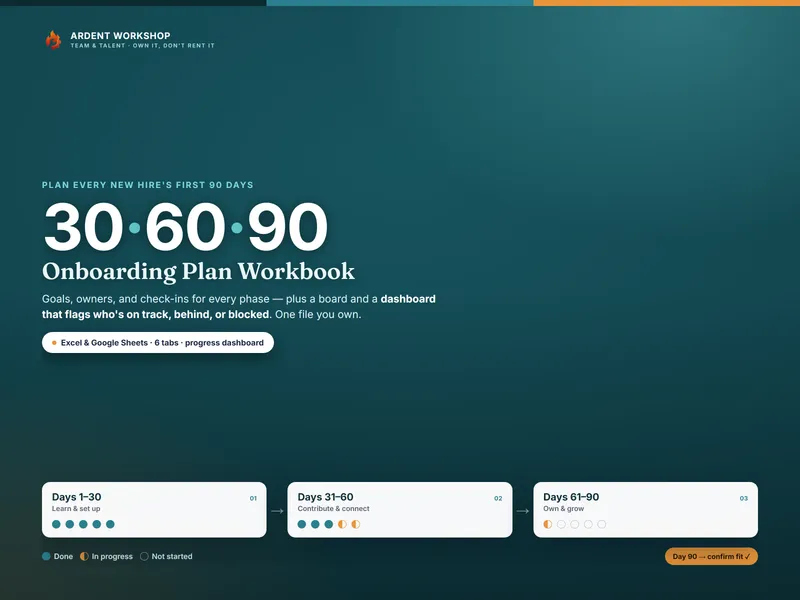
The rows you just wrote outlive this hire. Keep them and you can compare hires across a year, not just candidates across a week. And the competencies your new hire rated 3 out of 5 or lower are exactly where their first training plan should start — hand them straight to a 30-60-90 onboarding plan instead of rediscovering them in month two.
If you’d rather not build the sheet from scratch, the free Interview Scorecard Starter is this method for one candidate — weighted competencies, a computed score, a recommendation, no signup. The Structured Interview Scorecard & Question Bank is the whole-slate version: eight weighted competencies you rename, re-weight, or leave blank to fit the role, ranked across every candidate with a Strong Yes / Yes / Maybe / No, plus 100+ questions and a decision log.
The scorecard is the cheap half of the hiring decision. The other half is the offer — here’s how much to pay your first employee without guessing, and why skills-based hiring is easier to promise than to practice.
The takeaway: twenty minutes of writing before the first interview replaces two weeks of arguing after the last one.