

Big Decisions 4 min read
How to Choose Between Two Apartments
Stuck between two apartments that both feel right? Use this 5-minute weighted scorecard to turn a gut feeling into a clear winner.
21 tools for the choices that are expensive to get wrong — a house, a job, a school, a move, a care arrangement, a contractor. One shared method: decide what matters before you look at anything, weight it, score every option against all of it, and let the arithmetic settle what arguing has not.
A big decision does not usually fail because somebody was not clever enough. It fails earlier: the question arrived already narrowed to a yes-or-no, the shortlist accumulated by accident, the criteria were written after the viewings, and by the time anybody did the comparing, the comparing could not change anything. Every tool on this shelf exists to move the thinking to the part where it still counts.
Start with the method if you have time, and with a scorer if you do not. How to Make a Big Decision is the readable half of the shelf — 109 pages that compute their own argument on a single worked decision rather than asserting it. It works out how close the result actually is (how far one weight must move before the answer reverses), what four ordinary revisions do to a matrix, which of two people’s disagreements actually change the winner, and how much checking the decision has earned given what an unwind would cost. There is nothing to fill in. Take the free Frame the Decision mini-guide first if you want the front of the method tonight — eight pages, no email asked for.
The Decision Helper is the fillable version of that method for any decision at all, and the rest of the shelf is the same engine with the criteria already written for one specific choice — a house, a job offer, a college, an elder-care arrangement. Learn the format once and it applies to all of them.
Afterward, the Decision Journal & Outcome Tracker keeps the page you wrote before you knew how it ended — which is the only thing that makes a review possible, because memory quietly reconciles what you believed with what happened.
New to the vocabulary? Start with what a decision matrix is and how weighted scoring works, then one-way door decisions and the pre-mortem. If you are weighing the method against the grid, read decision playbook vs decision matrix template. And if your top two options both look good, that is a specific, solvable situation — here is what to do about it.
None of these tools is financial, legal, medical or tax advice. They structure your own judgment and make the trade-offs explicit; where a decision turns on money, health, property or a contract, take it to someone qualified who knows your situation.
Recommended templates
21 templates
The playbook that teaches the method, a universal weighted scorer, a decision journal for afterward, and helpers with the criteria already written for a house, a job, a college, a car, a move, a care arrangement, a vendor and a venue — in Excel and Google Sheets.
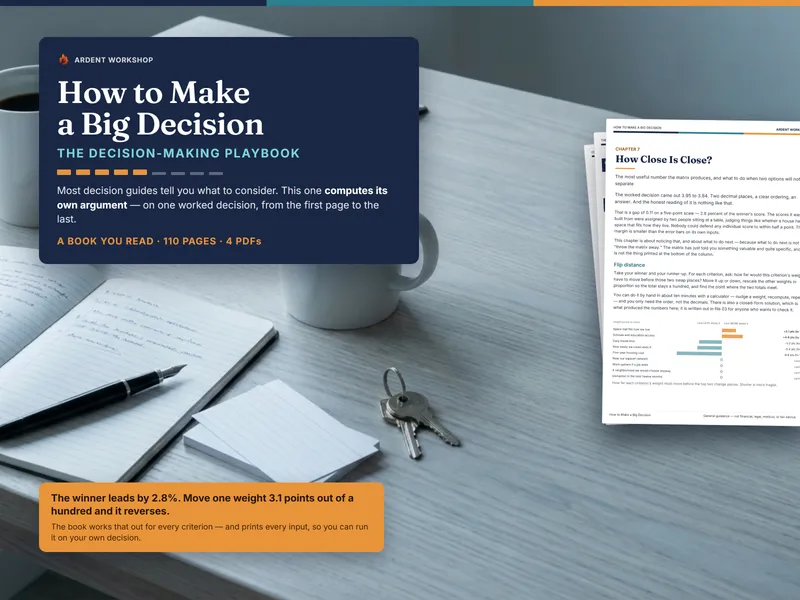
How to make a big decision: weighted scoring done honestly, flip distance, the four ways you rig your own matrix, and what checking is really worth.
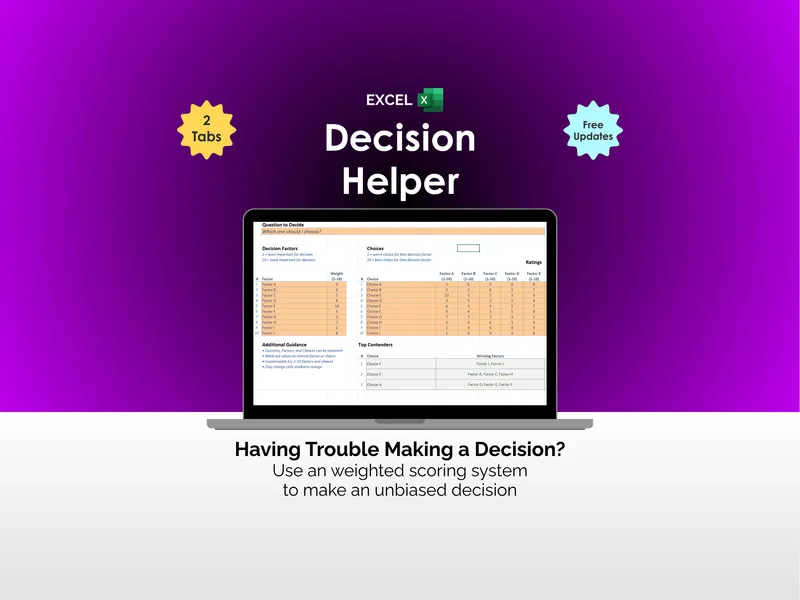
Stuck on a big choice with five tabs open and zero clarity? This excel decision helper is a weighted decision matrix template that ranks options for you.

A decision journal spreadsheet that scores your process the day you decide, then measures how overconfident you actually are once the results are in.
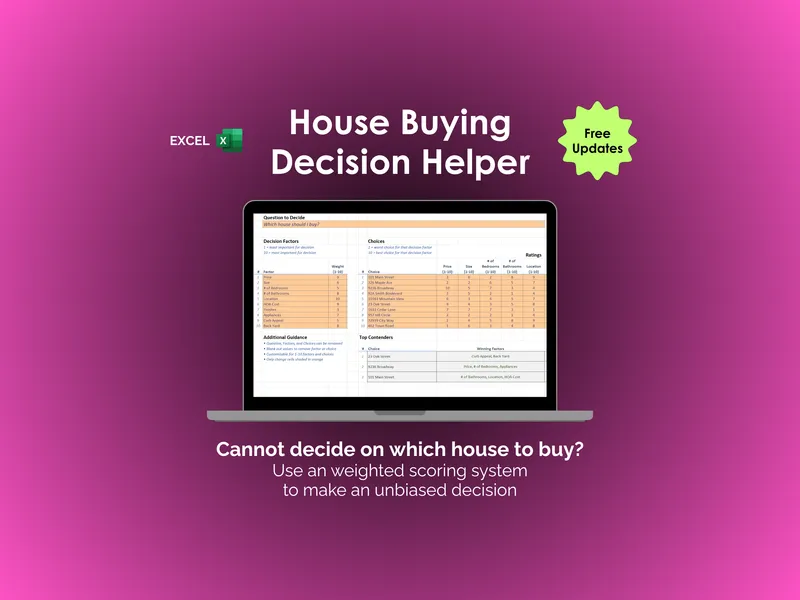
Which house actually wins on the factors you care about? An excel house buying decision helper that scores up to 10 homes against 10 weighted factors.

Settle whether to buy or keep renting. Computes your break-even year, runs six readiness checks, and weights 16 criteria to your household.
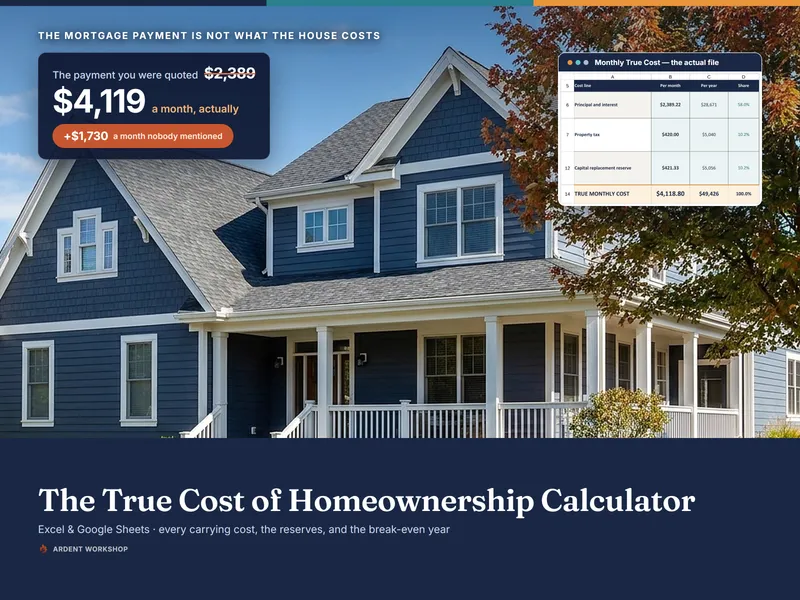
Find what a specific home really costs per month — the mortgage payment plus the seven lines listing sites leave out — and the year owning beats renting.

Compare competing job offers with a weighted decision matrix — score pay, benefits, growth, commute & fit, and rank offers by overall fit.

Score staying in your job against going self-employed — with the self-employment tax, the benefits you lose and the unpaid hours worked out, not guessed.

Negotiate your job offer with a total-comp calculator, a prep worksheet, a counter builder, and 11 email & phone scripts — a workbook you own for Excel & Sheets.
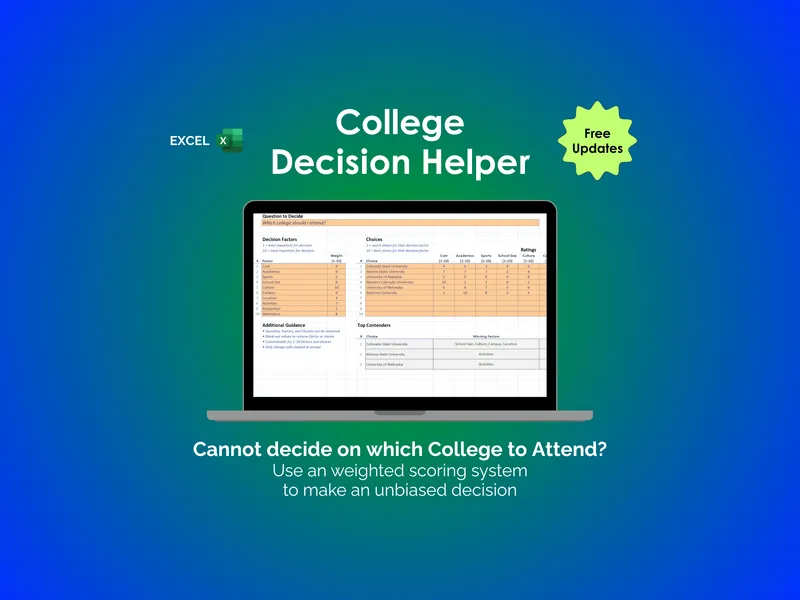
College choices come down to two camps: the gut-feel and the scored. This excel college decision helper is a college comparison spreadsheet with weighted factors and ranked contenders.
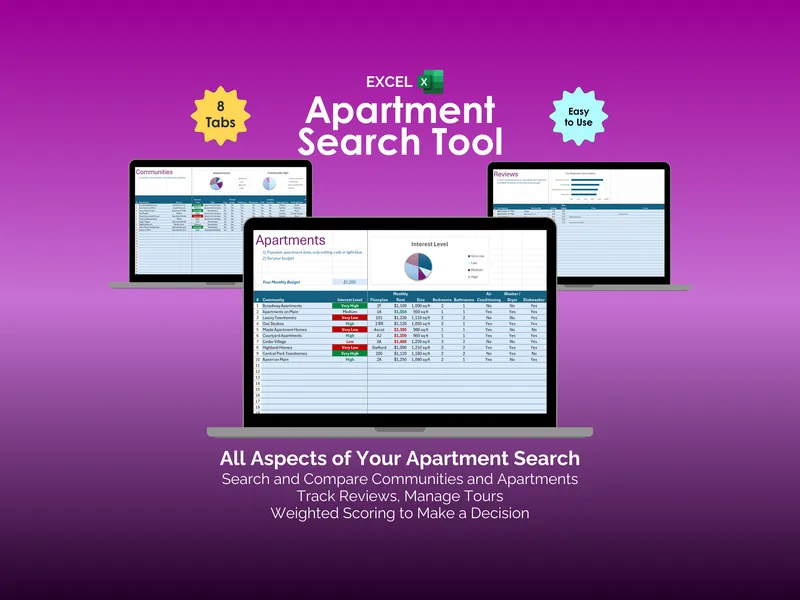
Apartment Search Tool is an eight-tab Excel workbook for renters comparing communities, apartment features, reviews, and tours, with weighted scoring to rank a shortlist.
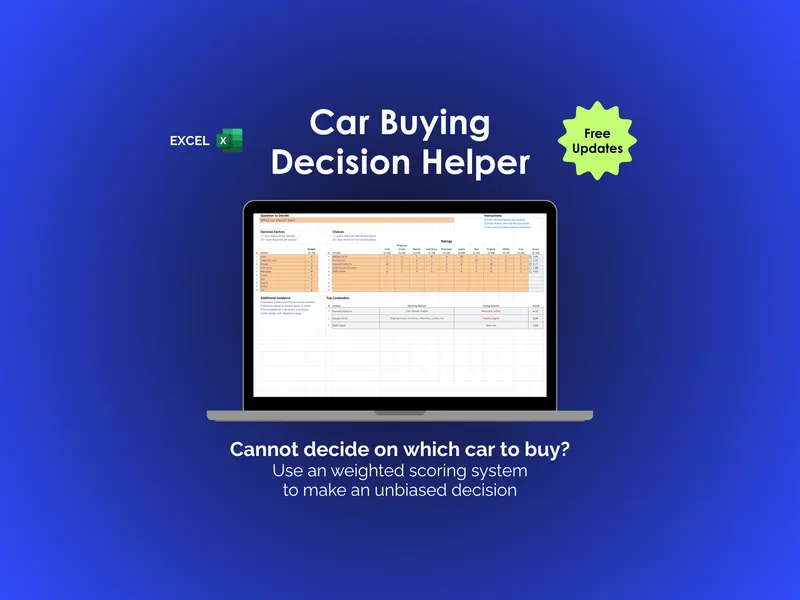
There are two kinds of car shoppers: the ones who score every option, and the ones who guess. This Excel car buying decision helper turns gut feel into weighted math.

Compare elder-care options — assisted living, memory care, nursing homes & in-home care — with a weighted scorecard that ranks them by cost, care & fit.

Compare up to five places you might retire to — including staying put — with a weighted scorecard that computes each one's true annual cost and tax bill.

Compare LLC, S-Corp, sole proprietorship & C-Corp with a weighted scorecard and a self-employment-tax estimator — find your best-fit structure.

Compare franchise & business opportunities with a weighted decision matrix — score investment, ROI, support, brand & lock-in, and rank them by overall fit.
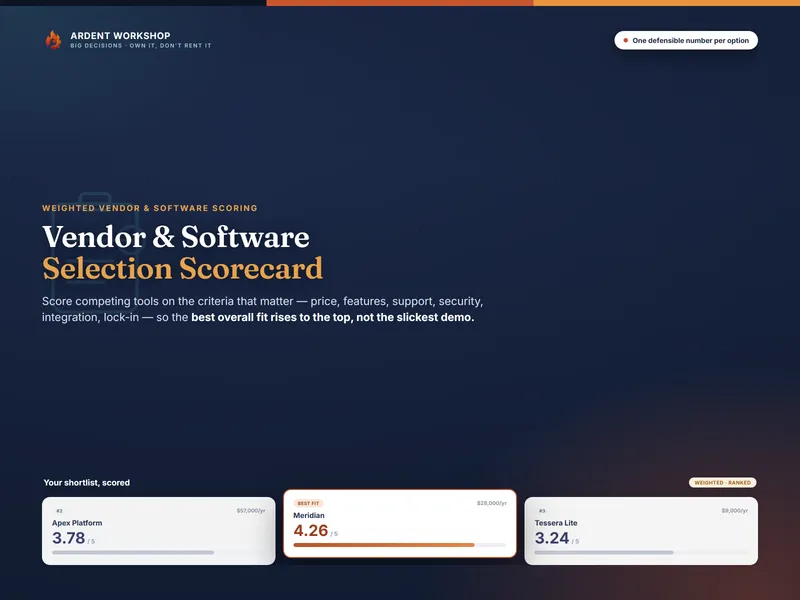
Compare vendors & software with a weighted scorecard — score price, features, support, security & integration, and rank options by overall fit.

Compare wedding venues with a weighted scorecard — score cost, capacity, location & the look, then rank by overall fit with an all-in cost calculator.

Work out what you can actually afford before a house, car, wedding or renovation — your ceiling computed three ways, with the binding constraint named.

180 curated contract red flags across venue, lease, contractor, home, vehicle and membership agreements — scored, with a deposit and cancellation tracker.

Turn a home-inspection report into a costed, prioritized repair ask — every finding priced from a built-in library and netted against your cash to close.
Where we fit
Compare the setup effort, collaboration, and automation you need. Ardent Workshop sells ready-made templates; a custom spreadsheet or software platform may fit better depending on the job.
Build the structure around your own process, with time set aside for formulas, layout, and maintenance.
Owned, structured, connected workbooks — a one-time price, yours to keep.
Consider a platform when you need shared workflows, automation, or integrations. Check the specific plan, permissions, and export options.
Reading list
The weighted approach applied to real decisions — apartments, job offers, colleges and where to go next.
Stuck between two apartments that both feel right? Use this 5-minute weighted scorecard to turn a gut feeling into a clear winner.

Renew your lease or move? Run this 10-minute cost check to compare both options and get one number that settles the decision.

Two good offers, one decision. Here's the total-comp math an offer letter hides, and how to score both offers instead of agonizing for a week.

How Social Security survivor benefits are calculated, why the higher earner's claiming age sets the survivor's check, and how to switch between benefits.

FDD Item 19 is where a franchisor puts any claim about what its outlets sell or earn, which the FTC rule calls a financial performance representation. Here is what the rule forces it to disclose, what it lets it leave out, and how to turn a gross-sales figure into what an owner actually takes home.

Multiple acceptances sound like a dream until you have to pick one. Here's a structured framework to make the biggest decision of your life with confidence.