

Team & Talent 11 min read
Your First One-on-One With an Employee
You hired help — now what? A first-time boss's guide to running a simple, useful one-on-one with your first employee, without the awkwardness.
A curated set of 9 files for the first year — when you were promoted a few weeks ago, you are running one-on-ones for the first time with people who used to be your peers, and nobody handed you a system.
Becoming a manager comes with almost no instructions, and the work does not arrive all at once. First there is a first ninety days to plan — yours, before anyone else's. Then a weekly rhythm of one-on-ones to keep, each one supposed to remember what the last one agreed. Then a quarter starts and somebody wants goals, so you write objectives and key results and discover halfway through that nobody can tell whether they have been met. And then, months later, a review form lands with a blank box in it.
Each of those has a good template. What none of them has is the join. A printed 30-60-90 list cannot know when you started, so it reads the same on your second day as on your eightieth. A folder of separate files cannot tell you which of your six people you have not actually sat down with since last month, or whether you wrote anything down about any of them that would survive being read back. The New Manager's Starter Kit is those four templates plus a fifth file whose only job is that join: type the day you were promoted and thirty milestones date themselves across weeks one to thirteen, and a coverage grid reads your own one-on-one log back to name the single person who needs you this week.
You do not have to start there. Each of the four sells on its own, and two of them have free starters with no signup — a 1:1 Meeting Starter Log for one person's running record, and an OKR Starter for a first set of objectives. Start with whichever problem you have this week; the kit is there when you have all four.
The hardest of the four to fake is the last one. By the time the review form lands you already know the rating — what stops you is the blank box, and what fills it is the language everybody reaches for the night before the deadline: detail-oriented, great attitude, has real potential. The fix is behavior-based feedback — describe the work, not the person — and the reason it is hard in your first year is not vocabulary. It is that nobody kept a record. A phrasing bank that names the evidence each phrase requires is only useful if you have the evidence, which is why the thing to start in month one is a place to write one line after every conversation.
When your job grows past this shelf. Everything here is scoped to running a team you did not hire and do not yet budget for. Once you own headcount — what good looks like across a whole team, who can cover for whom, where the key-person risk sits, who is ready for more — that is a different set of problems, and the wider manager shelf is where those files live.
One caveat worth reading before you write anything down. These are templates and general management guidance — not legal advice, and not HR advice for your organization. A file that holds notes about named people also carries obligations: where it may live, who may see it, how long you may keep it, and in many places an employee's right to see what you wrote about them. Find out your own employer's rules before the file becomes a habit, and take proper advice before you write anything that will support a pay decision, a formal warning, a demotion or a dismissal, or that touches a protected characteristic, a disability or accommodation request, leave, or a complaint an employee has raised.
Recommended templates
9 templates
The files a first-year manager actually reaches for. The New Manager's Starter Kit gathers the first four into one connected file; each of them also sells on its own if you only have one of the four problems today.

Four manager workbooks - 30-60-90 plan, one-on-ones, OKRs, review phrasing - plus a fifth that joins them and names who you are neglecting this week.
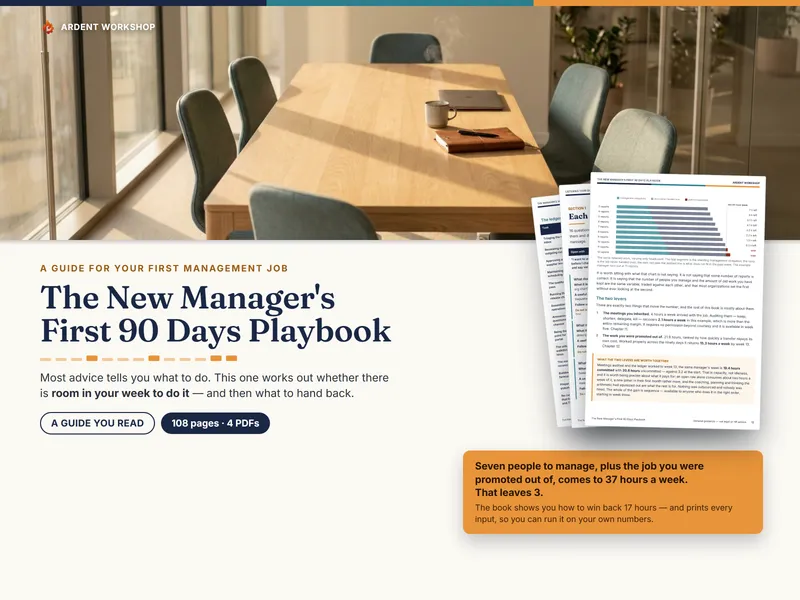
108 pages across 4 PDFs for your first 90 days as a new manager: your week costed, 62 listening-tour questions, and a delegation ledger ranked by payback.
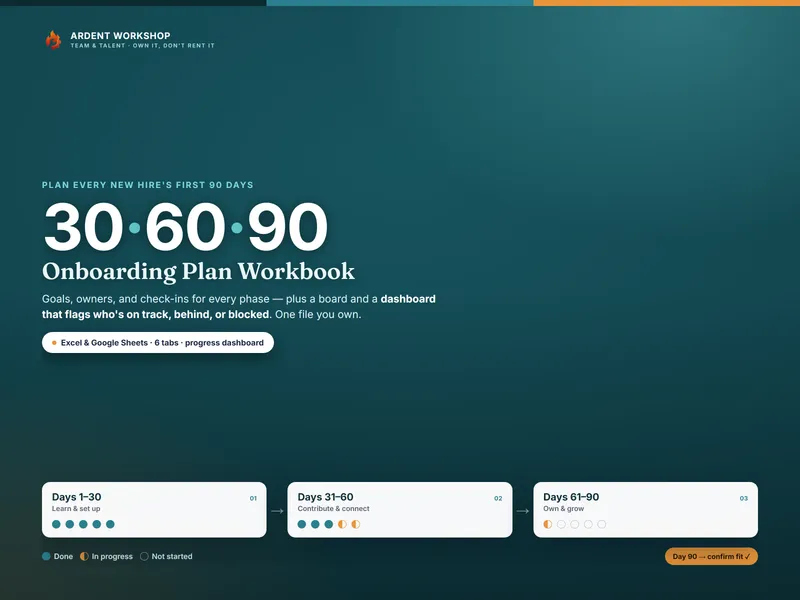
A 30-60-90 onboarding plan for Excel & Google Sheets — plan and track every new hire's first 90 days with goals, check-ins, and a progress dashboard.
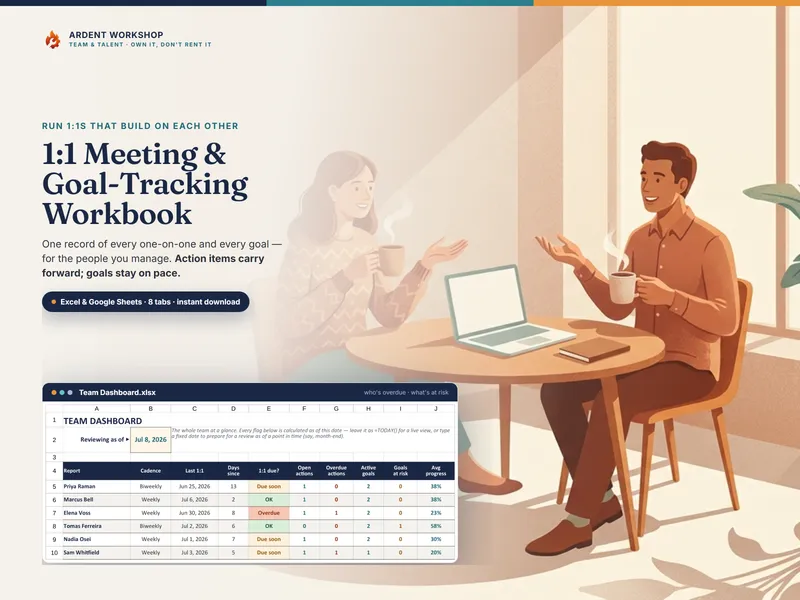
A 1:1 meeting & goal-tracking workbook for Excel & Google Sheets — log every one-on-one, carry action items forward, and track goal pace across your team.
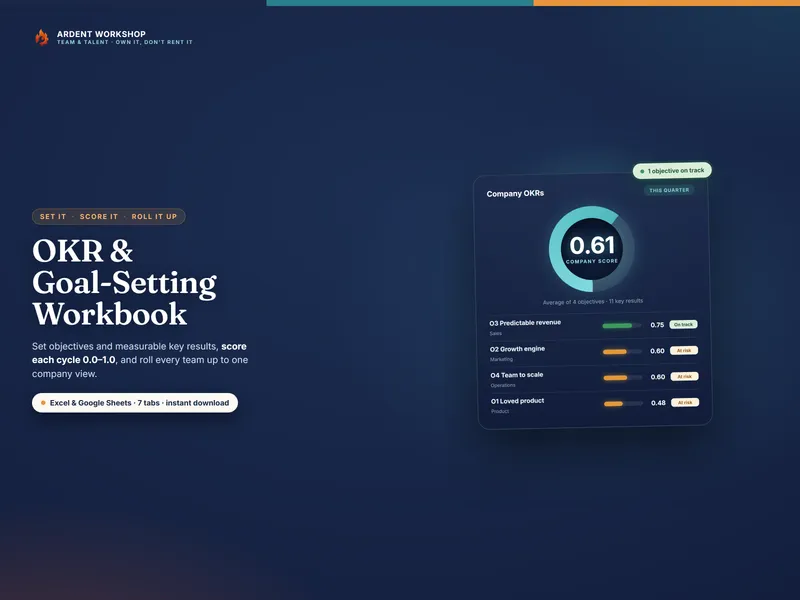
An OKR workbook for Excel & Google Sheets — set objectives and key results, score progress 0.0–1.0 each cycle, and roll every team up to one company view.

189 performance review phrases by competency and rating level, plus 54 more for goals and calibration — each naming the evidence it requires.

15 word-for-word manager scripts for difficult conversations — each branched for the four replies you actually get, with the exact next line for every one.

A printable 108-card one-on-one question deck for managers — every card carries the follow-up that makes it count, plus a Router that picks your three.

Three hiring workbooks - applicant tracker, interview scorecard, 30-60-90 plan - plus a fourth that turns the interview into the new hire's first ninety days.
Where we fit
Compare the setup effort, collaboration, and automation you need. Ardent Workshop sells ready-made templates; a custom spreadsheet or software platform may fit better depending on the job.
Build the structure around your own process, with time set aside for formulas, layout, and maintenance.
Owned, structured, connected workbooks — a one-time price, yours to keep.
Consider a platform when you need shared workflows, automation, or integrations. Check the specific plan, permissions, and export options.
Reading list
Running a first one-on-one, what to do in a first ninety days, what to delegate first, and how to coach somebody who is struggling.
You hired help — now what? A first-time boss's guide to running a simple, useful one-on-one with your first employee, without the awkwardness.

Your first 90 days at a new job aren't a test — they're a grace period. Here's a week-by-week playbook for using it before it closes.

Just hired your first helper? Here's exactly what to hand off first, what to wait on, and the few tasks you should never let go of.

A worked Eisenhower matrix example for managers: one team lead's 17 tasks sorted into Do, Schedule, Delegate and Drop, with the capacity checks that make the Delegate box work on a real team.

How to manage an underperforming employee: run this diagnostic before you write anyone off. Most underperformance is fixable — here's the coaching system.

How to write a performance improvement plan that someone can actually meet: the seven parts every PIP needs, the test each part must pass, and a filled-in eight-week example with every date worked out.

The annual performance review is quietly dying — and small teams have the least reason to keep it. Here's what's replacing it in 2026, and how to run it.

Hiring your first helper after years working solo? How to onboard them well—the first week, the slow start, and a system to train without losing your rush.

The signs of employee burnout show up in your schedule, coverage, and time-off records before anyone says a word. Here's how to read them.

When two employees don't get along, it is often an undefined seam between their jobs, not a personality clash. How to tell which, and fix the right one.