Promote from within when the new role’s core skill is one the person already practices. Hire externally when the role’s core skill is one nobody on your bench has ever done. Everything else — loyalty, tenure, who asked first, who you like — is a tiebreaker, not the decision.
That rule is easy to state and hard to apply, because the two options never arrive as equal evidence. One candidate you have watched work for two years. The other you will know for ninety minutes.
That asymmetry is the whole problem. When a role opens up in a small shop — lead maker, production manager, the person who runs Saturdays — you are comparing a long, messy, honest record against a short, polished, optimistic one. Most owners resolve that discomfort by picking whichever option feels least risky at 11 p.m. on a Tuesday, which is not a decision so much as a mood.
Ask around and you will hear both answers stated as law. “Always promote from within — loyalty is everything.” “Always hire outside — fresh eyes fix stale shops.” Both camps are describing real outcomes. They are just describing them from different jobs.
Promoting From Within vs. Hiring Externally: What You Are Actually Choosing
Two definitions, since the terms get used loosely:
- An internal promotion is moving someone who already works for you into a role with more scope, more decisions, or more responsibility for other people’s output. It fills the new role and opens their old one.
- An external hire is bringing in someone from outside your business for that role. It fills the new role and opens nothing — but you are buying a stranger’s claims about their own work.
That second clause is the whole trade. One option costs you a search and a stranger’s learning curve; the other costs you a search anyway, just for an easier job.
The Case for Promoting From Within
You are paying less for better information
The research here is unusually clean. Wharton’s Matthew Bidwell tracked seven years of internal moves and external hires inside one financial services firm’s U.S. investment banking arm, from 2003 to 2009, and found that external hires were paid roughly 18 percent more than workers promoted into the same jobs (opens in new tab), received lower performance ratings for their first two years, and left — voluntarily and involuntarily — at higher rates. Paying more to get less, as the paper’s title puts it. In fairness to the other side of this argument, the same study found external hires arrived with more experience and education, and those who stayed were promoted faster afterward.
You are not paying a premium for a better worker. You are paying a premium for less information. An internal candidate has a two-year record you watched happen: what they do when a batch fails, whether they cut corners when you are not there, how they talk to a difficult customer at 4:55 on a Friday. No interview process buys that. The best structured interview in the world is a sample of ninety minutes.
The cost of hiring is real money for a shop your size
SHRM’s 2022 recruiting benchmarks put the average cost per hire near $4,700 (opens in new tab). For a business with a payroll department, that is a line item. For a two-person candle shop, most of an equivalent number would not be cash at all — it would be your hours: writing the posting, reading sixty applications, scheduling, no-shows, trial shifts, and the three weeks the work does not get done while you do all of that.
An internal promotion skips most of that spend. It does not skip all of it, for reasons covered below.
Promotion is a retention signal to everyone who did not get promoted
The people you did not promote are watching what happens. When internal moves are possible, staying is a strategy; when every good role arrives as a stranger, staying is a dead end. LinkedIn’s own 2024 platform data reports that companies with strong internal mobility tend to see tenures about 53 percent longer (opens in new tab) than companies where internal movement is rare — a company-level pattern rather than proof that any one promotion keeps any one person.
In a five-person shop, one promotion is a policy announcement. Everybody reads it correctly, including the parts you did not intend.
They are already trained on the ninety percent nobody writes down
Your glaze schedule. Which customer always asks for a rush and always pays late. Which supplier’s “in stock” means in stock. An external hire is competent at their old shop’s version of the work and starts at zero on yours. That knowledge transfer is the real onboarding cost, and it is usually larger than the paperwork.
The Case for Hiring Externally
You cannot promote a skill nobody has
This is the case that ends the debate whenever it applies. If the opening is “someone who can build a wholesale channel” and nobody on your bench has ever sold wholesale, loyalty does not manufacture the skill. You are choosing between paying market rate for experience and paying tuition for a two-year experiment — with your accounts as the tuition.
Promoting into a skill gap is not a promotion. It is an unfunded training program with a title attached.
Your best producer may be your worst manager — and you can lose both
The most under-discussed risk in promoting from within is that it is a double-sided bet. Researchers Alan Benson, Danielle Li, and Kelly Shue studied sales workers across hundreds of firms and found the pattern everyone jokes about is measurable: strong individual sales performance strongly predicted promotion into management — and the stronger the promoted person’s sales record, the worse their team’s sales performed afterward (opens in new tab). Firms kept promoting the best doers, and kept getting weaker managers.
Read that as two losses in one move. You removed your strongest producer from producing, and you installed a first-time manager who is now responsible for everyone else’s output. If the new role is mostly about other people’s work — scheduling, quality, training, correcting — then “best at the craft” is close to irrelevant as a qualification. It is a different job that happens to sit in the same building.
A shop that only promotes eventually only knows what it already knew
Every small operation accumulates habits that made sense once. An outside hire is one of the few reliable ways to find out which of your methods are craft and which are just history. That value is real, and it is highest when the shop has never had anyone but you set the standard.
“The only candidate” is not a candidate
If you are promoting someone because they are the only person available, you have not made a decision — you have accepted a default. Defaults are fine when the stakes are small and reversible. A promotion is neither: unwinding one costs you the role and usually the person.
The Cost Nobody Prices When You Promote From Within: The Backfill
Here is where most of these decisions go wrong, and it is not a judgment call — it is arithmetic.
An internal promotion does not fill a hole. It moves the hole. Promote your best decorator to production lead and you now need a decorator. So the honest comparison is never “promote (free) vs. hire (expensive).” It is:
| What you’re comparing | Promote from within | Hire externally |
|---|---|---|
| Who fills the new role | Known worker, short ramp on your systems | Stranger, long ramp on your systems |
| Who fills the old role | Nobody yet — you are still hiring | Already covered |
| Number of hires you run | One (for the easier, junior job) | One (for the harder, senior job) |
| Where the risk sits | New role: can they manage? | Both roles: are they who they said they were? |
| What you pay for | Training and ramp time | Salary premium and unknowns |
The good news is that this asymmetry usually favors promoting: hiring a decorator is a far easier search than hiring a production lead, and you are running the easy search with your best decorator still in the building to train their replacement. But it only favors you if you actually run that second search. The classic small-shop failure is promoting someone into a new title on Monday and quietly expecting them to keep doing their old job too, which produces a resentful lead, an unbacked production floor, and a resignation letter before the year is out.
This is the same key-person exposure that shows up when one person is the only one who can do a critical task — worth reading alongside why your most reliable employee is also your biggest risk. A promotion either reduces that exposure (because you finally cross-trained the old role) or doubles it (because now one person holds two jobs). If the underlying question is really about coverage rather than seniority, the separate decision of whether to cross-train the team or hire a specialist is the one to settle first.
Map the coverage before you announce anything. A cross-training and coverage planner exists for exactly this: it shows, per task, who else can actually do it — which is the difference between a promotion and a gap with a party.
Where the Real Dividing Line Between Promoting and Hiring Sits
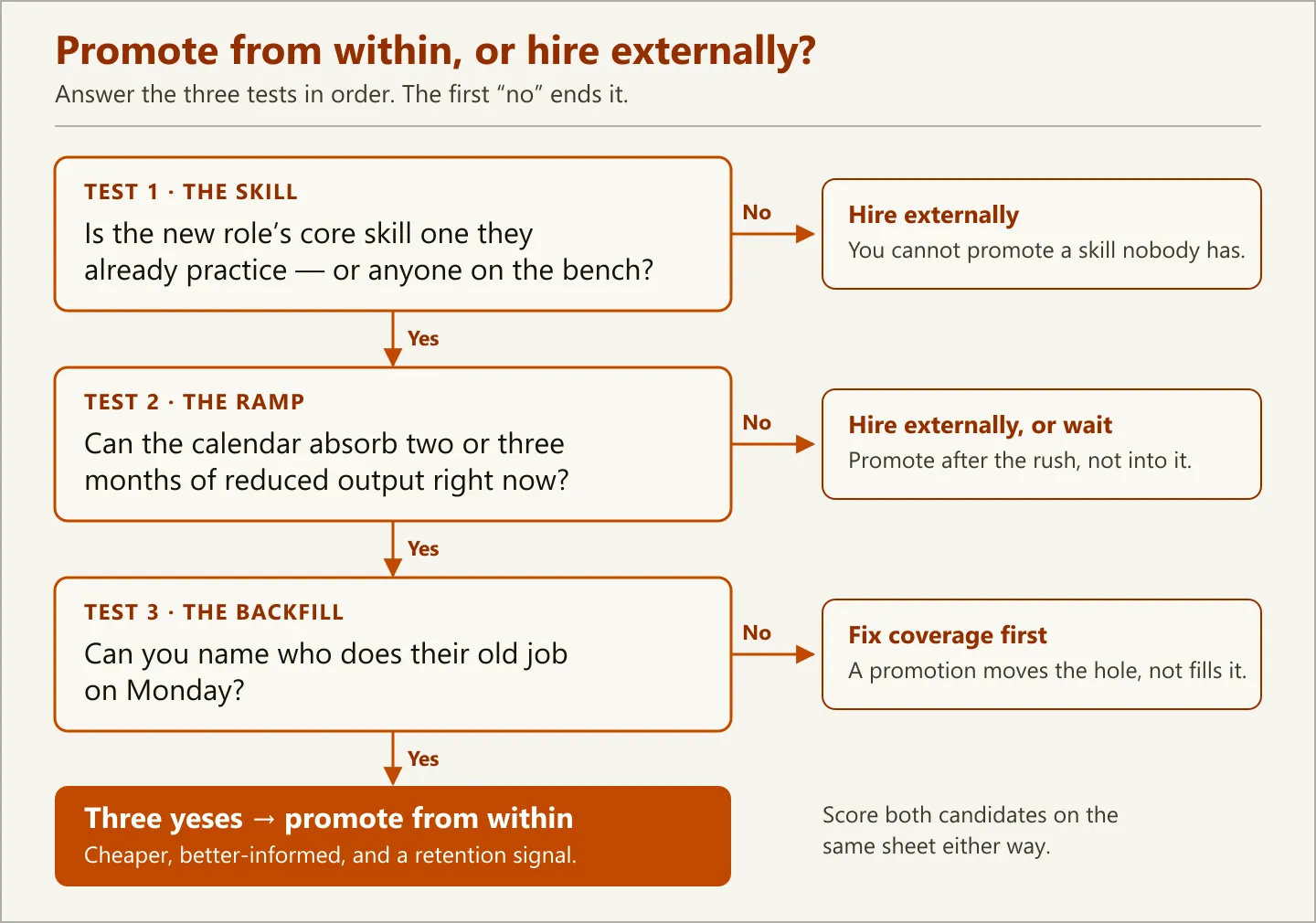
Three tests, answered in order. The first “no” ends the exercise — sometimes with an answer, sometimes with a “not yet.” Three yeses mean promote.
The Skill Test: Has Anyone on Your Bench Done This Work?
Write down the single activity that consumes most of the new role’s week. Not the title, the activity. If it is “produce accurately and fast” and your candidate produces accurately and fast, that is a match. If it is “decide what the team does each day and correct them when it is wrong,” ask whether you have ever seen this person do that — assign work, hold a standard, deliver bad news. Not “could they, probably.” Have you watched it.
If neither they nor anyone else on the bench has ever done the role’s core activity, lean external — you cannot promote a skill nobody has, and promoting into a gap is really an unfunded training program with a title attached.
The Ramp Test: Can Your Calendar Absorb the Dip?
Most promotions come with a dip. The person is doing less of what they were great at and more of what they are new at, so output falls before it rises. Two to three months is a reasonable planning assumption rather than a measured law — use your own record if you have one. In a slow season, that dip is affordable and the payoff is enormous. Eleven weeks before your biggest rush, it is a self-inflicted wound.
If the calendar cannot absorb the dip, you are not choosing internal versus external. You are choosing now versus later — and later is often the right answer, with the internal candidate promoted after the rush and an experienced temporary hire covering the season.
The Backfill Test: Who Does Their Old Job on Monday?
The answer has to be a name, not a hope. If you cannot name the person, fix coverage first, or you convert one open role into two.
Before you announce: set the pay
If you cannot pay the promoted person meaningfully more than they made in the old job, you are asking for extra responsibility at the old rate, and they will notice by the second month. Set the number before the conversation, not after — a pay band workbook turns “what feels fair” into a defensible range, which matters more when you have two people at the same level and only one gets the move. If you have never priced a role from scratch, what to pay your first employee walks through the loaded cost.
Which Way to Lean: Promote by Default, Hire Externally on Purpose
Promote from within by default, and treat external hiring as the exception you make on purpose — because the evidence on cost, performance, and retention genuinely favors internal moves. None of that evidence was gathered in businesses the size of yours, though; the mechanisms travel better than the magnitudes do. Here is the whole decision on one screen, including the cases the three tests do not reach:
| Your situation | Lean | Why |
|---|---|---|
| New role is a bigger version of work they already do | Internal | Skill match is real; ramp is short |
| New role is mostly managing other people’s output | Depends | Only if you have seen them hold a standard, not just hit one |
| Role needs a capability nobody in the shop has | External | You cannot promote a skill nobody has |
| Peak season starts in under 90 days | Wait | Promote after the rush, with temporary cover through it |
| Shop has never had anyone but you set the method | External | Buying a second way of working is the point |
| Internal candidate is the only candidate | External | At minimum, put one outside candidate in the pool to compare against |
| No one can backfill the old job | Neither yet | Fix coverage first, then decide |
The honest summary: promote for demonstrated capability, hire for missing capability, and never do either to avoid a conversation.
Score the Internal and the External Candidate on the Same Sheet
Both options look best in the last conversation you had about them. The fix is scoring the same criteria for both candidates, on paper, before anyone’s feelings are attached to an outcome.
A workable five-criterion version, weighted for a small shop. Score every criterion so that 5 always favors that candidate — comfortably affordable is a 5, and a large downside to not choosing them is a 5:
- Core-skill match (weight 3) — how much of the new role’s main activity have you actually seen them do?
- Ramp you can afford (weight 2) — how fast do they reach standalone in your calendar?
- Coverage after the move (weight 2) — is the old job covered without you doing it?
- Cost you can sustain (weight 2) — the loaded cost, not just the wage.
- Downside if you choose the other way (weight 1) — who walks, and what breaks?
Score each 1 to 5, multiply by the weight, total both columns. The weights sum to 10, so each total lands between 10 and 50. The number is not the decision — the gap is. A gap of more than about a fifth of the winning total means you already knew. A gap inside a few points means the two candidates are genuinely close, and you should decide on the criterion you weighted highest, not on whoever you spoke to most recently.
For the internal side, the evidence you are scoring should already exist rather than being reconstructed from memory: a skills matrix shows who can do which task at which level, which is most of Criterion 1 answered before you start. For the external side, run a real process rather than a vibe check — a structured interview scorecard and question bank makes candidates comparable to each other and, importantly, to your internal candidate, who should be scored on the same sheet. If you have never run one, the 20-minute structured interview scorecard covers the build.
These live in a file you keep, not a subscription you rent — which matters here, because the value of this record is entirely in how many years of it you have. A skills matrix you have maintained for three years answers the promotion question almost by itself.
Four Mistakes That Make the Promote-or-Hire Decision Worse
-
Promoting as a reward. A promotion is a job, not a bonus. If you want to recognize excellent work, pay for excellent work — raises, bonuses, and senior-level titles that do not add supervisory duties all exist for this. Handing someone a management role as a thank-you is how you lose a great maker and gain a struggling manager. If you are unsure which you are doing, plotting the bench on a 9-box talent grid separates the two things owners constantly conflate: current performance and capacity for a bigger job.
-
Not writing the job first. If the role only exists as a feeling (“I need someone to take things off my plate”), no candidate can match it and no scorecard can score it. Write the ten activities that fill the week before you evaluate anyone. A 30-60-90 day onboarding plan is worth building for an internal promotion too — the assumption that a promoted insider needs no onboarding is exactly why so many of them flounder in a role they have never held.
-
Assuming the title changes the pay rules. Calling someone a manager does not automatically make them exempt from overtime. The Department of Labor is explicit that job titles do not determine exempt status (opens in new tab) — the actual duties and salary have to meet the tests. Creating a “lead” title and stopping overtime does not end the obligation, because the obligation follows the duties, not the title.
-
Not telling the people you did not pick. In a small shop, silence is an answer, and the answer everyone hears is “there is no path here.” A five-minute conversation naming what would make them ready next time converts a disappointment into a development plan. Skip it and the runner-up starts looking — which means your internal promotion can quietly cost you an external hire anyway.
The Takeaway: When to Promote and When to Hire Out
Promote from within when the job is a bigger version of what someone already does well, you can afford the ramp, and you know who covers their old work. Hire externally when the job needs a capability your shop has never had, when the season cannot absorb a learning curve, or when your internal candidate is the candidate only because nobody else was available — that is a default, not a decision.
And write it down either way. The reason this decision feels so hard the first time is that you are reconstructing two years of evidence from memory under time pressure. The second time it is much easier — but only if the first time left a record.