The three phases
The plan rests on one idea: a new hire's first quarter has a natural arc — learn, then contribute, then own — and each phase has a different job. Rushing a phase, or skipping the setup at the start, is what makes month three go wrong.
- Days 1–30 — Learn & set up. Remove friction and build a shared picture. Accounts and equipment ready on day one, the team and key stakeholders met, required training done, and a written, agreed understanding of what the role is for and what good looks like. The goal isn't output yet; it's a hire who is fully set up and oriented.
- Days 31–60 — Contribute & connect. The turn from learning to doing. The new hire owns a first real piece of work end-to-end, gets fluent in the day-to-day tools and processes, builds the working relationships the role depends on, and exchanges honest, two-way feedback at the 60-day mark.
- Days 61–90 — Own & grow. Confirm the hire is delivering at the level the role needs and owning an area without close supervision, then set the direction for what comes next with a development plan and a clear 90-day review. Onboarding hands off to the person's ongoing goals — it doesn't end at a cliff.
What makes a milestone, not a wish
A plan is only as good as its milestones, and a vague one — “get settled in” — can't be checked, owned, or talked about honestly. Three things turn a wish into a milestone:
- An owner. One name responsible for it happening. Some milestones sit with the new hire, some with the manager, some with IT or a buddy — but each has exactly one owner. A milestone everyone owns is one nobody owns.
- A definition of done. What you'd point at to say it's finished. “Set up” is a hope; “can log in to every tool with the right permissions, no requests open” is a definition you can check.
- A target day. “By day 15” beats “in the first month” — it makes the plan a schedule, and it surfaces the milestones that quietly have to happen in week one.
Who writes it — and who it's for
A 30-60-90 plan is usually written by the hiring manager, ideally with the new hire in their first week. It's easy to confuse with the version a candidate sometimes writes to win a job — a “here's what I'd do in my first 90 days” pitch. That's a different document. As an onboarding tool, the plan is the manager's: it's how you make sure a good hire isn't lost to a slow, disorganized start that had nothing to do with them.
There is a third case worth naming, because it is the one nobody writes a plan for: someone promoted into managing the team they already work in. They don't need onboarding into the work — they know it — and the 30-60-90 grid still helps, but only once somebody has told them what belongs in each phase. That is what The New Manager's First 90 Days Playbook is for: the same ninety days as a method rather than a template, week by week, including the arithmetic on whether the job fits in the week at all. The week-one questions from it are free and ungated as the First-Week Listening Questions guide, and there's a walkthrough of what to do in your first week as a manager.
Running the plan: check-ins
A plan you write once and never revisit is a document; a plan you review on a rhythm is a management tool. Hold a week-1 check-in to catch anything broken early, then the 30-, 60-, and 90-day reviews that anchor the three phases, with shorter touch-points in between. Keep the feedback two-way — a new hire's fresh eyes are the best signal you'll get about a broken process, but only in the first few weeks, before it starts to look normal. If you hold only one review well, make it the 30-day: a problem found on day thirty is a conversation; the same problem found on day eighty is a crisis.
Move the dates to fit the role
Thirty, sixty, and ninety are a rhythm, not a rule. A complex technical role may need longer to reach real ownership; a role much like one the person has done before may move faster. Keep the three-phase shape — learn, contribute, own — and adjust the milestones and target days to the job in front of you.
Common mistakes
- All setup, no contribution. A plan that's ten access-and-training tasks and nothing about real work leaves the hire busy but not landing. Balance setup, people, expectations, and contribution across the phases.
- Writing it and filing it. The plan only works if you both look at it. Walk the hire through it in week one, and update the statuses after each check-in.
- Treating it as a probation scorecard. A 30-60-90 plan is a shared plan to help someone succeed, not a stack of evidence for a decision. Keep it that way.
- A plan of thirty items. A strong plan is a handful of real milestones per phase. A plan nobody can hold in their head is a plan nobody reads.
Related templates and concepts
A 30-60-90 plan is the onboarding end of the hiring funnel that begins with a job applicant tracker. To plan one new hire for free, the 30-60-90 starter plan is an ungated taste of the method, and the 24-goal library is a second free download. Bought on its own, the full 30-60-90 Onboarding Plan Workbook tracks all your new starters on one board with a progress dashboard. The paid Hire & Onboard Kit bundles that workbook with an applicant tracker and an interview scorecard, and adds a Command Center that scores your slate and drafts a hire's six goals from their two lowest competencies — all inside that one workbook, since the four files are not linked to each other. See the templates for HR & team leads hub for the rest of the toolset.
Templates that implement this
Templates that build a 30-60-90 plan
3 templates
A per-hire plan with an owner, a definition of done, and a target day for every milestone — plus a board and a dashboard that track all your new starters at once.
- $19.95 Spreadsheet
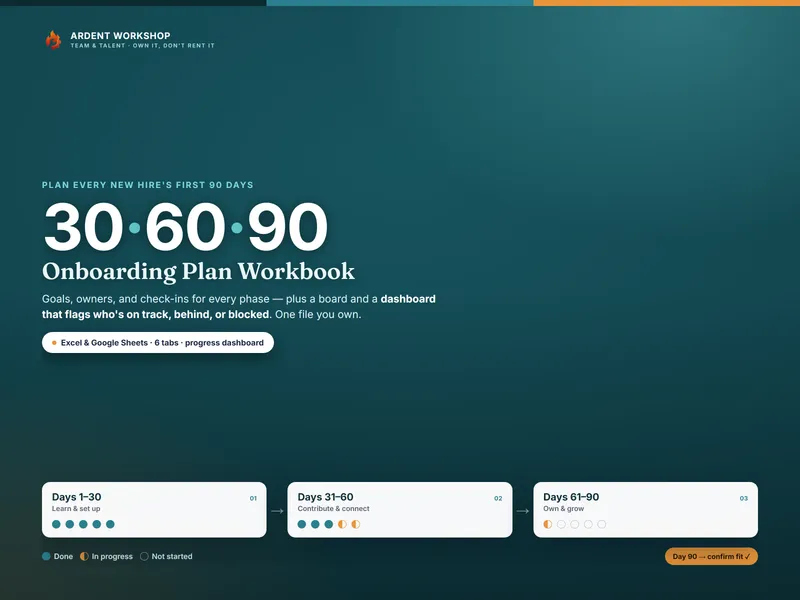
30-60-90 Onboarding Plan Workbook — New Hire Onboarding Tracker for Excel & Google Sheets
A 30-60-90 onboarding plan for Excel & Google Sheets — plan and track every new hire's first 90 days with goals, check-ins, and a progress dashboard.
Team & TalentView details - $16.95 PDF
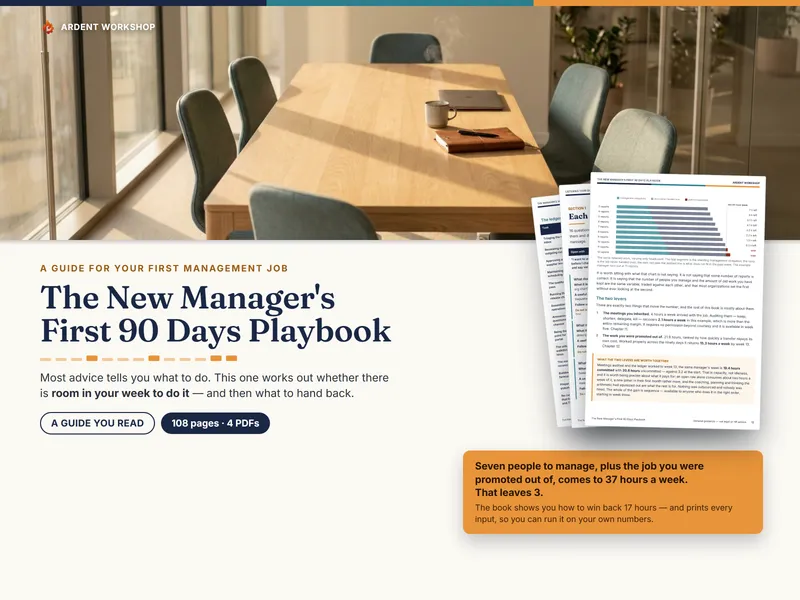
The New Manager's First 90 Days Playbook — What to Do Each Week, What to Ask, and How to Make the Job Fit the Week You Actually Have
108 pages across 4 PDFs for your first 90 days as a new manager: your week costed, 62 listening-tour questions, and a delegation ledger ranked by payback.
Team & TalentView details - $14.95 Spreadsheet

Job Applicant Tracker - Excel & Google Sheets
Job applicant tracker for Excel & Google Sheets: log openings, candidates, and interviews, score on a weighted scorecard, and see a live hiring dashboard.
Team & TalentView details