The one rule
Describe the work, not the person. Everything else in this entry is a consequence of that sentence. A trait — sloppy, difficult, unmotivated, detail-oriented — is an inference you drew from something you saw. Behavior-based feedback goes back to the thing you actually saw.
Why the trait version fails, in four ways
- It can't be checked. Either the count is right or it isn't. A verdict is neither — which sounds like an advantage right up until somebody disputes it.
- It can't be acted on. Nobody can stop being sloppy on instruction. Anybody can add a check to one field on one form.
- It doesn't survive the year. A stranger reading the file next spring learns something from the count and nothing at all from the adjective.
- It puts the person's identity on the table. Someone can accept that their work had a fault. Being told what they are gets defended — and the rest of the conversation is lost.
The four kinds of evidence that make it work
Behavior-based feedback is only as good as the fact underneath it. In practice there are four, and each usually already exists in a record somebody keeps anyway:
- A count. “214 delivered, 6 returned”; “11 of 12 committed dates”. From the job or ticket system, the delivery log, your own inbox.
- A date. “Flagged on March 14”; “known here on the 3rd, told on the 9th”. From the calendar, the message history, your one-on-one notes.
- A named artifact. The Monday project note, the hardware schedule, the cut list. Name it in writing so it can be found later.
- A downstream consequence. “The electricians were rebooked”; “the buyer told us first”. Ask the person downstream — it's a two-minute question and it makes the feedback. Ask about the work, not the person, and don't share the rating you're weighing.
The words that mean you've stopped describing work
These are the tells. Each one rates a personality, a temperament, or a resemblance to whoever is already senior — and each has a behavioral version underneath it that says more and risks less.
- Attitude, professionalism — rates a personality, filtered through whether you enjoy the person's company. Write the specific act and its effect on someone else's work.
- Culture fit — rates resemblance to the people already here, which is where bias can hide unexamined. If the concern is real there is a behavior underneath it; write that, or drop it.
- Confident, assertive, quiet — rates temperament, often just extroversion. Rate whether the information traveled instead, and offer writing as an equal route.
- Potential — rates how much this person reminds you of somebody senior. Name the capability, the evidence so far, and the assignment that would test it.
- Hard-working, dedicated — rates hours and visibility, which rewards whoever answers email at midnight. Rate the output and the standard it met.
- Difficult, abrasive, emotional — judgments that studies of review language consistently find are applied unevenly across sexes and cultures. State what was said or done, to whom, and its specific effect.
A five-second test
Put the sentence in the mouth of the employee's own manager next year, describing somebody they have never met. If it still tells them something — a count, a date, an artifact, a consequence — keep it. If it evaporates, it was never carrying anything.
Behavior-based, not outcome-based
One important distinction: rating the outcome is not the same as rating the behavior. A project that went badly is not proof of poor judgment, and one that went well is not proof of good judgment. Rate what was knowable at the time and the steps taken with it. Rating outcomes teaches a team to avoid risk and to claim credit for luck.
The one legitimate exception
There is a fair place for a sentence about someone's manner: when the manner itself is causing a specific, observable effect on other people's work, and you can state what was said or done. That's a behavioral rating, not a personality one — and the giveaway that you've got it right is that you could read the sentence aloud to the person and stand behind every word. If you couldn't, don't write it.
Where the wording has to change with the rating
Behavior-based feedback isn't one register. At a strong rating the sentence has to show the standard moved — something other people now reuse, a problem that stopped recurring, a capability somebody else gained. At a shortfall it has to carry a count, the date the concern was first raised, the one specific change wanted, and the support being provided. If a paragraph would read fine one rating up or one rating down, it isn't doing its job.
Two things that are not evidence
- What other people said, unattributed. “There has been some feedback that…” is unanswerable, and it's the sentence employees most resent. If a concern was reported to you, raise it with the person at the time, then write it with the date it was reported and the date you raised it. A review should never be the first time someone hears a complaint about themselves.
- Your memory of the year. What memory returns is the last six weeks plus anything dramatic — that's recency bias, and it's one of the best-documented distortions in performance ratings. Four lines per person after each one-on-one turns review week into a writing job instead of an archaeology job.
Where this stops
This is general management guidance on how to word feedback — not legal advice, and not HR advice for your organization. What a performance-improvement plan must contain, how much notice a written warning requires, and what documentation supports a dismissal are set by national, state and sometimes local law, by your own handbook and contracts, and by any collective agreement you are party to. Take proper advice before you write any feedback intended to support dismissal, demotion, a formal warning or a pay decision, or that touches a protected characteristic, a disability or accommodation request, leave, or a complaint an employee has raised.
Related templates and concepts
Behavior-based feedback is the input to calibration, and it's what a competency matrix and a 9-box grid are only as good as. To try the method for free, the 10 free review rewrites (PDF, no signup) are ungated; the full Performance-Review Phrasing & Feedback Wording Bank prints the evidence under each of its 189 competency phrases, and adds 54 more for goals, self-review, calibration and promotion. The reason this is hard in a first year of managing is rarely vocabulary - it is that nobody kept a record to describe, which is what the New Manager's Starter Kit exists to fix: it carries the phrasing bank alongside a one-on-one log whose notes get tagged to the same competencies the phrases are organized by. See how the bank compares to an AI review generator, read how to write a review that holds up, or browse the templates for managers hub.
Templates that implement this
Templates that make feedback behavior-based
3 templates
Wording banks and review workbooks built so that every sentence names the count, the date, or the artifact behind it — not an adjective.
- $19.95 Mix

Performance-Review Phrasing & Feedback Wording Bank — 189 Review Phrases by Competency and Rating Level, Plus 54 for Goals, Self-Review and Calibration, Each With the Evidence It Requires
189 performance review phrases by competency and rating level, plus 54 more for goals and calibration — each naming the evidence it requires.
Team & TalentView details - $24.95 Spreadsheet
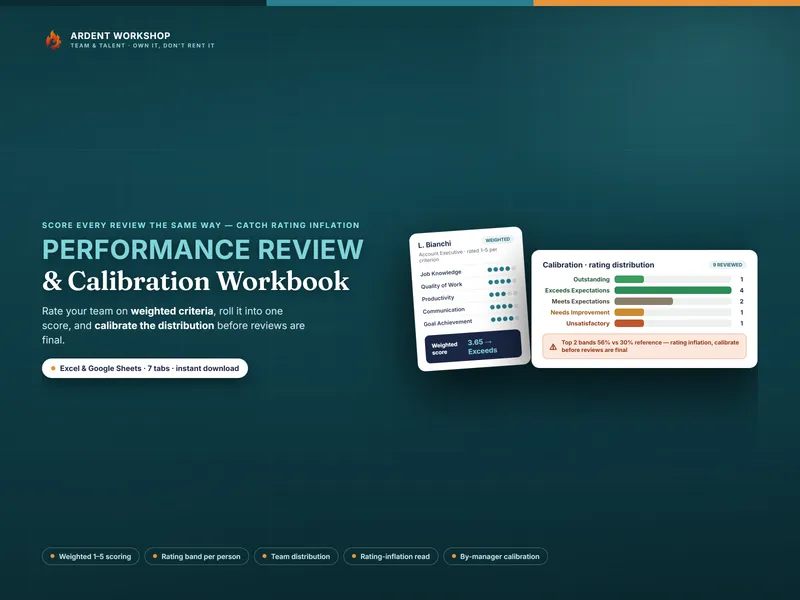
Performance Review & Calibration Workbook — Weighted Scoring & Rating Distribution (Excel & Sheets)
A weighted performance review template for Excel & Google Sheets — score your team on shared criteria and calibrate the rating distribution.
Team & TalentView details - $19.95 Spreadsheet
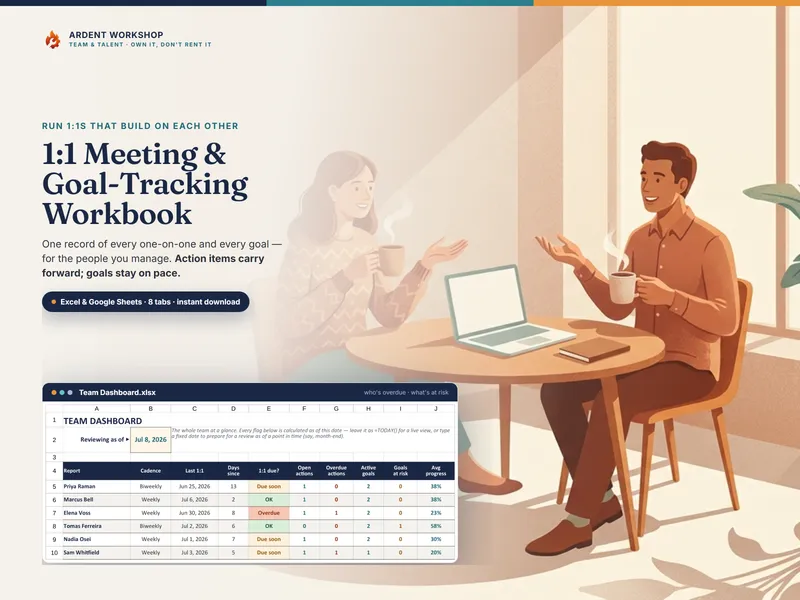
1:1 Meeting & Goal-Tracking Workbook — One-on-One & Goal Tracker for Excel & Google Sheets
A 1:1 meeting & goal-tracking workbook for Excel & Google Sheets — log every one-on-one, carry action items forward, and track goal pace across your team.
Team & TalentView details