The two get confused because they look alike on paper — a document, a manager, dated goals, a review — but they answer different questions. An IDP asks where someone is headed and what closes the gap to get there. A PIP asks whether someone is meeting the standard for the role they already have, right now. Reaching for the wrong one, in either direction, tends to land badly: a growth plan that quietly turns corrective reads as a trap, and a corrective plan dressed up as development reads as avoidance.
IDP vs PIP: side by side
Every cell below describes what a well-run version of each plan generally contains — not a requirement. Whether either applies to you, and what it must contain, is a question about your own employer's policy.
| What matters | IDP | PIP |
|---|---|---|
| What it is | A plan aimed at growth toward a future role | A formal, corrective plan addressing a current shortfall |
| Orientation | Growth — where the person is headed | Correction — where performance currently falls short |
| Who owns it | Usually the employee, with the manager's support | The manager, following the employer's policy |
| Timeframe | Open-ended, reviewed on a set cadence | Time-bound, often 30–90 days |
| Typical trigger | A career conversation, a target role, a competency gap | A sustained performance shortfall, usually after informal steps already tried |
| What it documents | Competency gaps, development goals, a learning plan | The specific shortfall, a measurable standard, the support offered |
| Stated consequence | None — it's a plan for growth, not a corrective process | Yes, stated in policy if the standard isn't met |
| Check-ins | Periodic — quarterly is common | Scheduled, ending in a review inside the plan's period |
Which one does your situation call for?
Your own policy decides this, and it outranks anything below. Where it leaves you room, three questions usually settle it:
- Is this about where they're headed, or how they're doing right now? If you're talking about a next role, a stretch skill, or a promotion path, that's an IDP question. If you're talking about whether today's standard is being met, that's a PIP question.
- Is there a specific, current shortfall you could state as a measurable standard? If yes, and it's already been raised informally without changing, a PIP fits. If you can't state a current shortfall — the person is meeting the bar, and you both want to plan where they go next — an IDP fits, not a plan dressed up to look corrective.
- Does it need a consequence attached? An IDP that quietly turns into a performance test isn't an IDP anymore. If you find yourself wanting to attach a consequence to a development goal, that's the sign to open a PIP instead of stretching a growth plan to do a corrective plan's job.
What is an individual development plan (IDP)?
An individual development plan maps the gap between where someone is now and the role they're aiming for next — current level against target level, competency by competency — then turns that gap into development goals, a typed learning plan, and dated check-ins. It's a manager-and-employee document rather than a corrective one: no consequence is attached to a goal that slips, because the plan's job is to give the growth conversation a place to live between reviews, not to test whether someone is meeting today's standard. Read the full mechanics on what an individual development plan is.
What is a performance improvement plan (PIP)?
A performance improvement plan is a formal, documented and time-bound plan that sets out a specific and measurable performance standard, the support the employer will provide, the review points inside the period, and the consequence stated in policy if the standard isn't met. It's a different kind of document from an IDP in a specific way: it exists because an informal conversation about a current shortfall didn't resolve it, not because someone is planning where to go next. Read the full mechanics on what a performance improvement plan is, including what has to be true before one starts and where it sits next to progressive discipline.
Can someone be on an IDP and a PIP at the same time?
There's no rule against it, and the two are different enough documents that they can coexist: a PIP addressing a specific, current shortfall in the role someone already has, and a separate IDP describing where they're headed once that's resolved. In practice, opening a forward-looking growth conversation with someone who is actively on a corrective plan can send a mixed message — it can read as if the shortfall isn't being taken seriously, or as if the growth conversation is a consolation prize. Many managers pause the IDP conversation, or keep it deliberately narrow, until the PIP closes one way or the other. Whether to run both at once, and how to frame it if you do, is a question for your own HR team and your own policy.
How an IDP's learning plan is built: the 70-20-10 model
The learning plan inside a well-built IDP is commonly organized around the 70-20-10 model: roughly 70% challenging on-the-job experience, 20% learning from others — feedback, coaching, mentoring — and 10% formal education such as courses and reading. It comes from research done in the 1980s at the Center for Creative Leadership on how successful executives said they had actually learned (reported by Morgan McCall, Michael Lombardo and Ann Morrison in The Lessons of Experience, 1988), and it was popularized in Michael Lombardo and Robert Eichinger's The Career Architect Development Planner (1996). Worth treating as a heuristic rather than a rule: it's drawn from executives' self-reports rather than a measured study, and critics note it lacks rigorous empirical support — a planning guide for spotting a course-heavy plan, not a quota every learning plan has to hit exactly. See what the 70-20-10 model is for the full breakdown.
Related planning frameworks: 30-60-90 plans and skill-level matrices
Two other plans get mentioned in the same breath as an IDP, and both are a different shape. A 30-60-90 plan is a fixed, roughly 90-day onboarding ramp for someone new to a role — not a recurring development cycle, and it ends once the new hire is settled rather than repeating on a cadence. An ILUO matrix is a four-level skills-coverage board — In training, Limited, Unsupervised, Operator — for rating how far someone is trained on a specific task across a whole team. It's related to the competency library inside an IDP in spirit, but it's built to show team-wide task coverage and key-person risk, not one person's path to their next role. If you need to see gaps across many people before you start writing individual plans, the Skills Matrix Template is the tool for that step.
Which template fits each plan
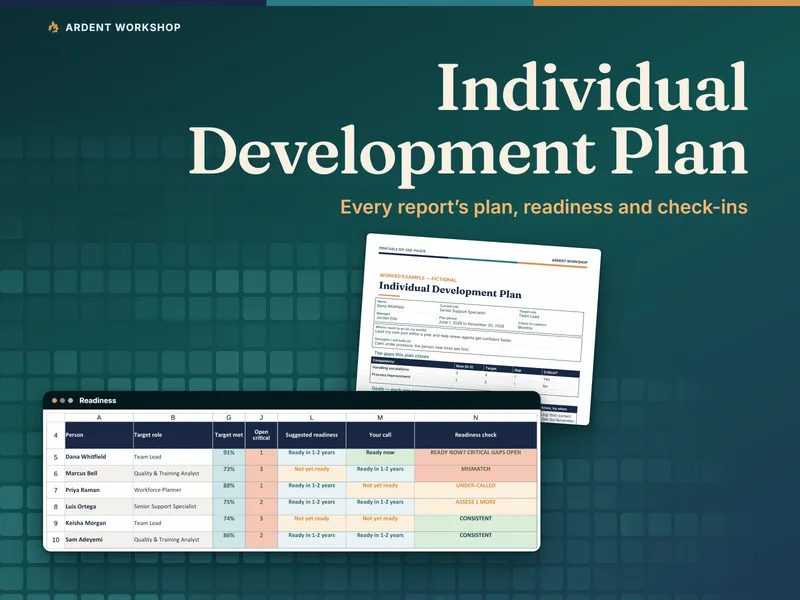
The Individual Development Plan (IDP) Workbook runs a manager's whole team of direct reports from one file: a competency gap assessment for each person's next role, development goals tied to the gap each one closes, a 70-20-10 learning plan whose actual mix is computed and flagged when it drifts course-heavy, a team development budget, check-ins due on each person's own cadence with overdue reviews and stalled goals flagged, and a readiness rating checked against the critical gaps still open, rolled up into a team view. There's also a free Individual Development Plan Template (free, no signup) — a one-person IDP workbook and printable one-pager, pre-filled for a worked-example employee with a 70-20-10 learning plan, to see the shape before you build a whole team's worth.
For the corrective side, the PIP & Corrective-Action Documentation Kit writes and dates the record — a warning register, an evidence log, a plan builder that won't mark a plan ready to issue until it passes its own checks, and eight corrective-action documents. And because the check-ins on both plans ride the same calendar as your one-on-ones, the 1:1 Meeting & Goal-Tracking Workbook keeps a running record of the meetings either plan gets discussed in. See templates for managers for the rest of the shelf.
Where documentation ends and HR or legal advice begins
Nothing above tells you whether a specific PIP is fair, whether an employee's development goals should factor into a pay or promotion decision, or what either plan is legally required to contain. Those questions are answered by the law that applies where you operate and by your own employer's policy, and both vary sharply between countries and between states. A template gives either conversation a place to live, dated, while the specifics are fresh — the judgment about what a given situation calls for belongs to your own HR team and, where a dismissal is on the table, to a qualified employment lawyer.
Frequently asked questions
- What's the actual difference between an IDP and a PIP?
- They differ in what they're for, not just in name: an IDP is oriented toward growth and a PIP is oriented toward correction, and that difference runs through everything else about them. An IDP is a plan an employee usually owns, with their manager's support, aimed at closing the gap between where they are now and the role they want next — it's open-ended, reviewed on a set cadence such as quarterly or annually, and carries no formal consequence if a goal slips. A PIP is a formal, time-bound plan the manager owns, addressing a specific and current performance shortfall, with a measurable standard, the support the employer is providing, scheduled check-ins, and a consequence stated in policy if the standard isn't met by the end of the period. Put simply: an IDP asks 'where is this person headed, and what do they need to get there,' and a PIP asks 'is this person meeting the standard for the role they're already in, right now.'
- How long does an IDP last, compared to a PIP?
- An IDP has no fixed end date — it's meant to be a living document a manager and employee revisit on a set cadence, with goals closing and new ones starting as the person's target role or priorities change. A PIP is deliberately time-bound: 30, 60 or 90 days are often used, though the actual length, and whether your organization sets one at all, is a matter of your own policy rather than a universal rule. That difference in shape is itself a signal — a plan with no end date is doing a different job than one with a review date and a stated consequence attached to it.
- Can someone be on an IDP and a PIP at the same time?
- They can — nothing makes the two mutually exclusive — but running both at once risks a mixed message, so many managers keep the IDP narrow or pause it until the PIP closes. How to handle it is a question for your own HR team and policy; the section above covers the tradeoff.