This isn't really template-versus-platform. Running one-on-ones is one thing performance-management software happens to include. The mistake is buying the whole per-seat platform when the part you'll actually use — keeping a record of your meetings, actions, and goals — is something you can own outright.
What each one is for
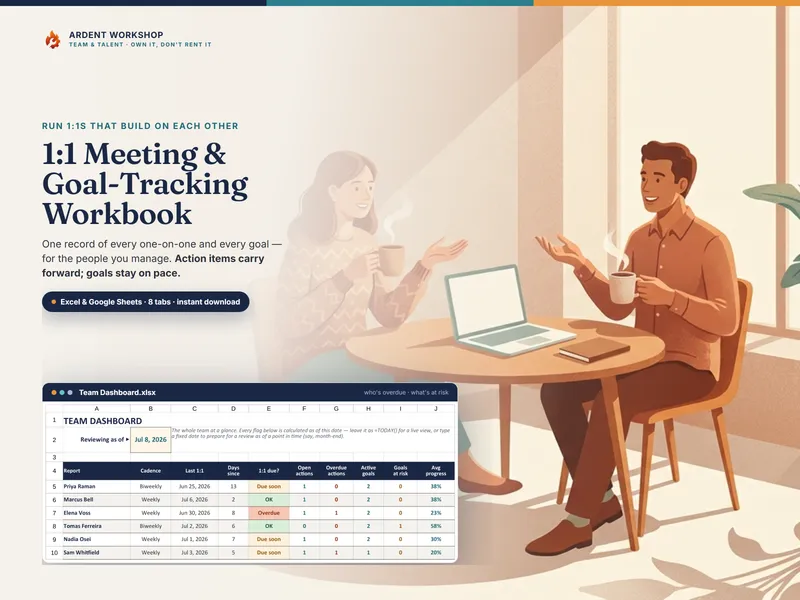
- A 1:1 template is a record-keeping and follow-through tool. Log each one-on-one — agenda, wins, challenges, a quick mood check-in — capture every action item with an owner and a due date so it carries forward until it's closed, and track whether each development goal is on pace against its timeline. A dashboard flags who's overdue for their cadence. It answers “where did we leave off, and what's slipping?”
- Performance-management software is a platform. Continuous feedback and check-ins, goal and OKR tracking, 360-degree reviews, an employee database and HRIS integrations, reminders, approval workflows, and analytics — with 1:1s one module inside it. It answers “run our entire performance process,” year-round, at a price to match.
When a 1:1 template is exactly right
- You want a running record of your one-on-ones, not a whole HR system.
- You're a team lead, a new manager, or a founder — not a large People team.
- You manage a handful of people directly and meet them on a set cadence.
- You'd rather own the file than rent a platform per employee.
- You want your team's notes in your own hands, offline.
At this stage a workbook beats a platform outright for the keep-the-thread job. The free 1:1 meeting starter log is a no-signup, single-report log to try the format, and the templates for HR & team leads hub collects the rest. If one-on-ones are new because the job is, the New Manager's Starter Kit carries the full workbook with a dated first-ninety-days plan, goal setting and review phrasing, and there is a whole shelf for first-time managers.
The signals you may want a full platform
- You run continuous performance management org-wide. Company-wide feedback cycles and goal cascades across many teams, with People-team oversight — not one manager's own cadence.
- You need 360-degree reviews. Structured feedback gathered from peers, reports, and multiple managers, collected and collated automatically.
- You need live HRIS data and integrations. Org charts, headcount, and role data flowing in, and goal or rating data flowing out to other systems.
- You need automated reminders and workflows at scale. Nudges, approvals, and roll-ups across hundreds of people that no single manager could keep by hand.
Even then, the one-on-one itself still comes down to a conversation, the actions you agreed, and whether goals are moving — the platform just hosts and automates it across many teams. The workbook is the habit; the platform is the plumbing.
What software genuinely does better
To be fair to the platforms: a good performance-management system really does more than a spreadsheet. Continuous feedback across the year, 360-degree review collection, live integration with your HRIS, automated reminders and approval routing, and org-wide reporting are real capabilities a workbook doesn't try to replicate. The 1:1 workbook has no 360s, no HRIS integration, and no automation beyond its own formulas — by design. If those platform features are things you'll actually use every month, the subscription can be worth it. The question is honest use, not feature count.
Side by side
| What matters | 1:1 template (owned workbook) | Performance-management software |
|---|---|---|
| What it is | A focused 1:1 & goal-tracking tool | A broad performance-process platform |
| Cost | One-time, low — you own the file | Ongoing subscription, often per employee |
| 1:1 log & action carry-forward | The whole point — actions flagged until closed | Included, one feature among many |
| Goal tracking | Progress bar and an on-pace check per goal | Built-in goal and OKR modules |
| Continuous feedback & 360s | Not its job — a manager's own record | Full — year-round check-ins and 360s |
| HRIS / integrations | You enter the people you manage | Live employee data and integrations |
| Setup | Open it and log a meeting — minutes | Implementation, config, rollout |
| Data ownership | The file is yours, offline | Hosted in the vendor's platform |
| Best for | A team lead or founder managing a team directly | A People team running continuous cycles at scale |
The honest middle ground
Plenty of organizations grow into a performance platform eventually, and that's the right move when continuous performance management across a large workforce becomes the job. The mistake is the reverse: buying a per-seat suite to keep a record of your one-on-ones, when an owned workbook does that part better and costs once.
Keep the thread either way
Whichever stack you end up on, the one-on-one itself comes down to keeping a thread across meetings, closing the actions, and checking that goals are on pace. The 1:1 Meeting & Goal-Tracking Workbook logs every meeting, carries action items forward until they're closed, tracks whether each goal is on pace, and reads a team dashboard that flags who you're overdue to meet with — one owned file for Excel, Google Sheets, and LibreOffice. Own the record; add a platform only when running performance management at scale genuinely becomes the job.
Frequently asked questions
- What's the difference between a 1:1 template and performance-management software?
- A 1:1 template is the artifact: an owned workbook where a manager logs each one-on-one, carries action items forward until they're closed, and tracks whether development goals are on pace — with a dashboard flagging who's overdue for a meeting. Performance-management software is a platform that folds 1:1s into a broader system — continuous feedback, 360-degree reviews, an employee database and HRIS integrations, and reporting — usually sold as a per-seat subscription. One is a focused tool you own; the other is a broad system you rent. For a manager keeping a running record of their team's meetings and goals, the workbook does that job without the platform.
- Can a spreadsheet replace performance-management software?
- For the job most managers actually do — keeping a thread across one-on-ones, closing action items, and tracking development goals — an owned workbook does it completely. What a spreadsheet doesn't do is collect 360-degree feedback, pull live employee data from an HRIS, run org-wide continuous-feedback cycles, or automate reminders and approval workflows across hundreds of people. If you're a People team running those processes at scale, software earns its keep; if you're a team lead, a new manager, or a founder managing a handful of people directly, the workbook is the right size of tool.
- How much does a 1:1 template cost vs performance-management software?
- An owned 1:1 & goal-tracking workbook is a single low one-time cost — you keep the file, edit it offline, and pay nothing monthly. Performance-management software is typically a recurring per-seat or per-employee subscription, often with an annual contract and setup. The subscription pays off when you genuinely use the full platform year-round; paying per seat just to keep a record of your meetings and goals is renting far more system than the job needs.
- Are one-on-one notes private if they're in a spreadsheet?
- A 1:1 record holds candid, personal notes about named people, so treat it that way whether it lives in a spreadsheet or a vendor's cloud — keep it confidential to those who genuinely need it, store it privately, and handle it the way your privacy policy and local employment law require. A spreadsheet you own is as confidential as the file controls you put around it, and the notes never leave your control. A note or a missed goal is an input to a conversation and to your own judgment — not, on its own, a verdict about pay, promotion, or any formal process.