Framework vs. matrix — two halves of one tool
The two words travel together and it helps to keep them apart. A competency framework is the standard: the abilities a role requires and the level it's expected to reach on each. A competency matrix is what you get when you score real people against that framework — a grid of who sits where. You build the framework once, then use the matrix every review cycle.
How it differs from a skills matrix
A skills matrix and a competency matrix look alike — people down one side, a grid of ratings — but they answer different questions:
- A skills matrix asks “can they do the task?” It maps concrete, often task- or tool-specific abilities: can this person run this machine, use this system, complete this procedure.
- A competency matrix asks “how do they work, and how far from what the role needs?” It captures the broader, behavioral model — communication, problem-solving, leadership — that sits behind a promotion case, a development plan, or a career conversation.
Most teams eventually want both: the skills matrix for hands-on coverage, the competency matrix for development and progression.
The proficiency scale
Every competency is rated on one shared ruler, so a “3” on Communication means the same distance up the ladder as a “3” on Quality. A common five-level scale runs:
- 1 — Awareness. Understands the basics; applies with close guidance.
- 2 — Developing. Handles routine situations with occasional support.
- 3 — Proficient. Independent and reliable — the everyday working standard.
- 4 — Advanced. Handles the complex and ambiguous; a go-to reference for others.
- 5 — Expert. Sets direction, coaches others, and is recognized beyond the team.
Proficient is the anchor, not the ceiling — not every competency needs a 5 at every role. What level a role should reach on each is set in the framework.
Competencies, grouped
A workable framework keeps to the dozen-or-so competencies that genuinely differentiate performance, usually sorted into three families:
- Core — how everyone is expected to work: communication, collaboration, accountability, adaptability, customer focus.
- Functional — how the work gets done well: technical expertise, quality, planning and delivery, problem-solving, use of tools and process.
- Leadership — how people lead others and the work: people leadership, coaching, strategic thinking, decision-making, influence and change.
Targets by role — the framework
The step that turns a list of competencies into a framework is deciding what level each role should reach on each one. Read across a row for a role's whole target profile; read down a column to see how a competency deepens with seniority. The most valuable part is usually the leadership step — the jump that becomes explicit at the first lead or manager role, naming what actually changes at promotion.
Scoring the team and reading the gaps
- Rate the pattern, not the peak. Level people at what they do reliably, on the evidence — not their best day or their job title.
- Measure each person against their own role. A strong associate and a stretched manager are judged against different bars, so the gaps are fair.
- A spiky profile is normal. Almost nobody meets every target; the gaps on a strong performer are their growth edges.
- Read the team, not just the people. A competency where the whole team sits below the bar — often a leadership one in a group of strong individual contributors — is a shared-program problem, not fifteen separate conversations.
Calibrate, or the numbers drift
A matrix one manager fills in alone is a hypothesis. It becomes fair only when a couple of managers rate against the same definitions and talk through where they differ, so a “3” means the same thing across teams. The “what good looks like” line behind each competency is what keeps that honest.
Common mistakes
- Treating a level as a verdict. It's a prompt for a development conversation, never a sole basis for a pay, promotion, or exit decision.
- Too many competencies. A forty-row framework nobody fills in beats no framework — at nothing. Keep the list tight.
- One bar for everyone. Without per-role targets, seniors look under-rated and juniors over-rated. The target belongs to the role.
- Scoring once and never revisiting. A framework is only true on the day it was scored; the movement between cycles is the point.
Related templates and concepts
A competency matrix pairs naturally with a skills matrix (competencies judge how someone works; skills map what they can do), a 9-box grid (performance × potential for talent reviews), and a gap analysis. To draft one role for free, the competency framework starter is an ungated taste; the full Competency Matrix / Framework Builder builds every role and scores your whole team. See how it compares to an LMS, or browse the templates for HR & team leads hub.
Templates that implement this
Templates that build a competency matrix
2 templates
Set the target level each role should reach on every competency, score your team against it, and see the gaps computed for you — one owned workbook.
- $24.95 Spreadsheet
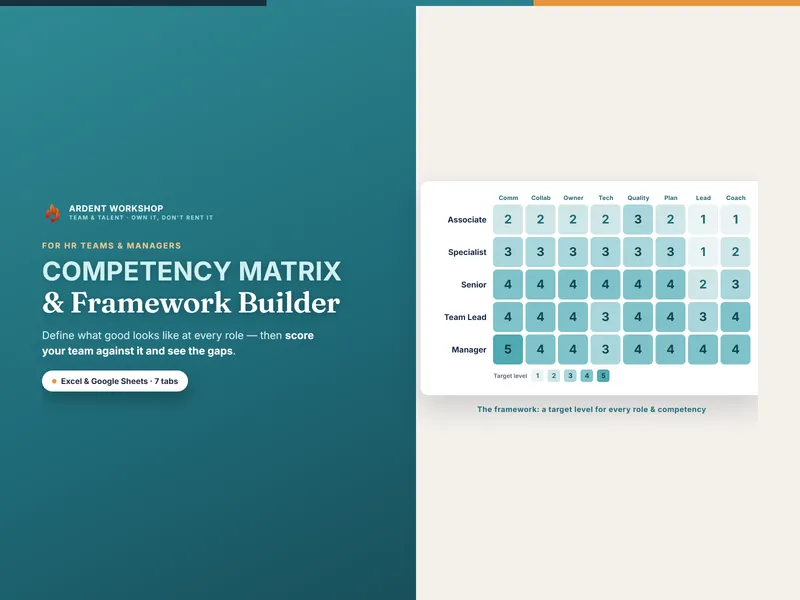
Competency Matrix & Framework Builder for Excel & Google Sheets — Skills Assessment & Gap Analysis
A competency matrix and framework builder for Excel & Google Sheets — define role targets, score your team 1–5, and see every competency gap.
Team & TalentView details - $24.95 Spreadsheet
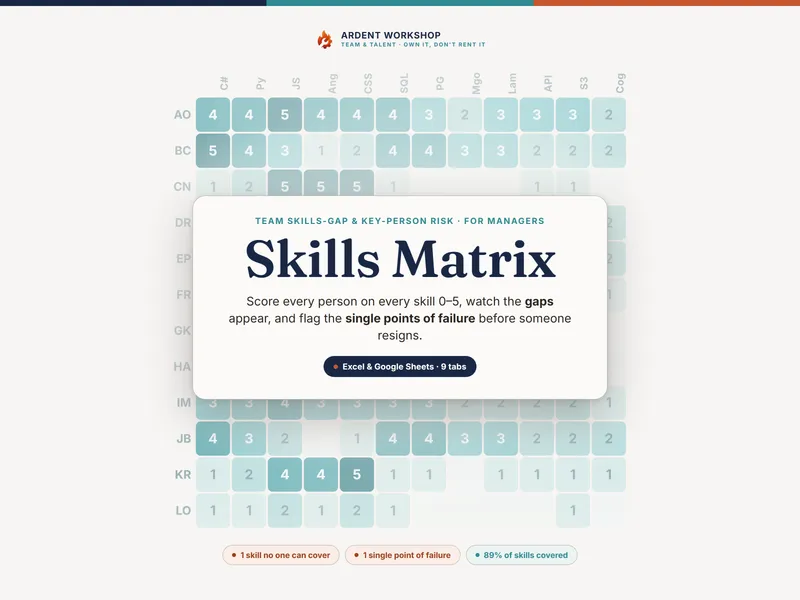
Skills Matrix Template - Team Skills Gap Analysis & Key-Person Risk (Excel & Google Sheets)
A 9-tab skills matrix for Excel & Google Sheets: score your team 0-5, find the skills gaps, and flag single points of failure before someone resigns.
Team & TalentView details