Objectives vs. key results
The whole method rests on telling two things apart that are easy to muddle — the goal and the number that measures it.
- The Objective. A short, qualitative statement of what you want to achieve this cycle — the destination. Good objectives are memorable and a genuine stretch: “Make a product users love and stick with,” not “Improve retention by 5%.” If your objective has a percentage in it, it is probably a key result in disguise.
- The Key Results. Two to five measurable outcomes that prove the objective was met — a number with a start, a target, and a current value. Good key results measure a result, not an activity: “Raise activation from 42% to 60%,” not “Ship the new onboarding flow.” Shipping the flow might not move activation; the key result keeps you honest about the outcome.
Aim for three to five objectives per team, and two to five key results under each. More than that and nothing is really a priority — focus is the entire point of OKRs.
How OKRs are scored
Each key result is scored on a 0.0-to-1.0 scale as progress comes in. The usual formula is simply how far you've moved from the start toward the target:
Score = (Current − Start) ÷ (Target − Start), capped between 0.0 and 1.0. It works whether the target is higher than the start (grow signups) or lower (cut churn) — either way, 0.0 means no progress and 1.0 means the target is reached. An objective's score is the average of its key results, and a company score is the average of the objectives.
The scores fall into three bands most teams color the same way:
- On track (0.7–1.0). On or ahead of pace. On a genuine stretch goal, 0.7 is the target, not a shortfall.
- At risk (0.4–0.6). Real progress, but short of the pace to land it — the goals that most need a plan this week.
- Off track (0.0–0.3). Little to no movement — a flag to raise, not a failure to hide.
Score vs. confidence
The score is a rear-view mirror — it tells you where a key result has got to. Confidence (High, Medium, or Low, set at each check-in) is the windshield: your forward read on whether you'll actually land it. A high score with low confidence is a number that has stalled — the early warning the score alone won't give you until it's too late.
The OKR cadence
OKRs are a rhythm, not a document. The teams that get value from them run a simple loop:
- Set, at the start of the cycle: agree the objectives and key results, with owners, start values, and ambitious targets.
- Check in, weekly or every two weeks: update each key result's current value and set a confidence. Fifteen minutes; it's the whole point.
- Review, mid-cycle: double down on what's working, unblock what's stuck, and reset a target that turned out wrong.
- Grade and retro, at the end: read the final scores, learn from them, and set the next cycle. Movement between cycles is the most useful thing OKRs show.
Common mistakes
- Writing your task list as key results. “Launch the campaign” is a task; a key result is what would be true if the objective were met — the signups, the revenue, the score.
- Too many objectives. Eight “priorities” is another way of saying none. Cut to the few that matter.
- Sandbagging the targets. Setting numbers you're already sure you'll hit makes the set look green and mean nothing. On a real stretch, finishing near 0.7 is a win.
- Wiring scores to pay. The moment OKR scores feed pay or performance ratings, people set safe targets and the honesty that makes OKRs useful is gone. Grade the goal, not the person.
- Setting and forgetting. OKRs you touch once a quarter tell you nothing you couldn't have guessed. The check-in is the value.
Related templates and concepts
OKRs pair naturally with a 9-box grid (OKRs track the goals; the 9-box maps the people behind them). To write one team's OKRs for free, the OKR starter sheet is an ungated taste that scores your key results; the full OKR & Goal-Setting Workbook rolls every objective up to a company view. See how it compares to goal-tracking software. If this is the first quarter you have had to set goals for anyone, the New Manager's Starter Kit carries that workbook with a dated first-ninety-days plan, one-on-one tracking and review phrasing; otherwise the templates for HR & team leads hub has the rest of the toolset, and there is a shelf for first-time managers.
Templates that implement this
Templates that run your OKRs
2 templates
Set objectives and key results, type a start, target, and current value, and each key result scores itself 0.0–1.0, rolls up into an objective score, and rolls up again to one company view.
- $24.95 Spreadsheet
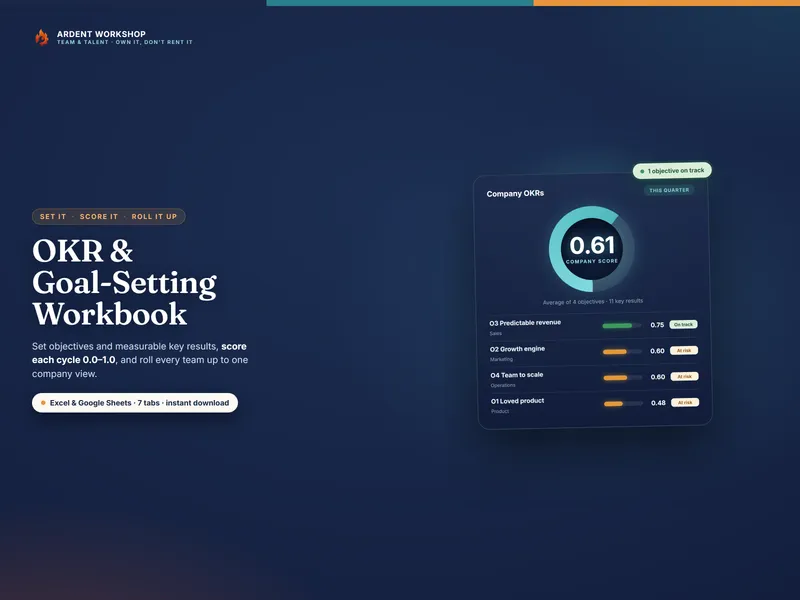
OKR & Goal-Setting Workbook — Objectives, Key Results & Company Rollup (Excel & Sheets)
An OKR workbook for Excel & Google Sheets — set objectives and key results, score progress 0.0–1.0 each cycle, and roll every team up to one company view.
Team & TalentView details - $24.95 Spreadsheet
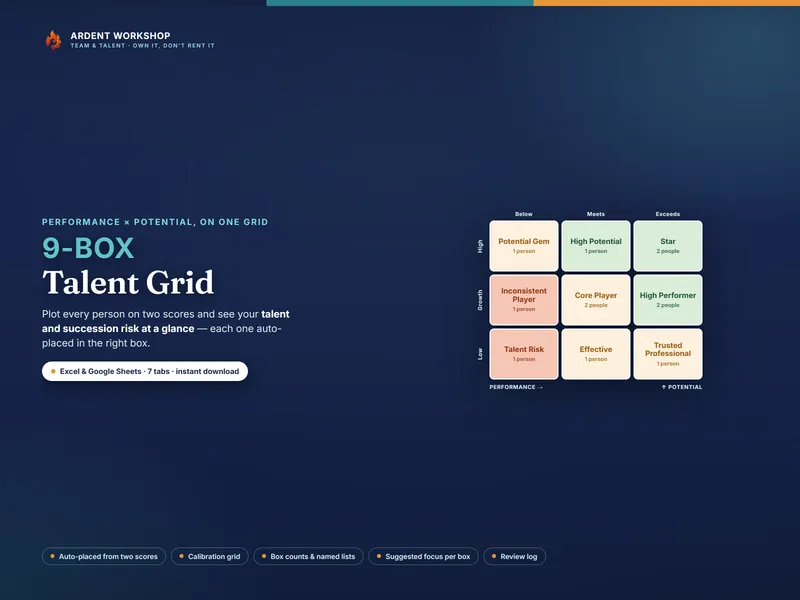
9-Box Talent Grid — Performance & Potential Matrix for Excel & Google Sheets
A 9-box talent grid for Excel & Google Sheets — score performance and potential, auto-place each person, and see succession risk on one grid.
Team & TalentView details