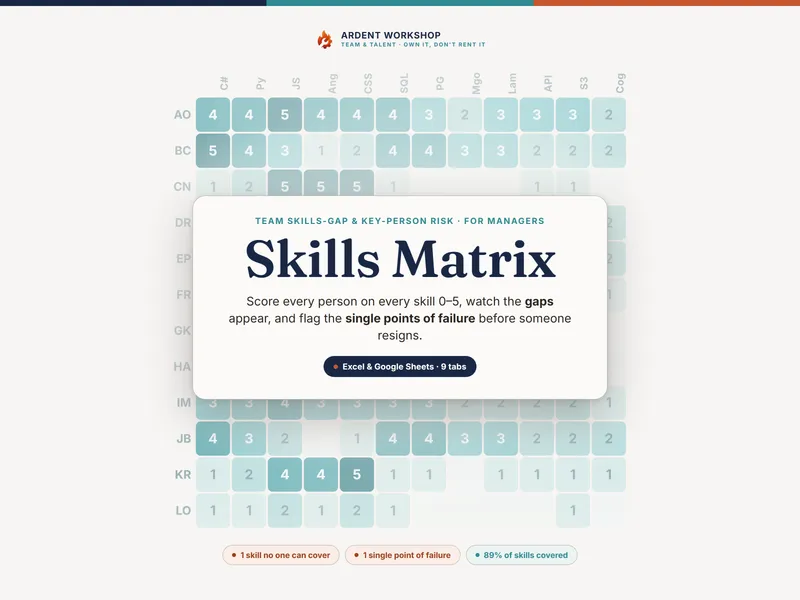
The grid in detail
- Rows — people. Every person on the team (or every role, if you're planning at the role level).
- Columns — skills. The specific capabilities the team needs. Be concrete: "Python" beats "programming"; "wedding-cake pricing" beats "baking."
- Cells — proficiency. A score on a defined scale, typically 0–4 or 1–5.
- Required-level row. The proficiency the team needs to have on each skill (often the maximum of project needs).
- Gap. Required − current. The cell that exposes the hiring or training priority.
The scale matters
A skills matrix is only as good as the scale behind it. "Knows Python" doesn't separate the engineer who's written one script from the one who's shipped a payments system. A working scale has behavioral anchors:
- 0 — none. Has not done this. Could not do this today.
- 1 — aware. Has read or seen it; could attempt with heavy support.
- 2 — competent with help. Can do routine cases with a senior nearby.
- 3 — independent. Owns the work, asks for help on the unusual cases.
- 4 — teaches others. Sets standards, mentors, can hire for the skill.
The scale doesn't have to be exactly this. It has to be the same scale used by every rater for every cell. Inconsistent scales turn the matrix into noise.
What the matrix surfaces
- Single points of failure. A column where only one person scores 3 or 4 is a key-person risk. Plan for the day they leave or take parental leave.
- Training priorities. Where the gap is biggest and the skill is fundamental, that's where the next training budget goes.
- Hiring priorities. Where no one is above 2 and the need is real, you're hiring — not training.
- Promotion readiness. The matrix is a fairer input to promotion conversations than gut.
- Project staffing. Match the project's required skills against the matrix and the assignment is half-done.
- Career conversations. Used 1:1, the matrix gives an employee a clear "here's where you can grow" instead of vague development talk.
How to build one in an afternoon
- List the skills the team actually does. Resist the temptation to list every possible skill — you'll get a column for every framework no one uses.
- Define a scale with behavioral anchors. Three to five levels.
- Self-score first, then have a manager review. Or vice versa — both work, but pick one and apply consistently.
- Add the "required level" row for each skill. Be honest about which skills you need at level 4 and which you can live with at 2.
- Compute the gap. Sort by largest gap. That's your action list.
- Refresh quarterly. Skills decay; people grow. The annual review cycle is too slow.
Skills matrix for a personal career
The same grid works for one person planning a career move. Skills the target role wants down the rows, your current proficiency in the middle, the required level on the right. Every gap is either training, a project, or a conversation to have. It turns "I'm not sure I'm ready" into "here are the four skills I'd close in three months."
Common mistakes
- Listing too many skills. 50 skills × 10 people = 500 cells nobody updates. Twenty skills is plenty.
- No defined scale. "Good at Excel" means different things to different raters. Define levels.
- Using it punitively. The moment people learn the matrix is used to score performance reviews, they start gaming the cells. Use it for planning, not punishment.
- Frozen in time. A matrix from last year describes a team that no longer exists.
- Hiding the matrix. If only managers see it, only managers act on it. Share with the team.
Related templates and concepts
Skills matrices pair naturally with a gap analysis (the matrix is a structured gap analysis on the skills dimension) and a RACI matrix (where the skills matrix says "who can," the RACI says "who will"). See the templates for project managers and templates for job seekers hubs for the broader toolset.
Templates that implement this
Templates that build a skills matrix
1 template
A skill-by-employee proficiency grid with built-in gap analysis — compare team coverage to project needs and watch the training priorities surface on their own.