By the time the review form lands, you already know the rating. You have known for months. What stops you is the blank box under it — and the knowledge that whatever goes in that box will be read by the employee, read by HR, and read again in a year by somebody who was not there.
So the box gets filled with the words everybody reaches for the night before the deadline: detail-oriented, great attitude, team player, needs to be more proactive, has real potential. Those sentences are not lazy so much as unusable. They rate a person rather than a piece of work, they cannot be checked, they cannot be repeated on purpose, and they give the employee nothing to do differently on Monday. If the review is ever challenged, they are the first thing to fall over.
This is the wording for that box — 189 phrases organized the way a review is actually written: by competency, and inside each competency by rating level — plus 54 more for goals and development, the employee’s own self-review, upward and peer feedback, calibration notes, and promotion write-ups.
Rating-locked, not warmed up and cooled down
Most review paragraphs get written in the same register whatever the score, which is why so many employees are surprised by theirs. The wording itself has to carry the rating, so in this bank the same competency reads structurally differently at each band:
- Exceeds has to show that the standard moved — something other people now reuse, a problem that stopped recurring, a capability somebody else gained.
- Meets has to read as a genuine positive finding with a real number in it. This is the rating most of a functioning team should get, and the wording should not sound like an apology.
- Needs Improvement has to carry a count, the date it was first raised, one specific observable change, and the support you are providing.
Every band carries a note saying what its language must do, and every competency has its own table of where the line sits between the three. The test: if a paragraph would read fine one band up or one band down, it is not doing its job.
Every phrase names its own price
Under every one of the 189 competency phrases is the evidence it obliges you to produce — a count, a date, a named artifact, or a downstream consequence, plus where each of those usually already exists in records you keep anyway.
That is deliberately uncomfortable. A review sentence you cannot evidence is not a weak sentence, it is a liability: the employee asks “such as?”, calibration discounts it, and if a decision ever turns on the record it is the line that makes the whole document look thin. If you cannot fill the bracket, the fix is a different sentence — not a vaguer one.
The summary paragraph, in five slots
Every review summary that holds up does the same five things in the same order: it makes a claim about the pattern as behavior rather than as an adjective; it produces one named, dated, countable piece of evidence; it says who else was better or worse off; it names the growth edge, which is present at every rating; and it commits to something with a date on it, including what you are providing.
Seventy-five slot lines cover all five slots at all three ratings. Pick one from each, fill the merge fields, and the paragraph is written — and it structurally cannot omit the evidence or the forward commitment, which is exactly what the weak paragraphs do. Then edit it until it sounds like you: the structure is the part that has to survive, not the sentences.
The spreadsheet does it for you. Pick a rating and five slot numbers from dropdowns, fill five short input columns, and the Review Builder assembles the finished paragraph in the next column. A Check column tells you whether any bracket is still unfilled — a blank input leaves its bracket visible on purpose, because a paragraph with a silent hole in it that reported “Ready” would be worse than no check at all. All nine paragraphs join together at the bottom, ready to copy into whatever form your company already uses. It opens on a complete worked review for an invented employee, so you can watch it work before you type anything.
Behavior, not personality — 24 rewrites
One rule runs through everything: describe the work, not the person. “Six of the 214 items came back for correction, and four of them were the same unit-conversion error on the intake form” is a fact somebody can act on. “Sloppy” is a verdict: it cannot be checked, it cannot be improved on instruction, and it hands the employee the easier argument.
The rewrite gallery takes 24 sentences that get written every cycle and shows the version that holds up beside it — including “not a good culture fit” (where discrimination hides), “should speak up more in meetings” (which rates extroversion rather than performance), and “has real potential” (the word that quietly carries the most bias in performance writing, because it rewards whoever most resembles the people already senior).
Five more sets, for the rest of the cycle
Beyond the ratings themselves: goals and development wording with the test built in; self-review phrasing written in the first person for the employee’s own form, so handing it to your team gets you better self-reviews to work from; upward and peer feedback; calibration notes — the four-line note that holds a rating in a room when somebody says “that looks generous”; and the two hardest paragraphs in the cycle, the promotion case and the not-yet-ready write-up.
Fill the worksheet first
Nine print-and-fill phrase-to-evidence sheets, one per competency, in US Letter and A4. The counts, dates, named artifacts and consequences to gather before you choose a phrase. This is the step everybody skips, and it is the one that decides whether the review is defensible — if a line on the sheet stays blank, you do not have the evidence for the rating you were about to write.
Own it, don’t rent it
Files you keep. No seat, no per-employee fee, no performance platform that decides one day it is no longer strategic and takes your wording library with it. The PDFs open on any device, the text files in any editor, and the spreadsheet is deliberately built from functions that have worked since Excel 2007 — so it calculates in Excel, Google Sheets and LibreOffice with no add-ins and nothing to enable.
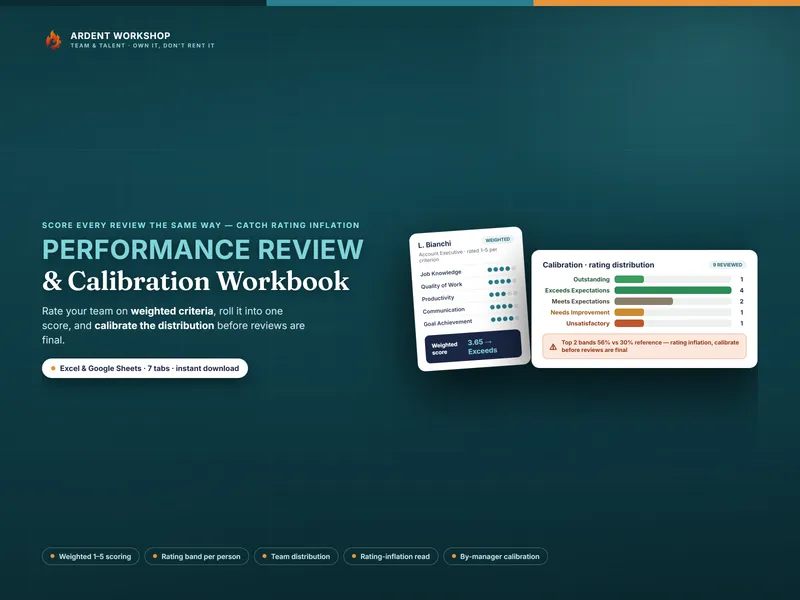
Pairs with the scoring. This bank is the wording. If you also need the rating itself — weighted criteria per role, one overall score and band per person, and a calibration tab showing the distribution across the team with a rating-inflation read — the Performance Review & Calibration Workbook is the companion file. Decide the rating there; write the paragraph here.
What this is not
A wording bank and general management guidance — not legal advice, and not HR advice for your organization. What a performance-improvement plan must contain, how much notice a written warning requires, what documentation supports a dismissal, and what you may record about an employee are set by national, state and sometimes local law, by your own handbook and contracts, and by any collective agreement you are party to. They vary sharply, and nothing here tells you what your obligations are.
Take proper advice before you write any review that will support dismissal, demotion, a formal warning or a pay decision, or that touches a protected characteristic, a disability or accommodation request, pregnancy or parental leave, sickness absence, or a complaint the employee has raised. Section 9 of the Start Here playbook lists these in full.
The company, employees, projects, clients and numbers in the worked reviews are invented.
Try ten of the rewrites free — the behavior-not-personality rewrites one-pager is ungated, with no email asked for.