The two axes
The whole grid rests on keeping two things apart that feel like the same thing — “good people.” They answer different questions, and conflating them is the most common way a 9-box goes wrong.
- Performance (the horizontal axis). How well someone delivers in their current role today, against what the role expects — typically scored Below, Meets, or Exceeds expectations. It looks at results now, not potential.
- Potential (the vertical axis). The capacity and motivation to take on more in future — a broader scope or a more senior role — typically scored Low, Growth, or High. Low potential is not a criticism; a brilliant specialist who is exactly where they want to be is a huge asset.
A top performer is not automatically high-potential, and a struggling newcomer is not automatically low-potential. Score the two axes separately, every time.
The nine boxes
The two scores cross into nine boxes. The names vary between organizations — they are a common, generic set, not a proprietary standard — but they usually run like this, from the top-right corner down to the bottom-left:
- Star (high performance, high potential) — top talent and the core of succession plans.
- High Potential (solid performance, high potential) — invest in growth.
- High Performer (high performance, moderate potential) — reward and broaden.
- Core Player (solid on both) — the dependable backbone of the team.
- Potential Gem (low performance, high potential) — often new or mis-fit; diagnose before you judge.
- Trusted Professional (high performance, low potential) — a valued expert and mentor.
- Effective (solid performance, low potential) — reliable at the current level.
- Inconsistent Player (low performance, moderate potential) — coach with a clear timeline.
- Talent Risk (low on both) — the clearest call on the grid; address it directly.
The three zones
The nine boxes fall into three diagonal zones, running from the bottom-left to the top-right. Read them as a gradient of where to spend your attention, not as good-person / bad-person:
- Retain & grow (top-right). Your strongest talent and clearest investment. The risk here is complacency — these are the people most likely to be poached.
- Develop & engage (the middle band). The dependable core and the people worth developing. Easy to overlook precisely because they cause no trouble.
- Assess & act (bottom-left). A clear, honest read is needed — diagnose whether the gap is skill, fit, or motivation, then coach, re-fit, or make a respectful change.
How to read the grid
- Look at the shape, not just the boxes. An empty top row is a succession gap — nobody obviously ready to step up. A team crowded into one box is usually a calibration problem, not a real lack of range.
- Watch your Stars. Ask, bluntly, what would make each of them leave — and whether you have removed it.
- Diagnose your Potential Gems. Strong potential, weak results, often means something is blocking them — and sometimes it is you.
- Spot key-person risk. A lone Star carrying a critical function is a risk dressed up as good news.
Calibrate — don't just score
The grid one manager fills in alone is a hypothesis. It becomes trustworthy, and fair, only when it is talked through with other managers in a calibration session: each manager scores their own people first, then the group walks the grid box by box, challenges the outliers, and names the common biases out loud — recency (the last thing they did colors the whole period), halo (one strength spreads to everything), and similarity (rating people like yourself higher). The conversation often changes the placement, which is exactly the point.
Common mistakes
- Treating a box as a verdict. It is a prompt for a conversation, not a permanent label — and never a sole basis for a pay, promotion, or exit decision.
- Conflating performance and potential. The single most common error, and the one that produces nonsense placements.
- Grade inflation. Everyone drifts up to the comfortable boxes because no manager enjoys placing a name in the bottom row. Calibration fixes this.
- Scoring once and never revisiting. People move boxes between cycles — that movement is one of the most useful things the grid shows. Re-run it regularly.
- Leaving it unprotected. The grid holds candid views of named people; keep it confidential to those who need it.
Related templates and concepts
A 9-box grid pairs naturally with a skills matrix (the 9-box judges the person; the skills matrix maps what they can actually do) and a gap analysis. To plot one team for free, the 9-box starter grid is an ungated taste of the model; the full 9-Box Talent Grid auto-places everyone and counts each box. See the templates for HR & team leads hub for the rest of the toolset.
Templates that implement this
Templates that build a 9-box grid
2 templates
Score two axes and each person is auto-placed in the right box, with a live calibration grid, box-by-box counts and named lists, and a suggested focus for every box.
- $24.95 Spreadsheet
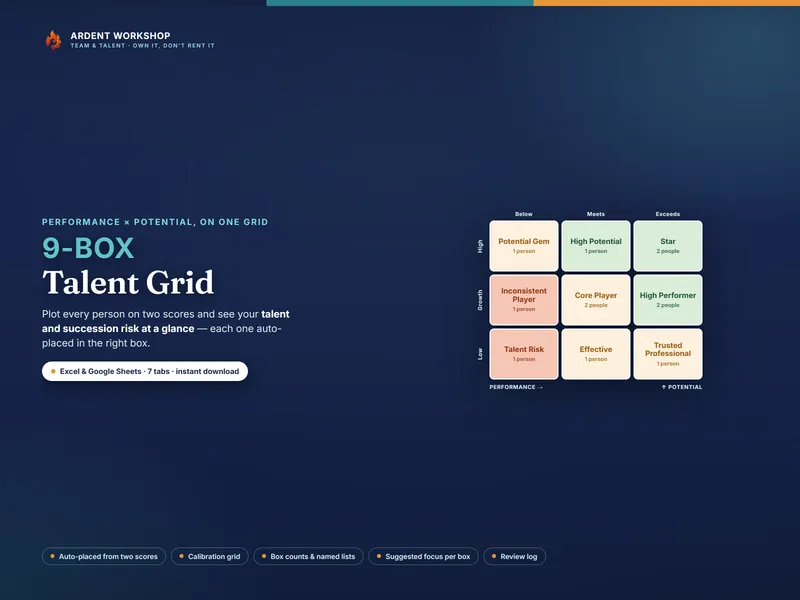
9-Box Talent Grid — Performance & Potential Matrix for Excel & Google Sheets
A 9-box talent grid for Excel & Google Sheets — score performance and potential, auto-place each person, and see succession risk on one grid.
Team & TalentView details - $24.95 Spreadsheet
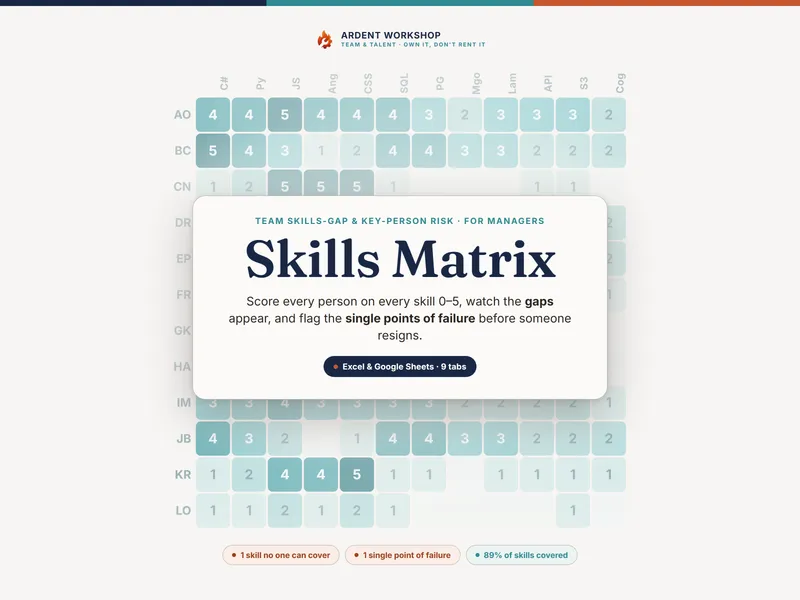
Skills Matrix Template - Team Skills Gap Analysis & Key-Person Risk (Excel & Google Sheets)
A 9-tab skills matrix for Excel & Google Sheets: score your team 0-5, find the skills gaps, and flag single points of failure before someone resigns.
Team & TalentView details