What actually goes into one
Formats vary — a one-page form, a spreadsheet, a page in a talent system — but a real IDP is built around the same handful of parts:
- A gap. Where the person is today against what their next role needs, competency by competency — not a vague sense of “room to grow,” but a named current level and a named target level.
- Development goals tied to that gap. A handful of real goals, not a dozen — each one closing a specific gap, not a generic “improve communication” nobody can act on.
- A learning plan behind each goal. The activities that actually close the gap, typically typed by the 70-20-10 model — challenging experience, learning from others, and formal coursework.
- A review cadence. Scheduled check-ins, not a plan written once in a kickoff meeting and never opened again.
- Eventually, a readiness call. Where the plan is aimed at a specific next role, a judgment on whether the person is ready now, likely one to two years out, or not yet — checked against whether the gaps that actually matter are closed, not just whether time has passed.
Who writes it — and who it's for
An IDP is usually the employee's to own, written with their manager's input rather than handed to them finished. That split matters: a plan the employee didn't help write rarely survives contact with a busy quarter, and a plan the manager isn't involved in tends to list wishes with no stretch assignment or budget behind them to make them real.
It's also worth saying plainly what an IDP is not: it is not the document you reach for when someone's current performance has a problem. That's a performance improvement plan (PIP) — corrective, time-bound, and carrying a stated consequence. An IDP is written whether or not anything is wrong today; plenty of the people who most deserve one are already doing well and simply need a visible path to what's next. See IDP vs performance improvement plan for the fuller comparison.
The gap it's built around
Everything else in the plan follows from one comparison: the person's current level on each competency the next role needs, against the target level that role actually requires. Score the two loosely and the plan drifts into generic goals nobody can act on; score them against a real skills matrix or a documented gap analysis and the goals that follow are specific enough to plan real work around. The gap with the most riding on it is a critical one the target role can't be filled without — and a gap like that with no goal pointed at it is worth flagging before it becomes the reason a promotion stalls.
Development goals tied to a gap
A strong IDP keeps the goal count small — a handful someone can actually carry alongside their day job, not a list so long it reads as a performance review in disguise. Each goal should trace back to a named gap; a goal with no gap behind it is usually either busywork or a leftover from a template nobody customized. The reverse failure is just as common and harder to see: a real, critical gap with no goal against it at all, quietly left uncovered while the plan fills up with easier work.
The 70-20-10 learning plan
Once a goal is set, the learning plan is what actually closes it — and the activities behind a goal tend to skew one of two ways if nobody checks: all courses, or all vague “shadow someone sometime.” The 70-20-10 model is a rough, well-known split for catching that drift: roughly 70% challenging on-the-job experience, 20% learning from others, and 10% formal education. It's a heuristic, not a formula to hit exactly — see the FAQ below for where it comes from and what it doesn't prove.
Review cadence and the readiness call
A plan is only as good as whether it gets reopened. Scheduled check-ins — commonly quarterly — are what turn a document written once into something that actually tracks progress, catches a goal that's stalled, and gives both people a reason to revisit it before the next annual cycle rolls around. Where the IDP is aimed at a specific next role, the check-ins are also where a readiness call gets tested against reality: ready now, one to two years out, or not yet — and worth checking against which critical gaps are actually closed, not just against how the conversation felt.
Common mistakes
- Filed and forgotten. Written earnestly once, then never opened again until the next cycle — by which point it no longer matches what the person is actually working on.
- Goals with no gap behind them. Generic goals — often copied from a template — that don't trace back to anything the person specifically needs for their next role.
- A course-heavy plan. Easy to fill a learning plan with links to courses; harder, and by the 70-20-10 heuristic usually more useful, to arrange the stretch assignment that actually builds the skill.
- Too many goals. A plan with a dozen goals is a plan nobody finishes. A handful, chosen against the gaps that matter most, beats a long list every time.
- One employee, one file, no team view. Fine for a single report; unworkable once a manager is trying to see every direct report's gaps, goals, and check-in status at once without opening a dozen separate documents.
Related templates and concepts
The free Individual Development Plan Template is a one-person IDP workbook and printable one-pager, pre-filled for a worked-example employee with a 70-20-10 learning plan, free and with no signup. The full Individual Development Plan (IDP) Workbook runs a manager's whole team from one file: a competency gap assessment for each person's next role, goals that inherit the gap they close and flag any critical gap left uncovered, a learning plan whose actual 70-20-10 mix is computed and flagged when it drifts course-heavy, a team development budget, dated check-ins that flag overdue reviews and stalled goals, and a readiness call checked against the gaps still open and rolled up into a team view.
Next: the full 70-20-10 model explained on its own, and IDP vs performance improvement plan for how the two compare side by side. See also the skills matrix a gap assessment starts from, the 1:1 Meeting & Goal-Tracking Workbook for the check-ins between cycles, the earlier 30-60-90 plan for someone's first quarter in a role, the ILUO matrix for tracking operational task coverage rather than a career path, and the templates for managers hub for the rest of the toolset.
Templates that implement this
Templates that build an IDP
3 templates
A workbook that runs a whole team of direct reports from one file — gap-linked goals, a computed 70-20-10 mix, and a team readiness rollup. The skills matrix supplies the current-level scores a gap assessment starts from, and the 1:1 workbook covers the check-ins between review cycles.
- $19.95 Spreadsheet
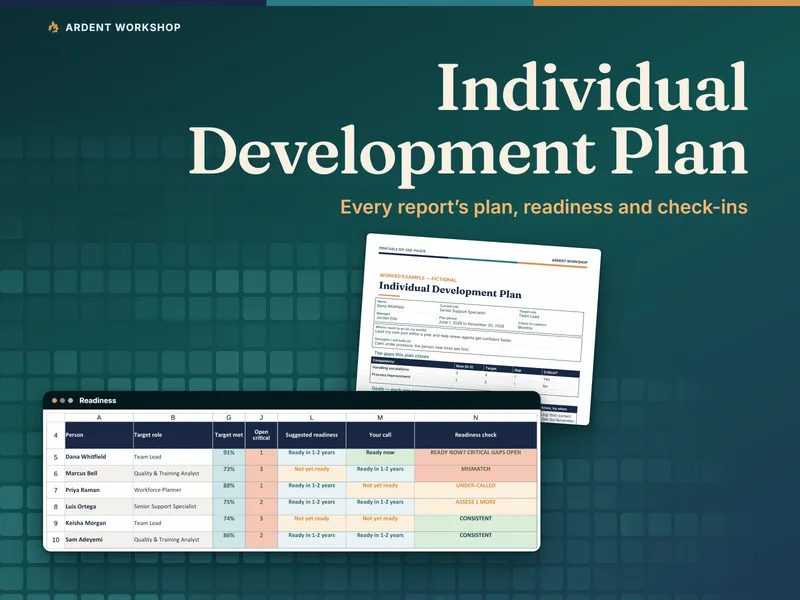
Individual Development Plan (IDP) Workbook — Team IDP Template for Excel & Google Sheets
An IDP workbook for Excel & Google Sheets — plans for up to 30 direct reports, readiness checked against evidence, and overdue check-ins flagged.
Team & TalentView details - $24.95 Spreadsheet
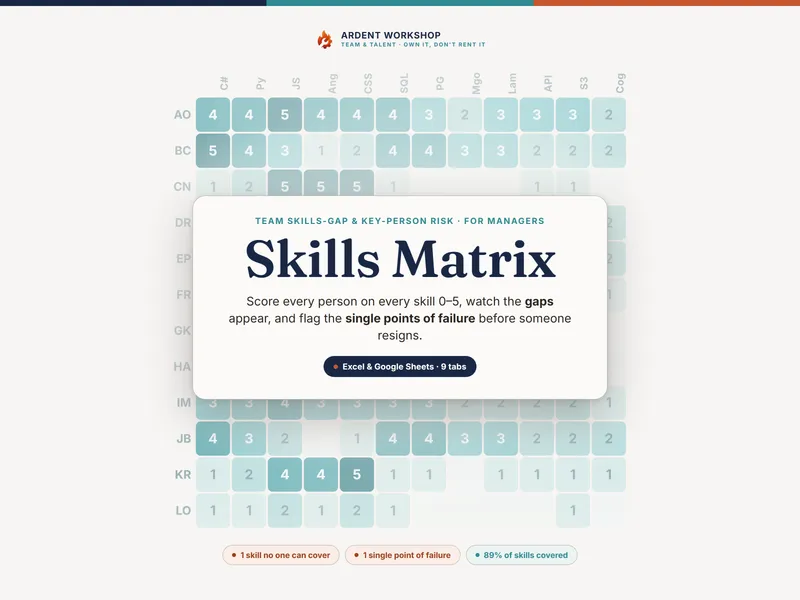
Skills Matrix Template - Team Skills Gap Analysis & Key-Person Risk (Excel & Google Sheets)
A 9-tab skills matrix for Excel & Google Sheets: score your team 0-5, find the skills gaps, and flag single points of failure before someone resigns.
Team & TalentView details - $19.95 Spreadsheet
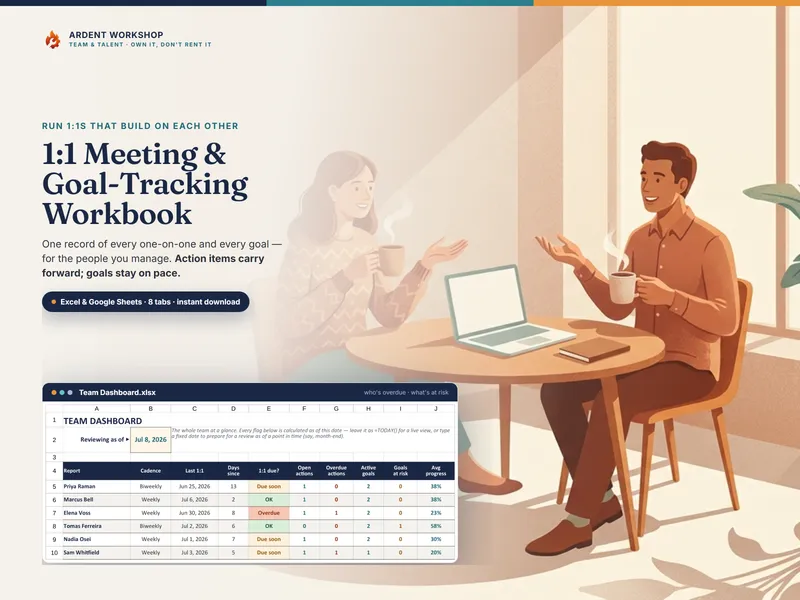
1:1 Meeting & Goal-Tracking Workbook — One-on-One & Goal Tracker for Excel & Google Sheets
A 1:1 meeting & goal-tracking workbook for Excel & Google Sheets — log every one-on-one, carry action items forward, and track goal pace across your team.
Team & TalentView details
Frequently asked questions
- What's the difference between an IDP and a PIP?
- An individual development plan is forward-looking and growth-oriented: it names a gap between someone's current skills and their next role, and sets goals to close it, whether or not anything is wrong today. A performance improvement plan is corrective: it addresses a specific shortfall in current performance, runs on a fixed clock — often 30 to 90 days — and carries a stated consequence if it isn't met. The two get confused because both use goals and a review date, but an IDP is something you build with your best people as much as anyone else; a PIP is not.
- Who writes an individual development plan — the employee or the manager?
- Both, and the split matters. The employee is usually the owner — it's their career, and a plan someone hands them tends not to stick — but it works best written with the manager, who has the context on what the next role actually needs and controls the stretch assignments, budget, and time that make the plan real rather than a wish list. A plan one person writes alone, without the other's input, is the version most likely to sit unopened.
- How often should an IDP be reviewed?
- On a fixed cadence set when the plan is written — quarterly is a common default — rather than left to whenever someone remembers. A plan without a scheduled check-in is a common way for one to stall: written earnestly in a kickoff meeting, then never opened again until the next annual cycle, by which point the goals no longer match what the person is actually working on.
- What is the 70-20-10 rule in an IDP?
- It's a rough split for how the learning activities behind each goal are typically weighted: about 70% challenging on-the-job experience, 20% learning from others through feedback, coaching, or mentoring, and 10% formal education such as courses or reading. It grew out of 1980s Center for Creative Leadership research on how successful executives said they learned (reported by Morgan McCall, Michael Lombardo, and Ann Morrison in The Lessons of Experience, 1988), and was popularized in Lombardo and Eichinger's The Career Architect Development Planner (1996). It's a heuristic drawn from executives' self-reports, not a measured law, and critics note it lacks rigorous empirical support — so treat it as a planning guide for catching a course-heavy plan, not a quota to hit exactly.
- Does every employee need an individual development plan?
- Not as a rule everywhere, but the case for writing one has nothing to do with whether someone is struggling — that's what makes it different from a PIP. A strong performer with no plan for what's next can be a retention risk; a plan gives them a visible reason to stay and grow rather than look elsewhere. Where IDPs are used team-wide, they're usually written once a person has been in a role long enough to have a real current-level assessment to build the gap from.
- What happens to an IDP when someone changes roles or leaves?
- When someone moves into the role the plan was aimed at, the IDP has done its job — write a new one aimed at whatever comes after. When someone leaves the team or the company, the plan's goals and learning activities go with them; what a manager keeps is the competency library and gap method for whoever fills the role next, not the departed person's individual goals.