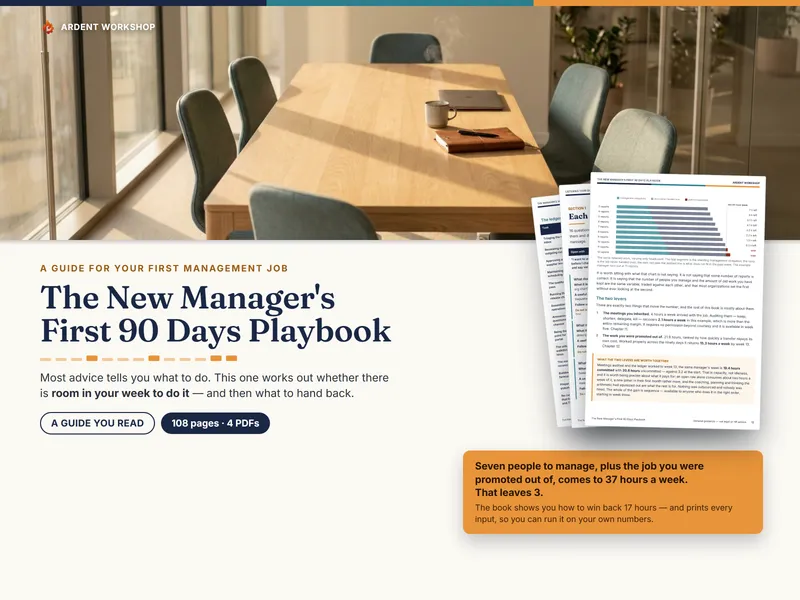
This is not really book-versus-course. It is a question about what a first-time manager is short of, and the honest answer is usually not inspiration — it is a method, an order to do things in, and someone to tell them that the job genuinely does not fit in the week they have been given.
What each one is for
- A management playbook is a method you keep. What to do in week one and what not to, how to run the listening conversations and what to ask in them, how to take over a team that includes your former peers, what to change now versus at day ninety, how to hand back the work you were promoted out of, and a 30-60-90 plan you can actually defend. It answers “what do I do this week, and in what order?”
- A leadership course is scheduled instruction. Sessions on a timetable, a cohort at the same stage, exercises, often role-play with feedback, sometimes a coach. It answers “give me practice, and people to compare notes with.” It runs on the provider's calendar rather than on the day your problem turns up.
When the playbook is exactly right
- You were promoted last month and start managing on Monday.
- You are paying out of your own pocket, or your development budget is small.
- You want the sequence — what happens in week one, week six, day ninety.
- Your questions arrive at awkward hours and you want an answer that evening.
- You would rather own the reference than lose access when a subscription or an employer relationship ends.
- You manage between three and a dozen people and have had no formal training.
When a course earns its price
- You need reps with feedback. Rehearsing a difficult conversation and being told how it landed is the single thing reading cannot replace.
- You want a cohort. Other people at the same stage, comparing notes, is genuinely valuable and a book cannot fake it.
- Your employer is paying. If the seat is funded, the calculation changes entirely — take it, and read as well.
- You have a specific, personal problem. A coach who knows your situation beats general guidance written for a lot of organizations.
- It is a credential you need. Some organizations require a completed program before a promotion.
The thing neither one tells you
Most first-90-days advice — in books and in courses — is about what to do. It is much rarer to be told whether there is room to do it. For one invented example manager with seven direct reports — planning estimates, not measurements of a real team — the standing obligations of the job come to 14.9 hours a week before any actual work happens: one-on-ones with the preparation and the writing-up, the team meeting, their own meeting upward, the standing meetings they inherited, approvals, the written update. The job they were promoted out of and are still doing comes to another 21.9 hours. Against a 40-hour week that leaves 3.2 hours for thinking, planning, learning an entirely new job, and anything that goes wrong.
That is an arithmetic problem, not a motivation problem, and no amount of resolve changes it. It is the kind of thing a written method can hand you with every input printed so you can substitute your own — and the kind of thing that is hard to take away from a session you attended three weeks ago.
What a course does not usually leave you with
- Something to open on the night. Course notes go stale; a reference you own is there in week nine when the 1:1s have gone quiet.
- Access, when the seat was your employer's. Where a company buys the place, the material usually goes with it — change jobs and you lose the platform, the notes and the cohort.
- Something to hand on. You cannot give your cohort place to the person you promote next year. You can hand them a marked-up file.
Try it before you decide
If you are in your first week and want to see whether a written method is what you are short of, the First-Week Listening Questions guide is free and ungated — no email. It is the week-one slice: fifteen questions across the three conversations you cannot postpone, and the fourteen-day report-back that decides whether any of it was worth doing.
Most people should do both, in this order
Read first, then decide. Ninety days into the job you will know exactly which parts you are struggling with, and you will choose a course or a coach for that specific thing rather than for management in general — which is a much better use of a training budget than picking a program in week one, when the only honest answer to “what do you need help with?” is “everything.”
Frequently asked questions
- What's the difference between a management playbook and a leadership course?
- A playbook is a written method you own: what to do in which week of your first ninety days, what to ask in the listening conversations, what to change now versus at day ninety, and how to work out whether the job even fits in your week. You read it at your own pace and keep it. A leadership course is scheduled instruction — live or recorded sessions, sometimes cohort discussion, sometimes a coach — delivered over a set period and usually priced per seat. One is a reference you return to in the week you need it; the other is an event you attend. If your questions tend to arrive on their own schedule rather than a course's, the reference is the thing you are short of.
- Is a leadership course worth it for a first-time manager?
- It can be, and it is worth being specific about when. A course earns its price when you need the two things a book genuinely cannot provide: practice with feedback — role-playing a difficult conversation and being told how it landed — and a cohort of peers at the same stage to compare notes with. If your employer is paying, take it. What a course usually does not give you is something to open at 8pm on the Tuesday before a conversation you are dreading, and that is when a good many new-manager questions turn up.
- How much does a management playbook cost compared with a leadership course?
- An owned playbook is a single low one-time cost — you keep the files, print the chapters you use, and pay nothing again. Management and leadership training is typically sold per seat, often as a multi-day program or a subscription to a learning platform, and coaching is usually sold per session, per engagement, or on retainer. Where the two differ most is commitment: one is a single payment, the other a budget line — which is why reading first and deciding afterward is a reasonable sequence if you are paying out of your own pocket.
- Can you learn to manage from a book?
- Partly, and it is worth being honest about which parts. What reading does well is sequence and method: the order to do things in, the questions to ask, what to change now versus later, and arithmetic like how many hours your standing obligations actually consume against the week you are paid for. What reading cannot do is give you reps. You will still learn the hardest parts — giving corrective feedback, sitting through a silence, being disagreed with — by doing them. A playbook shortens the guessing; it does not remove the practice.