What a one-on-one is — and isn't
A one-on-one is a recurring, private conversation between a manager and a single person they manage. It is deliberately small: one manager, one report, a standing slot on the calendar. Its purpose is the working relationship itself — how the person is doing, what is getting in their way, what they need, and where they want to grow — not a project stand-up or a formal review.
It helps to say what it is not. A one-on-one is not a status meeting where the manager collects task updates (email or a board does that better), not a group team meeting, and not a performance review — the annual or half-year rating conversation is a separate, formal event. A 1:1 is the ongoing, informal thread that runs between those milestones.
How often, and how long
There is no single correct cadence, but the common defaults are weekly or every other week, for roughly 30 minutes. The right frequency depends on the person and the moment:
- Weekly suits new hires, people in a new role, anyone ramping up, and fast-moving work where a fortnight is too long to leave a blocker unspoken.
- Every other week is a sustainable default for experienced people in a steady role.
- Monthly can work for very senior, autonomous reports — but it is usually the floor, not a target, because the thread goes cold if the gaps get too long.
Whatever cadence you pick, the two things that matter most are that the meeting is protected — rarely cancelled, and rescheduled rather than skipped when it clashes — and that it is predictable, so the person can save things up for it.
Whose meeting is it?
The most useful reframing of the one-on-one is that it belongs to the report, not the manager. The manager owns making it happen and holding the cadence; the report largely owns the agenda. A widely used rule of thumb is that the person being managed should bring most of what gets discussed — their questions, their obstacles, their goals — while the manager listens more than they talk, adds context the report can't see, and gives feedback. A meeting the manager fills entirely with their own agenda has quietly turned back into a status update.
What a one-on-one is for
- Progress and blockers. Not a task-by-task readout, but the things that need a conversation — what's stuck, what needs a decision, what the person can't unblock alone.
- Feedback, both directions. The manager gives specific, timely feedback rather than saving it for a review; the report gets a regular, low-stakes channel to raise concerns and push back.
- Development and goals. Where the person wants to grow, what they're working toward, and whether those goals are actually moving — the part most likely to fall off the agenda under day-to-day pressure.
- The relationship and how they're really doing. Workload, motivation, and a simple read on how the person is feeling — the signals that surface problems long before they show up in results.
Why they matter
A one-on-one is one of the highest-leverage habits a manager has, for a simple reason: it is the regular, protected time in which small problems get raised while they are still small. Blockers get cleared before they stall a project, feedback lands close to the event that prompted it, disengagement gets noticed before it becomes a resignation, and development goals stay visible instead of surfacing once a year at review time. None of that requires a long meeting — it requires a consistent one.
What should you ask?
A one-on-one more often fails quietly than by cancellation. The manager arrives without a question, so they ask the only one that is always available (how's it going?) and get the only answer that question can produce. The meeting then fills with status, which is already written down somewhere and teaches neither person anything.
Two habits fix it. First, ask something specific enough to be answered: what took most of your time since we last talked, and was that the right place for it? beats how's everything? because it names a period and asks for a judgment. Second, and more important, follow the answer up. A question you don't follow up on is small talk with a clipboard — the second question (what would you have spent that time on instead?) is usually where the useful part lives.
It also helps to rotate. Workload questions are easy and urgent, so they tend to crowd the agenda; career, feedback, and wellbeing questions are neither, so a quarter can pass without one. If you want the questions already written, the free twelve 1:1 questions card sheet gives you one from each of twelve situations, each with its follow-up, on cards you print and cut — no signup. The longer version — the four questions to retire, how to route from what you noticed to three questions, and what to do with a non-answer — is in what to ask in a one-on-one.
Why a record beats memory
The habit is easy to start and surprisingly hard to sustain, and the reason is almost always the same: without a record, every meeting starts cold. Action items live in whoever's notebook and quietly slip; goals get discussed once and never tracked; and across a team of several people, no one can say who they're overdue to meet with. A light running record fixes all three — it carries the loose ends forward, keeps each conversation building on the last, and turns "I think we talked about that" into something you can actually look up.
A record works best when it captures, per meeting, a short agenda, the wins and challenges discussed, and any action items with an owner and a due date — then keeps open actions and active goals visible until they're closed. That is exactly the thread a template is built to hold.
Want to try that before committing to anything? The free 1:1 meeting starter log keeps the thread for one person in a single tab, with no signup — a low-friction way to see whether the habit sticks.
A note on privacy
A one-on-one record holds candid, personal notes about a named person. Treat it accordingly: keep it confidential to those who genuinely need it, store it privately, and handle it the way your own privacy policy and local employment law require. A note or a missed goal is an input to a conversation and to your own judgment — not, on its own, a verdict about pay, promotion, or any formal process.
Related templates and concepts
A one-on-one is where individual goals get set and checked; to point a whole team at the same quarter, those goals roll up into OKRs. The full 1:1 Meeting & Goal-Tracking Workbook adds a team roster, automatic action-item carry-forward, on-pace goal tracking, and a dashboard that flags who you're overdue to meet with. If the gap is the questions rather than the record, the 1:1 & Coaching Question Deck is 108 printable questions across twelve situations, each carrying the follow-up that makes it count and a specific move for when you get a non-answer. If one-on-ones are new because the job is, the New Manager's Starter Kit carries that workbook alongside a dated first-ninety-days plan, goal setting and review phrasing, plus a file that reads your one-on-one log back to say which report you have not sat down with - see the shelf for first-time managers.
Alongside it, set team objectives with the OKR & Goal-Setting Workbook, see talent and succession risk on one grid with the 9-Box Talent Grid, and find the rest of the toolset in the templates for HR & team leads hub.
Templates that implement this
Templates for the 1:1 itself, and for the record
3 templates
Log every one-on-one in one place, carry action items forward until they're closed, and track whether each development goal is on pace — one owned workbook for Excel, Google Sheets, and LibreOffice. The question deck covers what to ask once you are in the room, and the OKR & Goal-Setting Workbook rolls team goals up to one view.
- $19.95 Spreadsheet
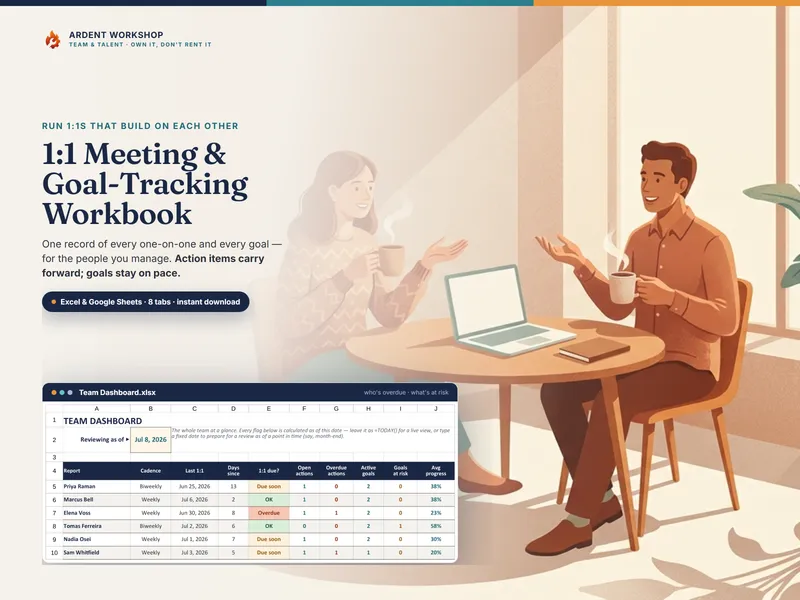
1:1 Meeting & Goal-Tracking Workbook — One-on-One & Goal Tracker for Excel & Google Sheets
A 1:1 meeting & goal-tracking workbook for Excel & Google Sheets — log every one-on-one, carry action items forward, and track goal pace across your team.
Team & TalentView details - $12.95 Mix

1:1 & Coaching Question Deck — 108 Printable One-on-One Questions for Managers, with Follow-Ups, a Router & a Rotation Log
A printable 108-card one-on-one question deck for managers — every card carries the follow-up that makes it count, plus a Router that picks your three.
Team & TalentView details - $24.95 Spreadsheet
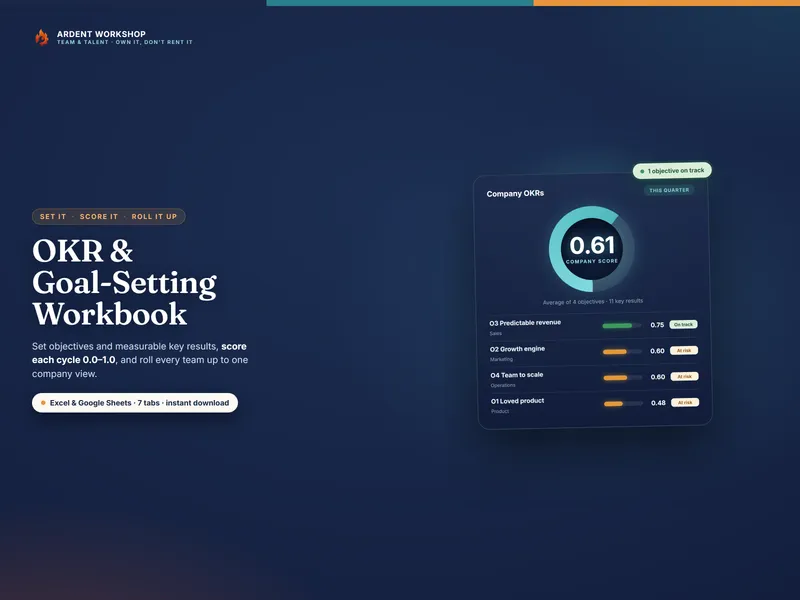
OKR & Goal-Setting Workbook — Objectives, Key Results & Company Rollup (Excel & Sheets)
An OKR workbook for Excel & Google Sheets — set objectives and key results, score progress 0.0–1.0 each cycle, and roll every team up to one company view.
Team & TalentView details