You have been handed a change to roll out. A new system, a new process, a reorganized team — and somewhere between the kickoff and the first deadline, you have written down fifteen names of people who “need to be involved.” Some of them will help. Some of them will quietly block you. Most of them want to be told something, but not the same thing, and not as often.
The usual response is to treat everyone the same: one big update email to all fifteen, and a long series of meetings that the people who matter skip. That is how a change dies in week six — not because anyone opposed it in the open, but because the one person who could stop it found out late and did.
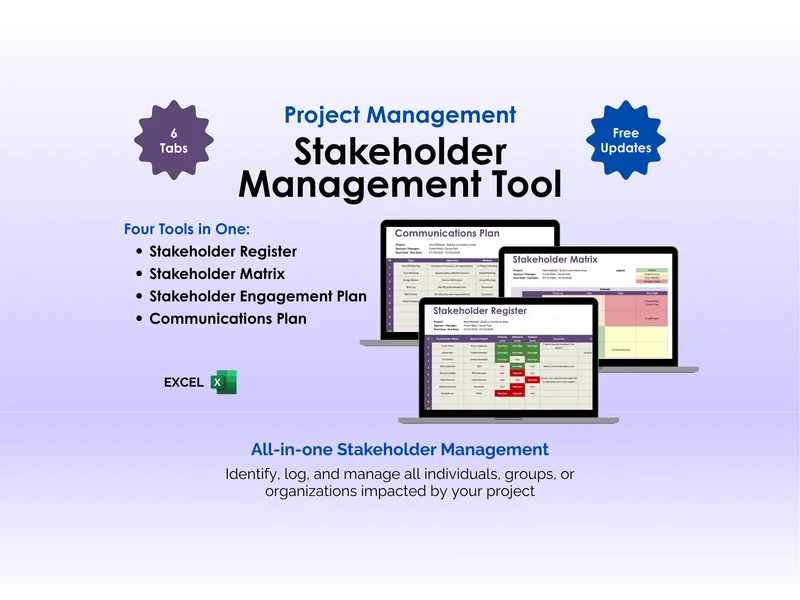
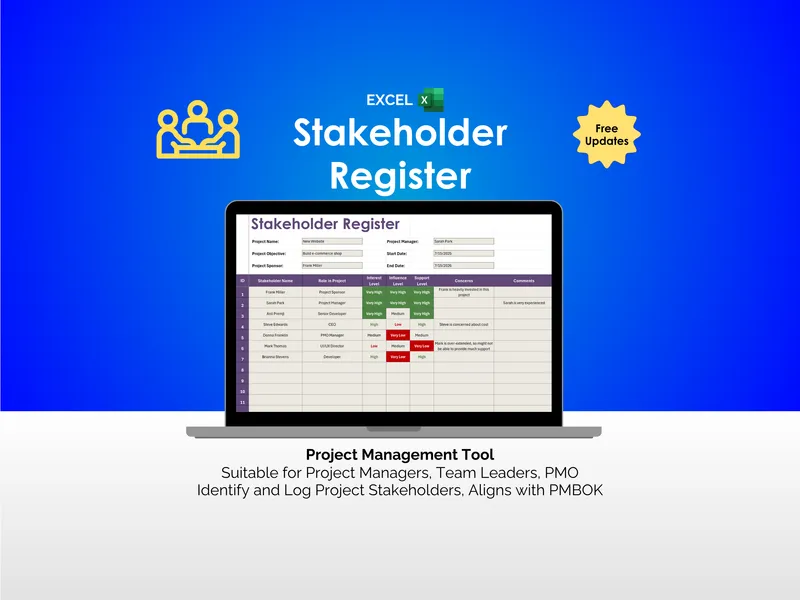
The power-interest grid is the one-page fix for exactly that problem. It sorts every stakeholder into four boxes by two questions — how much can this person affect my change? and how much does my change affect them? — and each box comes with a different way to engage. If you would rather not redraw it by hand every time someone’s position shifts, the Stakeholder Management Tool builds the grid automatically from influence and interest ratings, and the simpler Stakeholder Register keeps the ratings and concerns for each name in one sortable list. The method matters more than the file, though, so here it is either way.
What is a power-interest grid?
A power-interest grid is a two-by-two matrix that places each stakeholder by their power over a change and their interest in its outcome, then assigns each of the four resulting quadrants an engagement strategy. Power runs up one axis, interest runs along the other, and the four boxes are usually labeled Manage Closely, Keep Satisfied, Keep Informed, and Monitor.
It is often called Mendelow’s matrix: as the Nielsen Norman Group’s guide to stakeholder analysis (opens in new tab) puts it, the earliest version is attributed to the researcher Aubrey Mendelow. It is not only a corporate project tool, either. Public-sector researchers have proposed a power-versus-interest grid as the first of several stakeholder analyses for working through a complex public problem (opens in new tab) (Bryson, Cunningham and Lokkesmoe, Public Administration Review, 2002).
What the grid is for, in one sentence: it tells you who to spend your attention on, and how, before you have run out of it. It is not a ranking of who matters as a person. A stakeholder in Monitor is not unimportant; they just do not need a weekly meeting about this particular change.
The two axes: what power and interest actually measure
The grid only works if both axes are scored on a concrete question. Vague scores (“she’s pretty senior, call it high”) produce a grid that just mirrors the org chart.
Power is what a stakeholder can do to your change. Can they stop it, delay it, or force it to be redesigned? A department head who must approve the budget has power. So does a payroll lead whose system the change has to feed, even if they are three levels below the department head. Power is about leverage over this specific change, not job title.
Interest is what your change does to them. How much does their daily work, budget, workload, or standing shift if the change succeeds? Frontline staff whose schedules are being rewritten have very high interest. An executive who will see the change only as one line in a quarterly report has low interest, however senior they are.
Two traps to avoid on these axes:
- Seniority is not power. A senior leader with no stake in the decision may be unable to block it, while a mid-level specialist who controls a system the change depends on can stop it cold.
- Volume is not interest. The person who replies to every email is not necessarily the one whose week the change rewrites. Score what the change does to them, not how loudly they talk about it.
The Open University’s course notes on stakeholder power and interest (opens in new tab) add a related caution: interest is fairly easy to estimate, while power is “a much more slippery concept.” That is why the scoring rule below asks a blunt question for each axis instead of asking for a general impression.
The four quadrants of the power-interest grid
Each quadrant is a different engagement strategy. Here is the grid in one table, then each box in detail.
| Power / interest | Low interest | High interest |
|---|---|---|
| High power | Keep Satisfied — consult before anything touches their remit; brief them at milestones | Manage Closely — involve them in decisions; talk to them weekly |
| Low power | Monitor — general announcements; re-check their scores at each milestone | Keep Informed — regular updates and an open channel for questions |
| Quadrant | Power / interest | What to do | Suggested cadence | How it goes wrong |
|---|---|---|---|---|
| Manage Closely | High / high | Involve in decisions before they are made | Weekly, or before every decision they touch | Too many names, so nobody gets real attention |
| Keep Satisfied | High / low | Consult on anything in their remit; keep updates short | At milestones | Ignored until something surprises them |
| Keep Informed | Low / high | Explain what is changing and why; invite questions | Every two weeks | Told the decision after it was made |
| Monitor | Low / low | Include in general announcements | Announcements at major milestones; re-score at each milestone | Never re-scored, so a shift goes unnoticed |
Manage Closely (high power, high interest)
These are the people who can stop the change and whose work it changes. Bring them into decisions before they are made, not after. If you can only do one thing well on the whole grid, do this box well. Keep it short — if more than four or five names sit here, you are probably scoring seniority instead of power.
Keep Satisfied (high power, low interest)
These stakeholders can block you but do not care much yet. Their interest is low because the change does not touch them — until it does. Brief them at milestones in a few lines, and consult them in advance on anything that falls inside their remit (their budget, their policy, their system). The Nielsen Norman Group guide calls these people “latents.” The risk here is not opposition; it is a surprise that turns low interest into high interest at the worst possible moment.
Keep Informed (low power, high interest)
These are the people the change happens to. They cannot stop it on their own, but their daily work is being rewritten. Tell them what is changing, why, and when, on a regular rhythm, and give them a real channel for questions. This box is where the operational knowledge lives — the people here know which part of the new process will break on a Tuesday night — so “informed” should run in both directions.
Monitor (low power, low interest)
These stakeholders neither drive the change nor feel it much. They get the general announcements. The one discipline this box needs is a re-check at every milestone, because the people here can move without anyone noticing.
How to build a power-interest grid in five steps
Most of the work is the scoring conversation, which is the useful part.
Step 1: List every stakeholder, then split the groups
Write down everyone who can affect the change or is affected by it. Then split any group whose members would score differently, such as a department whose head can veto the change while its staff cannot. “Finance” is not a stakeholder; the finance controller and the payroll lead are two.
Step 2: Score power from 1 to 5
Ask one question per name: if this person said no, what happens? A 5 can stop the change outright. A 4 can delay it or force a redesign. A 3 can cause friction or rework but not move a date. A 2 can complain to someone who matters. A 1 cannot change the outcome.
Step 3: Score interest from 1 to 5
Ask: if this succeeds, how different is this person’s week? A 5 means their daily work changes. A 4 means a regular part of their week changes. A 3 means they will notice. A 2 means a minor or occasional effect. A 1 means they will not.
Step 4: Plot the scores and flag every 3
Treat 4 and 5 as high and 1 to 3 as low, place everyone in a quadrant, and mark every score of exactly 3. Those are the people sitting on a line, and they are where the grid is most likely to be wrong. A 3 is a judgment call wearing a number — the flag reminds you to check it with someone who knows that person better.
Step 5: Write one action and one cadence per quadrant
For each quadrant, write what you will do and how often: who gets a weekly conversation, who gets a milestone summary, who gets the regular update, and who gets the general announcement. Then set a date to re-score. A grid without a cadence is a picture; a grid with one is a plan.
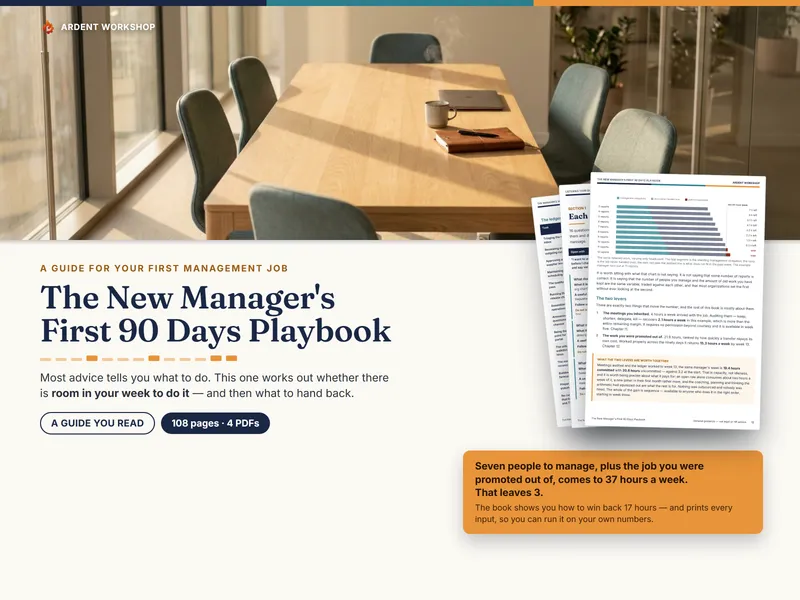
If you are a new manager doing this for the first time, the listening tour comes first: the New Manager’s First 90 Days Playbook carries 62 questions for exactly those early conversations, including the ones with your own manager and your new peers — and the answers are what you score from.
Worked example: rolling out a new shift schedule
Picture an operations manager moving a 40-person team from a paper roster to a shared scheduling system over six weeks. The manager lists ten stakeholders, splitting “the supervisors” and “the staff” out from the managers above them, and scores each one.
| Stakeholder | Power | Interest | Quadrant | Flag |
|---|---|---|---|---|
| Your own manager | 5 | 4 | Manage Closely | |
| Payroll lead | 4 | 4 | Manage Closely | |
| Three shift supervisors | 4 | 5 | Manage Closely | |
| Site director | 5 | 2 | Keep Satisfied | |
| HR business partner | 4 | 3 | Keep Satisfied | interest 3 |
| 40 frontline staff | 2 | 5 | Keep Informed | |
| Staff council rep | 3 | 5 | Keep Informed | power 3 |
| Manager of the team that borrows staff | 2 | 4 | Keep Informed | |
| IT administrator | 3 | 2 | Monitor | power 3 |
| Finance controller | 2 | 2 | Monitor |
Three things this grid shows that the flat list of names did not:
- The supervisors are the real Manage Closely group. Their power is a 4 even though none of them is senior: they run the roster every day and can delay go-live by quietly keeping the paper version going alongside the new system. The change succeeds or fails at their level, so they get a weekly conversation, not the all-staff email.
- The payroll lead needs more attention than the site director on this change. The new schedule feeds pay, so a payroll objection forces a redesign. The site director can stop the project but has no reason to — a milestone summary covers it.
- The three flags are the risks. The HR partner’s interest jumps to a 5 the moment an overtime rule is involved. The IT administrator’s power becomes a 5 if account setup slips, because nobody can log in. The staff council rep is only a 3 on power alone — which leads to the next section.
The manager’s cadence follows straight from the boxes: a weekly check-in with their own manager, the supervisors and payroll, a two-line milestone note to the site director and HR, an update every two weeks with a question thread for staff, the council rep, and the neighboring manager, and the all-hands announcements for IT and finance. Each flag gets its own action: HR is consulted before any overtime rule is set, the council rep gets a direct line to the manager, and the IT administrator’s access deadline goes in the calendar as a risk.
Why stakeholders move between boxes
A power-interest grid is a snapshot, and the people on it move. The Nielsen Norman Group guide notes that a stakeholder’s power and interest “can alter throughout your project,” and that a change in leadership can move people from one side of the grid to the other. Three kinds of movement matter most:
- Interest spikes when the change reaches someone. A Keep Satisfied stakeholder turns into a Manage Closely stakeholder the day the change touches their budget or policy. What is cheap to prevent is the surprise: consult them before it does.
- Low-power stakeholders gain power together. The Open University notes that disparate groups with little power individually “can wield a surprising amount of power if they unite in common cause.” Forty frontline staff are each a 2. Forty frontline staff refusing a new system, with their council rep speaking for them, are a 5.
- Leadership changes reset the grid. A new sponsor, a new director, or a budget owner leaving can move several names at once. Re-score the whole grid the same week.
The practical rule: re-score at every milestone, and immediately after any change in leadership, budget, or scope.
Mistakes that make the grid lie
- Scoring the org chart. If your Manage Closely box is just the leadership team, you scored seniority. Go back to the power question: if this person said no, what actually happens?
- Overloading Manage Closely. Nobody wants to demote a senior name, so the top-right box swells to a dozen people and the close management becomes a weekly mass email. Keep that box to the people a decision genuinely cannot proceed without.
- Lumping groups together. “IT” or “the warehouse team” as one dot hides the person in the group who can stop you. Split until each dot would get one score.
- Treating Monitor as “ignore.” Monitor means check again later, not never think about them. A stakeholder left unchecked here can move without anyone noticing.
- Scoring once at kickoff. A grid drawn in week one describes the project as it was. If it has not been re-scored since, it is describing a project that no longer exists.
When the grid stops being the right tool
The grid is strongest for deciding who gets what kind of attention — communication planning, change management, and the first weeks of anything new. It is weaker for running the day-to-day of a long project, where the question is less “who is important?” and more “whose sign-off does this decision need, and by when?”
For that, a decision-led map works better, and we have written a separate guide on how to build a stakeholder map around decisions instead of people. The two fit together: the grid sets the engagement plan, and the decision map tells you who to chase this week. Once you know who has to say yes to which piece of work, a RACI matrix records who is responsible, accountable, consulted and informed on each task.
The power-interest grid is also a close cousin of the 9-box talent grid: two axes, a handful of boxes, and an action for each one. The difference is the subject. The 9-box maps your own team’s performance and potential; the power-interest grid maps everyone around a change.
Common Questions About the Power-Interest Grid
What are the four quadrants of a power-interest grid?
Manage Closely (high power, high interest), Keep Satisfied (high power, low interest), Keep Informed (low power, high interest), and Monitor (low power, low interest). Each quadrant is an engagement strategy, not a ranking of how much a person matters.
What is the difference between power and interest?
Power is what a stakeholder can do to your change: stop it, delay it, or reshape it. Interest is what your change does to them: how much their daily work, budget, or standing shifts if it succeeds.
Is the power-interest grid the same as Mendelow’s matrix?
Yes. The grid is often called Mendelow’s matrix, after Aubrey Mendelow, to whom the earliest version is attributed. The quadrant labels vary between sources; the two axes and the four boxes do not.
How often should you update a power-interest grid?
Re-score it at every milestone, and immediately after any change in leadership, budget, or scope. A grid scored once at kickoff describes the project as it was, not as it is.
Do you need software to make a power-interest grid?
No. A whiteboard works for a single session, and a spreadsheet works better for anything longer, because the scores can be re-sorted and the grid redrawn every time someone’s position changes.
The takeaway
The power-interest grid is not about deciding who matters. It is about deciding how each person should hear from you, so that your limited attention goes to the people who can stop the change and the people the change happens to — and nobody with power finds out late.
Score power by asking what happens if they say no. Score interest by asking how different their week becomes. Flag every 3. Write a cadence for each box. Re-score at every milestone.
When the grid needs to live longer than one whiteboard session, the Stakeholder Management Tool keeps the register, the power-and-interest grid, the engagement plan and the communications plan in one connected workbook, so a changed score re-sorts the grid instead of starting a new one. If you only need the list itself, the Stakeholder Register holds each person’s influence (power), interest, support and concerns, and the Communications Plan records each touchpoint’s audience, frequency and owner, so the communication each quadrant gets is written down.
Sources
- Stakeholder Analysis (opens in new tab) — Nielsen Norman Group (Maria Rosala, 2021), on Mendelow’s power-interest matrix, its quadrants, and how stakeholders move between them.
- Successful IT systems, section 4.4 (opens in new tab) — The Open University, OpenLearn, on the power/interest grid, shifting interest, and low-power groups uniting.
- What to do when stakeholders matter (opens in new tab) — Bryson, Cunningham and Lokkesmoe, Public Administration Review 62(5), 2002, proposing the power-versus-interest grid as the first of five stakeholder analyses.