The 1:1 & Coaching Question Deck is a printable, print-and-cut deck of 108 one-on-one meeting questions for managers — 135 cards across twelve situations, each carrying the question, when to use it, the follow-up that makes it count, and a move for when you get a non-answer.
You already hold the meeting. It’s in the calendar, it recurs, and you show up.
What goes wrong is smaller and more specific than “we don’t do 1:1s well”: you arrive without a question, so you ask the only one that’s always available — how’s it going? — and you get the only answer that question can produce. Then you fill the gap with status. Six months later the meeting has a reputation: it’s the one where nothing happens.
This is a deck you keep on the desk and draw three cards from, two minutes before the meeting.
What a free list of one-on-one questions doesn’t give you
You can find a hundred one-on-one questions in ten seconds. Two things a copy-pasted list rarely gives you, and they’re the reason this exists.
Four things on every card, not one. The question, the moment to use it, the follow-up that makes the first question count, and the specific move for when you get a non-answer. What took most of your time since we last talked? is a fine opener. What would you have spent that time on instead? is the reason it earns its place. And when the answer is a task list, the card tells you what to do: make them rank it.
The Router. One card set that turns what you actually noticed this week into three specific cards, in order. Twenty-two real signals — messages arriving late at night, “all good” for four weeks running, a strong performer passed over again, deadlines slipping at the edges rather than in the middle — each mapped to a trio, with the reading behind why that order. Messages arriving late at night, more than once this week routes to the honest-hours card, then the cut-list card, then the one about the last real time off. The reading says why: get the real number first, then cut something yourself, because a person who is underwater cannot prioritize their own rescue.
Twelve one-on-one situations, nine questions in each
The standing check-in and workload. The blocker they won’t volunteer. Career and growth. Feedback in both directions, including feedback about you. The report who says “everything’s fine” every week. The one who’s visibly overloaded. The debrief after a project ships, or doesn’t. The run-up to a performance review. A new report’s first month. A remote or hybrid report. Skip-level conversations. Working across teams.
Every card carries its set number and its set name as well as a colored edge, so a shuffled deck sorts back into twelve piles in about a minute — and so the color is never the only cue.
Twelve Pick-Three cards, and a rotation log
For the meetings you already run — the standing weekly, the monthly deeper one, the growth conversation, the pre-review, a new report’s first month, the skip-level, the hard week — there’s a pre-sequenced trio that opens wide, deepens once, and closes on a commitment. Each card prints the three real questions and the reason they’re in that order.
And then the part that’s easy to skip. The rotation log is a printable grid of your reports against the twelve sets, because of one predictable failure: the workload questions are easy and urgent, so they get used every week, and the growth and feedback questions are neither — so a whole quarter can pass without a single question from either. Write a date each time you draw, glance at the grid once a month, and go wherever the column is emptiest.
Printing the question cards: three sizes, at home or at a print shop
This is a file you print, not a box that arrives. Three trim sizes for the question cards — a 2.5 × 3.5 in deck card that fits a card box, a 3 × 5 in index card (the one to start with), and a 3.5 × 5 in large card that’s the most readable across a table. Each comes two ways: print-ready PDFs with the page sized to the card for a print shop, and imposed US Letter sheets with light cut guides for a home printer and a paper trimmer. The Router, Pick-Three, method and blank cards carry more text than a pocket card can hold, so those are laid out for the index and large sizes only. The whole deck is 44 pages at index-card size, and you don’t need all of it on day one.
There’s also a 22-page Question Index & Router to keep open on the desk — every question by set, the full Router table, and a cross-index by what each question is designed to surface, for when you know the problem but not where it lives.
A file you keep, not an app you rent
No login, no seat, no subscription. Print the sets you use now, print more when you need them, and print a second copy for the person you promote. It can’t be discontinued because a company decided the product was no longer strategic, and it will still open in five years.
If you want the method before the deck, what to ask in a one-on-one walks through the two-minute version, and a printed question deck versus a one-on-one app sets out which half of the problem each one solves.
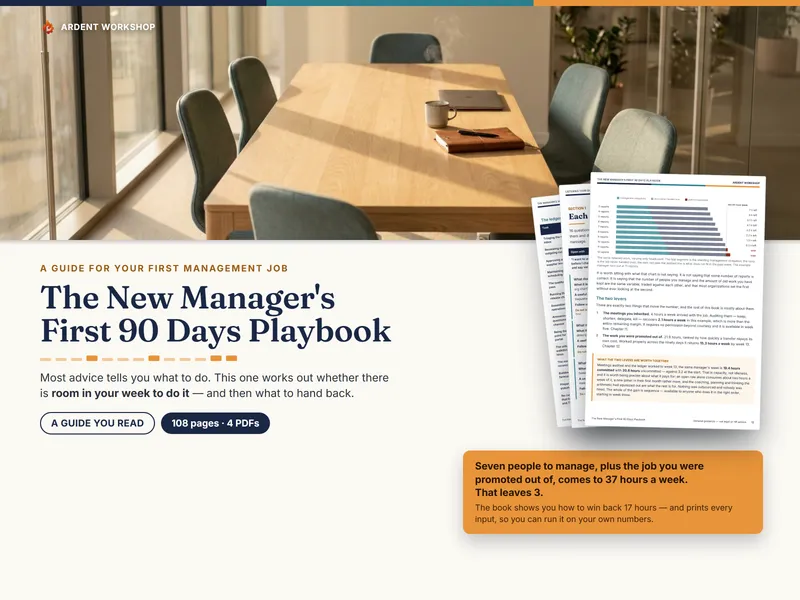
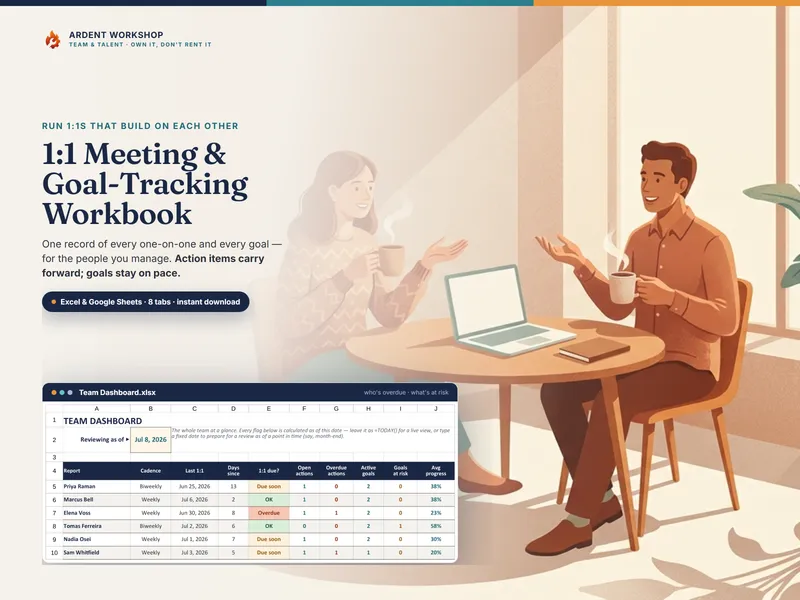
This deck is where the questions live. Where the answers go is the 1:1 Meeting and Goal-Tracking Workbook — a running log per report, goals that carry forward, and action items that don’t die in a notebook. If you’ve just been given a team, the New Manager’s First 90 Days Playbook is the wider job around this meeting, and the Performance-Review Phrasing and Feedback Wording Bank is the wording for the review these conversations feed.
Want a piece of it first? The One-on-One Questions Card Sheet is free and ungated — no email required. It’s twelve questions, one from each situation, each with its follow-up; the paid deck adds the other ninety-six, the two extra fields on every card, the Router, the trios and the rotation log.
What this is not
Conversation prompts — not legal, medical, HR, or employment-law advice, and not a substitute for your employer’s policies or your HR team. Some cards touch on workload, hours, wellbeing and pay. Where a conversation touches conduct, a protected characteristic, an accommodation or a grievance, that is an HR conversation before it is a management one, and you should know what your organization requires you to escalate before you promise anyone confidentiality.
Anything you write about a named report — on the 1:1 sheet, the rotation log or the follow-through tracker — is an employee record wherever you keep it, paper included. Keep it factual, keep it somewhere only you and HR can open, and follow your organization’s rules on records. Route anything beyond your role to whatever support it actually provides: an EAP, occupational health, or your HR team.