Ask three managers who should get the one raise you can afford, and you will get three answers — all of them defensible. One says the person most likely to quit. One says the person who has been quietly underpaid for two years. One says the person who absorbed the most new work this year and never once mentioned it.
They are not disagreeing about the people. They are answering three different questions, and nobody ever said which question the raise was supposed to answer.
That is the whole problem. Deciding who gets a raise feels like a judgment about who is most valuable, when it is really a budgeting decision with three competing claims on the same pot of money. Separate the claims and it stops being a gut call.
The pot is genuinely small. Mercer’s July 2025 survey of 1,157 U.S. compensation leaders projected 2026 salary increase budgets of 3.5% in total, including 3.3% for merit (opens in new tab). Run that against an illustrative five-person team averaging $60,000 and you have roughly $10,500 for the year. Spread evenly, that is $2,100 a head — about $40 a week before tax, which is the raise nobody remembers receiving. Concentrated, it is one $6,000 move that genuinely changes somebody’s mind about staying, plus smaller corrections for everyone else.
You are not choosing who is best. You are choosing what the money is for.
Why “Who Deserves It Most” Is the Wrong Question
“Who deserves it most” has no answer because deserving is not one scale. A raise can do three different jobs, and each job has a different winner.
- A retention raise is money spent to change someone’s decision about leaving. Its test is whether they are still here in a year.
- A market raise is money spent to close the gap between what someone is paid and what their work costs to buy today. Its test is whether the gap closes.
- A merit raise is money spent to recognize that someone’s job got bigger. Its test is whether their pay now matches the role they actually hold.
These are not three flavors of the same thing. They fail differently, they decay at different speeds, and they are owed to different people. A manager who says “I just want to be fair” is usually holding all three at once and hoping one person satisfies all of them.
Nobody does. That is why the decision feels impossible — not because you lack information about your team, but because you have not decided which of the three you are buying.
One clarification before the argument: this post is about pay, not title. Deciding whether someone should move up a level is a different call with a different test, covered in promote from within or hire externally. Here the org chart stays exactly as it is and only the numbers move.
The Case for Paying the Person Most Likely to Leave
The strongest version of this argument is not sentimental. It is arithmetic about time.
People do leave, routinely and unremarkably. In July 2026, 3.1 million people in the U.S. quit a job, a quits rate of 1.9% (opens in new tab). When one of them is on a five-person team, the cost is not the salary you stop paying — it is the weeks the work does not get done properly while you recruit, plus the months at half speed while somebody new learns the parts of the job nobody ever wrote down.
Against that, a $6,000 raise is cheap. It buys the thing you actually want, which is for Monday to look like last Monday.
The argument gets stronger the harder the person is to replace. If one person is the only one who can run the month-end close, quote the custom work, or talk to your two largest customers, their departure is not a vacancy — it is an outage. That is the same key-person exposure that surfaces when you go looking for single points of failure on your team, and a raise is one of the few levers that acts on it this quarter rather than next year.
If you are trying to hold on to someone specific and you want the risk written down rather than felt, the Stay-Interview & Retention-Risk Tracker scores flight risk against impact and ranks who to keep, so “I think she might leave” becomes a number you can compare against the other four people.
The Case Against Paying the Flight Risk First
Now the other side of the retention-raise argument, and it is a serious one.
A retention raise pays the ask, not the work — and everyone learns which one you respond to. The person who told you they were interviewing gets $6,000. The person who did the same quality of work and assumed you would notice gets $2,100 and a thank-you. You have not rewarded performance. You have run an auction, and you have published the rules.
Three further objections worth taking seriously:
- A pay raise only fixes a pay problem. If the real reason someone is looking is a manager they dislike, a commute, or work that stopped being interesting two years ago, money buys a delay and nothing else. You will have the same conversation in nine months, from a higher base.
- The aggregate quits rate tells you nothing about your person. A 1.9% monthly rate across the whole economy is not a forecast for the one employee in front of you. Retention risk is a specific judgment about a specific person’s specific situation, and it deserves to be scored as one rather than assumed from a mood.
- The people who did not threaten to leave are watching. They will draw the obvious conclusion, and some of them will act on it next cycle. You may have solved this year’s retention problem by manufacturing next year’s.
Here is where it gets interesting: both sides are right, and they are right about different failure modes. Side A is right that a vacancy is the most expensive outcome. Side B is right that the mechanism you reward is the mechanism you will get more of. Neither argument tells you what to do, because neither one names the tiebreaker.
Where the Real Dividing Line Sits: Which Gap Gets Worse If You Wait
The dividing line is not who deserves the money. It is which gap gets worse if you do nothing for another year.
That question has an answer, and the three claims answer it differently.
| Claim | What happens if you wait a year | Speed of decay |
|---|---|---|
| Market gap — paid below the going rate for the work | The gap grows on its own as market rates move; eventually they find out, and it becomes a resignation | Fast, and it compounds |
| Retention risk — one person is actively looking | Either nothing at all, or a vacancy next month | Unpredictable, high variance |
| Scope change — the job got bigger, the pay did not | Resentment builds slowly; the person quietly stops absorbing new work | Slow, but hard to reverse |
Read that table and one thing stands out: the market gap is the only claim that gets worse whether or not anything else happens. Retention risk might resolve itself. Resentment can be bought back with a credible date. A person paid 15% under their band is more underpaid every quarter you leave it, entirely without your help, and the day they discover it is the day you lose both the person and the argument.
That is the tiebreaker. Not virtue — decay.
How to Score a Raise Decision on Four Factors
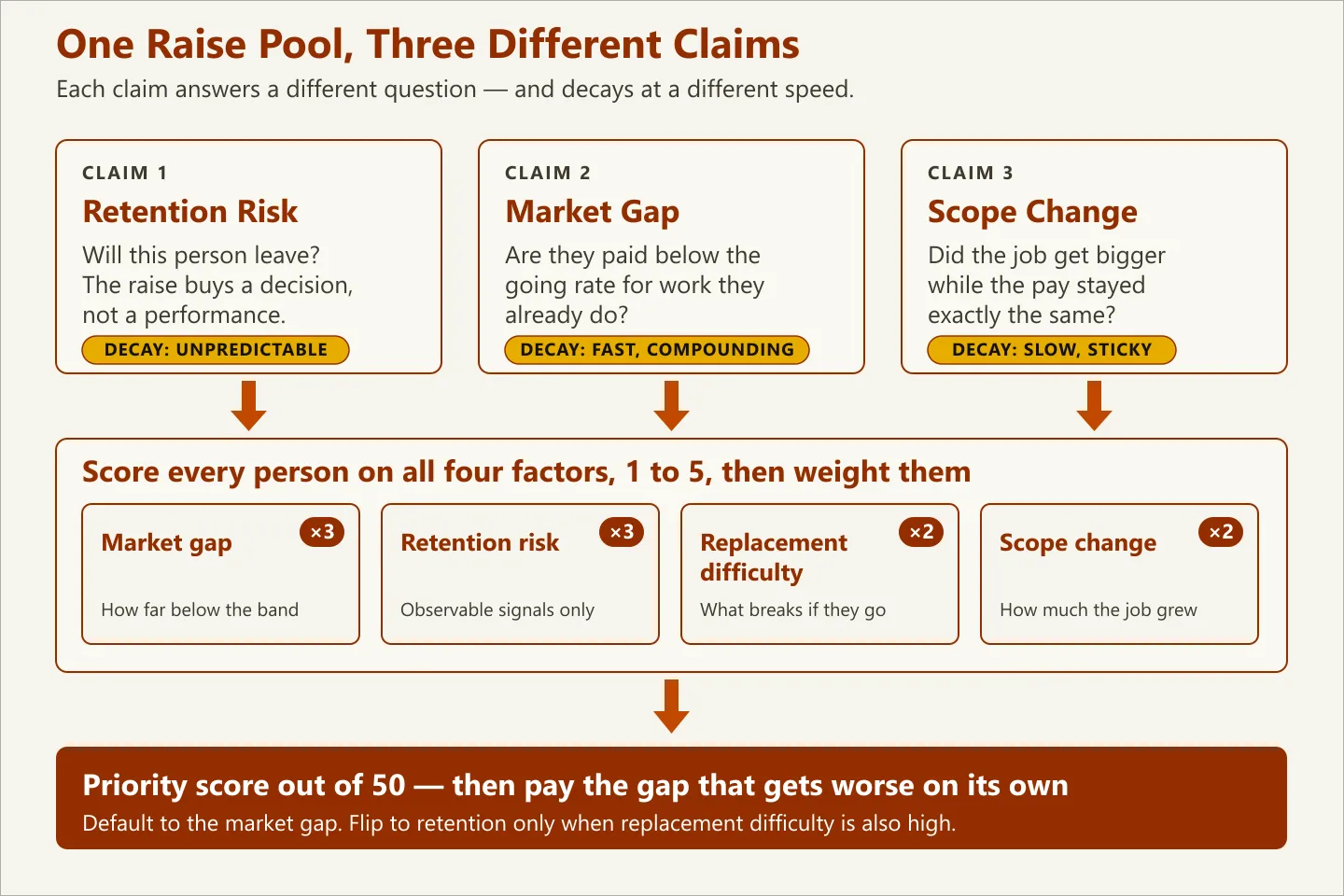
Score each person on four factors, 1 to 5, then weight them. The point of the weights is not precision. It is that you commit to what matters before you look at the names, which is the only reliable defense against deciding with your gut and reverse-engineering a reason afterwards.
| Factor | What you are scoring | Score 1 | Score 5 | Weight |
|---|---|---|---|---|
| Market gap | How far below the pay band midpoint they sit for the work they actually do | At or above midpoint | 15%+ below, doing the full job | ×3 |
| Retention risk | Specific, observable signals — not a feeling | No signals at all | Actively interviewing, or has told you | ×3 |
| Replacement difficulty | What breaks, and for how long, if they go | Covered by two other people | Sole holder of critical work | ×2 |
| Scope change | How much the job grew since pay was last set | Same job as last year | Materially larger role, same pay | ×2 |
Multiply, add, and you have a priority score out of 50. The two ×3 factors are the ones that get worse on their own; the two ×2 factors change how expensive it is when they do.
Two definitions this depends on, because scoring the market gap honestly is where most of these exercises quietly fall apart:
- A pay band is the minimum-to-maximum salary range you have decided a given role is worth, which is what turns “she seems underpaid” into a measurable distance.
- Compa-ratio is that distance expressed as a single number — someone’s pay divided by their band midpoint, so 0.85 means they sit 15% below the middle of their own range.
If you do not have bands yet, this is the step that has to happen first, and it is genuinely most of the work. The Compensation Pay-Band & Pay-Equity Workbook builds the bands, computes compa-ratio and range penetration per person, and screens for pay equity — so the market-gap column becomes a calculation rather than an impression.
For the scope-change column, the input you want is a rating you can defend next to everyone else’s, not a memory of the last eight weeks. The Performance Review & Calibration Workbook scores the team on shared criteria and calibrates the rating distribution, which is what stops one generous rater’s 5 from outranking a careful rater’s 4.
A Worked Example: Splitting One Raise Pool Across Five People
Here is how the math plays out with illustrative numbers — a made-up five-person team, a $10,500 annual pool, and the four factors above.
| Person | Market gap (×3) | Retention risk (×3) | Replacement difficulty (×2) | Scope change (×2) | Priority score |
|---|---|---|---|---|---|
| Dana | 5 | 2 | 4 | 3 | 35 |
| Priya | 2 | 5 | 4 | 2 | 33 |
| Marcus | 2 | 1 | 2 | 5 | 23 |
| Tomas | 2 | 2 | 3 | 2 | 22 |
| Elise | 1 | 1 | 1 | 1 | 10 |
Dana and Priya finish two points apart, which is exactly the argument this post opened with: Dana is 15% under her band, Priya is the one who might leave. The score does not break that tie on its own — but the decay table does. Dana’s gap grows without anybody’s help; Priya’s risk may not materialize, and if it does, it is a conversation you can have again.
Look at Marcus and Tomas too, because that pair is the weighting doing its job. Tomas is ahead of Marcus on retention risk and on replacement difficulty, level on market gap, and behind on only one column. Marcus finishes ahead anyway, and the arithmetic is the whole argument: his three-point lead on scope change is worth six, while both of Tomas’s one-point edges together are worth five. That is why you set the weights before you look at the names — a profile that is slightly better in several places is not the same as one claim that is clearly true in a place that matters.
An allocation that follows from that:
- Dana — $6,000. A band correction, framed as one. This is not a reward, it is a fix, and saying so out loud is what makes it repeatable next year.
- Priya — $3,000. Enough to be a real answer to a real concern, paired with the non-pay change she actually asked for.
- Marcus — $1,500. His job got bigger, which is genuine but slow-decaying, and a dated commitment to revisit at the next cycle costs nothing and means something.
- Tomas and Elise — $0 this cycle, with a specific, written statement of what would change it.
That is $10,500. Note what it is not: five equal slices. Three people got a number that changes a decision, and two people got the truth instead of $40 a week.
Four Ways Managers Get the Raise Decision Wrong
- The peanut-butter raise. Dividing the pool equally feels fair and satisfies nobody. An amount too small to change anyone’s behavior still costs the entire budget, so you have spent all the money and bought none of the outcomes.
- Recency scoring. Whoever had a visible win in the last two months scores higher on everything, including factors that have nothing to do with recent performance. Score the whole team on one column before moving to the next — it is much harder to drift when you are comparing five people on one question than one person on five.
- Paying the loudest ask. Related to recency, and more expensive. The overlap between “asked for a raise” and “should get the raise” is real but partial, and treating the ask as the decision hands your compensation budget to whoever is most comfortable negotiating.
- Ignoring pay compression. If a recent hire earns more than someone with four years and better output, that is the most corrosive number in your payroll and it is invisible right up until it is not. Compression usually outranks everything else on this list, because it is the one gap people can verify for themselves.
What to Say to the People Who Did Not Get the Raise
Most of the damage in a raise cycle is not done by the allocation. It is done in the week afterwards, by managers who avoid the conversation and hope nobody notices.
They notice. And they talk. How much of that is even your choice depends on where your employees work: Colorado’s Equal Pay for Equal Work Act requires employers to disclose compensation in all job postings and notices, both internal and public (opens in new tab), and prohibits employers from preventing employees from discussing their pay. Check what your own state requires — and either way, plan your explanation for a world where the numbers are known.
Three things a good version of that conversation contains:
- The actual reason, named. “The increase went to a band correction — Dana was materially below the range for her role, and that had to be fixed first.” Not “budget was tight this year,” which everybody already knows is true and nobody experiences as a reason.
- What would change it, specifically. A named piece of scope, a skill, or a coverage gap — something they could point at in six months and say “I did that.” Vague encouragement is worse than nothing, because it converts into a grievance the moment the next cycle passes.
- A date. Not “we will see how things go.” The next review cycle, on the calendar, with this conversation attached to it.
If none of those three is available to you, that is worth knowing too. It usually means the person has no real path here at their current pay, which is a different problem than a raise budget and will not be solved by one.
The Verdict: Who Should Get the Raise
Default to the market gap. When one raise has to do one job, pay the person sitting furthest below the band for work they are already doing — because that is the only one of the three claims that gets worse on its own, and the only one where “we should have fixed this sooner” will be provably true.
Three situations flip it:
- Retention risk and replacement difficulty are both high. If someone is actively looking and is the sole holder of critical work, the outage cost dominates. Pay them, and start fixing the coverage problem the same week — you have just discovered you were one resignation away from a bad quarter.
- Nobody is meaningfully below band. Then the market claim is empty and the money should follow scope: pay the person whose job grew the most since their pay was last set.
- You have a compression problem. A newer hire out-earning a stronger, longer-tenured colleague outranks everything, including a live flight risk. It is the gap most likely to be discovered, and the hardest to explain once it has been.
And the honest fourth case: sometimes the right answer is that nobody on this team gets a meaningful raise this cycle, because everyone sits fairly inside their bands and the budget does more as one non-pay change the whole team feels. That answer is defensible — but only if you say it out loud, on a date, with the reasoning attached.
The one thing that is never defensible is deciding in your head, splitting the money to make the discomfort go away, and calling it fair.
Common Questions About Deciding Who Gets a Raise
Should I split the raise between two people instead?
Splitting is right when two people both sit below the band for work they are already doing, because a band correction has a defined size — you are paying a gap, not a ranking, and a half-fixed gap is still a gap. Splitting is wrong when you are using it to avoid choosing. The test: can you name the specific size each half is meant to close? If not, you are peanut-buttering with extra steps.
What if the person asking is not the person who scores highest?
Score them anyway, then tell them the truth about where they landed and what would move it. An ask is information, not a claim — it tells you their retention risk went up, which is a real input to one of the four factors. What it must not do is skip the other three.
Do I have to tell people what everyone else got?
No, but plan for them to find out. Depending on where your employees work, pay ranges may have to be disclosed by law whether you want them disclosed or not. The practical standard is this: could you say your reasoning out loud to the whole team without changing a word of it? If not, the problem is the reasoning, not the disclosure.