You made your first hire. For about six weeks it felt like a win. Then it started to feel like a second job — you’re re-checking their work at night, little things are drifting, and one Tuesday you catch yourself thinking the thought every new boss eventually thinks: maybe it’s easier to just do it myself.
The short version: to run a one-on-one with your first employee, put a recurring 15-minute private meeting on the calendar, name it something unthreatening like “weekly check-in,” let them talk first, and end every meeting with a written who-does-what list. That’s the entire system. And here’s the reframe underneath it — the thing nobody tells you when you make your first hire: the problem almost certainly isn’t your employee. It’s the missing rhythm. You hired a person, but you never built the one habit that makes managing a person work: a short, recurring, protected conversation. A one-on-one.
Jump to the shape of the meeting if you want the structure right now. Otherwise, let’s follow one maker through it — including how to keep the habit from dying in month two.
The six weeks that send you back to doing it yourself
Picture a candlemaker — let’s call her Renata, a composite of the makers we see all the time. Two years of nights and weekends turned her kitchen-table hobby into a real shop: a rented studio unit, a wholesale account, more orders than two hands can pour. So this spring she did the scary thing and hired her first employee. Jordan. Twenty hours a week, mostly pouring, labeling, and packing.
For about six weeks, it felt like a win. Then it started to feel like a second job.
Renata found herself re-checking Jordan’s work at night. Little things drifted — a label crooked here, a wax temperature guessed there. She’d meant to mention the new wholesale packing standard three times and never found the moment. Jordan, for his part, had no idea he was doing anything wrong, and had stopped asking questions because Renata always looked busy.
Nothing here is a performance problem. Nobody was slacking, nobody was careless, and Jordan would have fixed every one of those things on the spot if anyone had told him. What was missing wasn’t effort or talent — it was a place for the two of them to talk that didn’t depend on catching each other between pours. That’s the gap a one-on-one fills, and it’s why the fix looks so small relative to the problem.
What a one-on-one actually is
A one-on-one is a short, recurring, private meeting between you and one person who reports to you — its entire purpose is the working relationship, not the day’s task list. Fifteen to thirty minutes. Just the two of you. On the calendar, every week or two, whether or not anything is “wrong.”
That last part is what makes it work. Most first-time bosses only talk to their new hire when something breaks — a batch is ruined, an order ships late, a customer complains. So every real conversation becomes a correction, and the employee learns that face time with the boss means bad news. A one-on-one flips that. It’s the one slot where the person knows they’ll be heard before the wheels come off.
It is emphatically not a status meeting. You already know the orders got packed — you can see the shelf. The one-on-one is for everything the shelf doesn’t tell you: what’s confusing, what’s frustrating, what they’re ready to take on next, and the two crooked labels they’ve been quietly unsure about for a month.
If that sounds soft, consider the hard version. Gallup’s analysis of 27 million employees found that managers account for at least 70% of the variance in team engagement (opens in new tab). When you’re the whole management team — which you are, with one employee — that number isn’t abstract. The single biggest lever on whether Jordan stays, cares, and gets better is the quality of his relationship with you. The one-on-one is where that relationship actually gets built.
Renata’s first one-on-one (and why it was clumsy)
The following Wednesday, Renata tried it. She’ll be the first to tell you it was awkward.
She’d texted Jordan the night before — “hey, want to grab 20 min tomorrow before we pour to check in?” — which, she realized too late, sounded exactly like a firing. Jordan showed up braced. She had no plan, so she opened with “So… how’s it going?” and got the answer that question always gets: “Good, yeah, fine.”
They stumbled through ten minutes. But right at the end, filling a silence, Jordan mentioned that he’d been guessing on wax temperature because the thermometer’s numbers had rubbed off and he didn’t want to bug her for a new one. A $9 thermometer had been quietly costing Renata a re-pour a week for a month.
That’s the whole case for one-on-ones in a single moment. The information you most need is almost never volunteered in the flow of a busy shop. It surfaces only when you build a container for it.
The clumsiness, by the way, is normal and temporary. A few things Renata fixed for round two:
- Name the meeting so it isn’t scary. “Weekly check-in” beats a vague “can we talk,” which reads as a threat. Put it on a recurring calendar invite so it’s obviously routine, not an event.
- Have a tiny bit of structure. Not a script — a shape. Three or four things you move through every time so neither of you is staring into “so… how’s it going?”
- Let them talk first. It’s their meeting more than yours. Your job is mostly to ask and to listen, then to remove whatever they name.
The shape of a good one-on-one
You don’t need a corporate agenda. You need four moves, in roughly this order. Renata now runs the same rhythm every week, and it fits in fifteen minutes.
| Segment | Minutes | What happens | A question that opens it |
|---|---|---|---|
| Their world | ~5 | They talk first — wins, frustrations, anything on their mind | “What went well this week, and what was annoying?” |
| Your world | ~4 | The one or two things you need to pass on — a standard, a heads-up, priorities for next week | “Two things on my end this week…” |
| Blockers | ~3 | Anything slowing them down that you can remove — a tool, a decision, an answer | “What’s in your way that I could clear?” |
| Next + growth | ~3 | Confirm action items, then one forward-looking beat about a skill or goal | “What do you want to get better at or take off my plate?” |
Two rules make this work over the long haul:
- The employee’s agenda comes first. If you spend the whole slot delivering instructions, you’ve built a status meeting with extra steps, and they’ll stop bringing you the real stuff.
- Don’t cancel it. The fastest way to teach someone they don’t matter is to bump their one-on-one every time you get busy. Reschedule if you must; skipping outright sends a message you don’t intend.
A question bank for when your mind goes blank
The hardest part of a one-on-one is not going empty at minute six. Keep a short list and pull one when you stall. Rotate them — you don’t ask all of these every week:
- What’s the most frustrating part of your week right now?
- Is there anything you’re unsure about but haven’t wanted to ask?
- What’s something we do that doesn’t make sense to you?
- If you could change one thing about how the shop runs, what would it be?
- What do you want to be doing more of? Less of?
- Is there a task I’m still doing that you could take over?
That second question — “unsure but haven’t wanted to ask” — is the thermometer question. It’s where the quiet, expensive stuff lives.
The part that makes or breaks it: what happens after
Here’s the failure mode that kills one-on-ones in month two. You have a lovely conversation, Jordan raises three things, you nod sincerely — and then nothing changes, because you forgot two of them by the time you were elbow-deep in wax. Do that twice and the meeting is dead. He’s learned that talking to you is a way to feel heard, not to actually change anything.
A one-on-one is only as good as its follow-through. Every meeting should end with a tiny, explicit list of who’s doing what by when — and that list has to survive until the next meeting. It’s the difference between “we should reorder the amber jars” evaporating and “Renata reorders amber jars by Friday” actually happening.
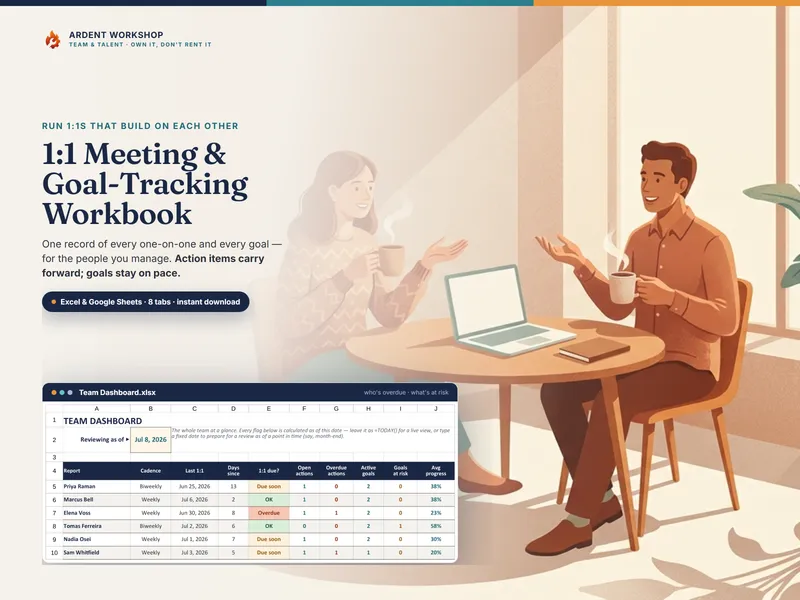
This is exactly where a shared record beats memory and sticky notes. Renata started keeping every check-in in one place — a running log of what they discussed, plus an action list where open items carry forward and nag her until they’re closed. That’s the whole idea behind the 1:1 Meeting & Goal-Tracking Workbook: one file that logs each meeting and rolls unfinished action items forward, flagged Overdue or Due soon, until you close them. And once you’re managing more than one person, its dashboard flags who you’re overdue to sit down with. It replaces the “wait, what did we say last time?” scramble that makes most people quietly abandon the habit.
If you’d rather start with paper, start with paper. The mechanism matters more than the tool: capture the actions, review them at the top of the next meeting. Open every one-on-one by reading last week’s list out loud. That thirty-second ritual is what turns a nice chat into a system.
From “check-in” to actual growth
Once the weekly rhythm settles — usually a month or so in — the one-on-one quietly changes jobs. It stops being about firefighting and starts being about where the person is going. That’s the point where a first hire either grows into real help or plateaus into a set of hands you still have to supervise.
For Renata, the “Next + growth” beat is where she and Jordan started naming skills. He wanted to learn the wholesale side — not just pack the boxes, but understand the account. So they set one small goal at a time and tracked it against the calendar, not against a vague someday. A goal that’s “40% done” means nothing on its own; a goal that’s 40% done with 70% of its time gone is a goal that’s quietly slipping. Seeing pace, not just percentage, is what lets you catch it early — and it’s why the workbook tracks goals against elapsed time rather than a lonely progress bar.
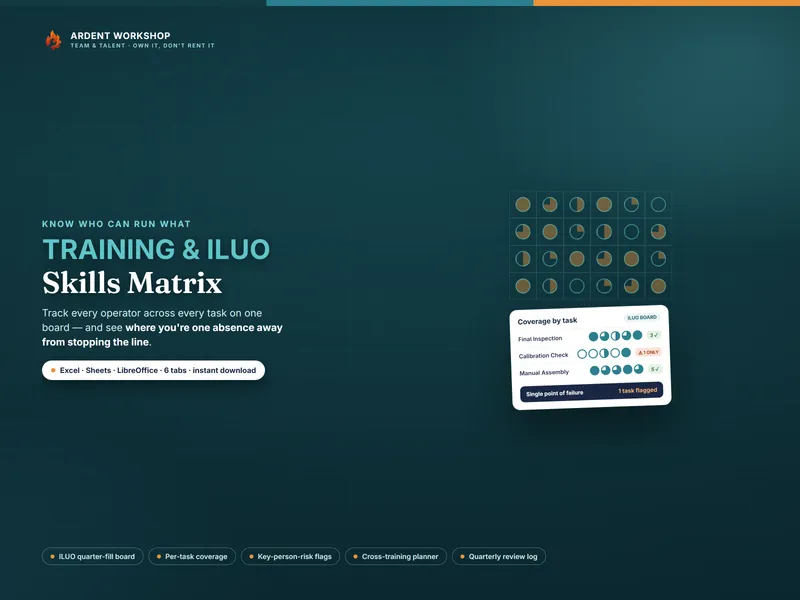
If you want to be more deliberate about what to teach next, this is where a simple skills map earns its keep. Laying out the handful of tasks your shop depends on and marking who can do each one — even for a team of one plus you — turns “Jordan should learn more stuff” into a concrete order of operations. A Training & ILUO Skills Matrix — a grid that rates each person from Inexperienced to Optimizing (that’s the “ILUO”: Inexperienced, Learning, Uses, Optimizes) on every task — does exactly that: it shows, at a glance, which skills live only in your head and which ones your new hire has genuinely picked up. The gaps it exposes become your one-on-one agenda for the next few months.
This connects directly to the bigger project every solo maker eventually faces: getting the business out of your head and into a system other people can run. Your one-on-ones are where you find out what’s still trapped up there — and if you haven’t yet, it’s worth reading what to hand off first when you finally hire shop help. The one-on-one is the conversation; delegation is what you’re building toward.
Six months later
By the fall, Renata’s Wednesday check-in was a fifteen-minute fixture, not a source of dread. The re-pours stopped. Jordan ran the wholesale packing standard without being reminded, because they’d talked it through in week two and written it down in week three. He’d taken over reordering supplies entirely. Renata stopped re-checking his work at night — not because she’d lowered her standards, but because the standards now lived somewhere other than her own worried head.
The awkward first meeting was worth it. Nearly all of them are. If you’ve made your first hire and you’re feeling that low hum of “why is this harder than doing it myself,” the answer usually isn’t a better employee or a longer to-do list. It’s a standing fifteen minutes, the same time every week, where the person you hired can finally tell you about the thermometer.
The takeaway, if you take nothing else: put a recurring fifteen-minute one-on-one on the calendar this week, let your employee talk first, and write down what you both agree to do before you leave the room. That’s the entire system. Everything else is refinement.
Managing your first employee is a skill like pouring wax or costing a recipe — nobody’s born knowing it, and it gets a lot easier with the right structure. When you’re ready to make it stick, the 1:1 Meeting & Goal-Tracking Workbook gives you the log, the action tracker, and the question bank in one owned file — no seats, no monthly fee, just the rhythm that turns a nervous first hire into someone you trust with the shop.