You already know who it is. There’s one name on your team that makes your stomach tighten a little when it lands in your inbox. The work comes in late, or half-right, or needs redoing. You’ve dropped hints. You’ve re-explained things you’re pretty sure you explained a month ago. And lately you’ve caught yourself doing the quiet math: how hard would it actually be to replace them?
Sound familiar? Almost every manager hits this moment. The temptation is to treat it as a hiring mistake — a bad apple you need to swap out. But before you write anyone off, it’s worth knowing that most underperformance is a fixable situation, not a permanent trait. The gap between “give up” and “turn it around” is usually one honest, well-structured conversation and a short window to prove it can change.
This post is the system for that. Managing an underperforming employee well isn’t a script for firing someone gently — it’s a real diagnostic for figuring out why they’re struggling, and a coaching approach that either fixes it or gives you the clarity to make a harder call with a clear conscience.
Start Here: Underperformance Is a Symptom, Not a Verdict
Underperformance is a symptom — the visible result of an underlying cause you haven’t diagnosed yet. Missed deadlines, sloppy output, and low energy are what you see. They are almost never the actual problem. The actual problem is usually one of a small handful of fixable things: unclear expectations, a skill gap, a role that doesn’t fit, a blocker you can’t see from where you sit, or something happening outside of work.
This matters because it’s expensive to get wrong in both directions. Replacing an employee is costly — Gallup estimates the cost of replacing one worker runs from one-half to two times their annual salary (opens in new tab), once you count recruiting, training, and the months a new hire takes to reach full speed. But keeping a coasting employee drags down everyone around them. The goal isn’t to be patient forever. It’s to diagnose fast, coach honestly, and set a clear line so you’re not stuck in limbo for six months.
There’s also an uncomfortable truth worth naming up front: a lot of underperformance is partly a management problem. Gallup’s research famously found that managers account for at least 70% of the variance in team engagement (opens in new tab). That doesn’t mean it’s your fault. It means you have far more leverage than you think — and the diagnostic below starts with the causes you can actually control.
Why Good Employees Start Underperforming
Here’s the part that surprises new managers: the person struggling today was, in most cases, hired because they were capable. Something changed, or something was never set up right in the first place. When you look closely, underperformance almost always traces back to one of five causes — and each one has a different fix.
| Root cause | What it looks like | The fix |
|---|---|---|
| Unclear expectations | Work is technically “done” but not what you wanted; they seem confused when you correct it | Define “good” in writing — the standard, the deadline, the definition of finished |
| Skill or knowledge gap | Effort is there, quality isn’t; they avoid certain tasks | Targeted training, pairing, or a checklist — not more pressure |
| Wrong role or fit | Strong in some areas, consistently weak in the ones the job needs most | Reshape the role, move them, or accept it’s not a match |
| A hidden blocker | Bottlenecked waiting on you, a tool, or another team; frustration is visible | Remove the obstacle — the problem was never them |
| Something outside work | A sudden drop from a previously solid performer | A human conversation and short-term flexibility, not a PIP |
Notice how different those fixes are. If you respond to a skill gap with more pressure, you make it worse. If you respond to a hidden blocker with a performance warning, you punish someone for a problem you created. You cannot coach a problem you haven’t correctly named — which is why the conversation comes after the diagnosis, not before.
The Diagnostic: Five Questions to Ask Before You Give Up
Before your next one-on-one with this person, sit with these five questions honestly. Answer them yourself first — you’ll be surprised how often the answer points back to something on your side of the table.
- Have I ever told them, specifically, what “good” looks like? Not “do better” — the actual standard, the actual deadline, in writing. If you can’t point to where you defined it, you can’t hold them to it yet.
- Do they have the skill, or just the assignment? Capability and effort are different failures. A skilled person who’s checked out needs a different intervention than a motivated person who’s in over their head.
- Is something blocking them that I can’t see from here? Ask directly: “What gets in the way of doing this well?” The answer is often a tool, a dependency, or a bottleneck that leads back to you.
- Has something changed? A sharp drop from a previously reliable person is rarely a competence issue. It’s usually life — health, family, burnout, money.
- Would a reasonable peer have succeeded with the exact same instructions and support I gave? If not, the setup was the problem, not the person.
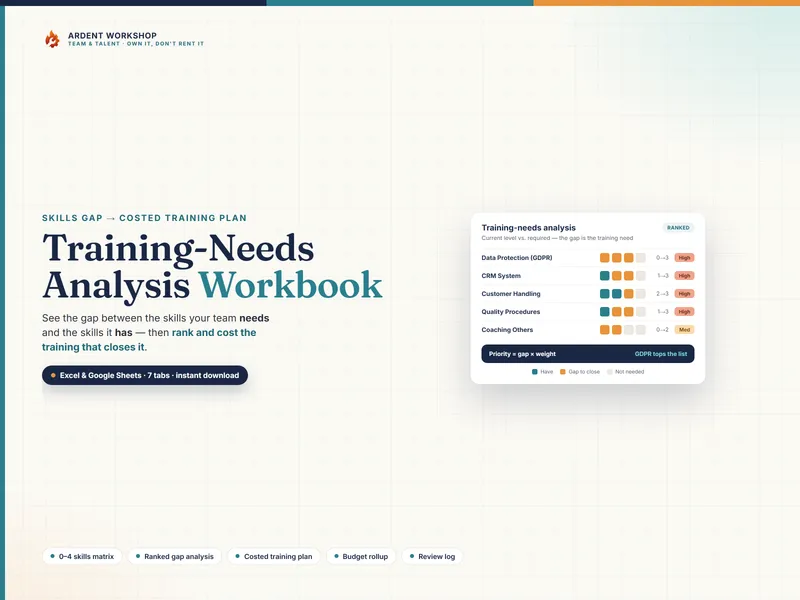
If you can’t confidently clear the first, third, and fifth questions, you’re not looking at an underperforming employee yet — you’re looking at an under-managed one. Fix your side before you coach theirs. A simple skills matrix that maps who can do what makes question two concrete: you can see at a glance whether this is a genuine capability gap or an expectations gap dressed up as one. And if it turns out to be a real skill gap, a training-needs analysis turns “they’re just not good at this” into a specific, teachable list — the difference between coaching and complaining.
This same read applies across a whole team, not just one person. If you keep finding capability gaps, here’s how to identify skills gaps on your team before someone quits.
How to Have the Coaching Conversation
Once you’ve diagnosed the likely cause, you earn the conversation. The goal of a coaching conversation is shared clarity, not a verdict — the person should leave knowing exactly what’s expected, what’s changing, and that you’re on their side about closing the gap. Here’s the arc that works.
- Open with the specific, not the general. “Your work has been slipping” invites defensiveness and gets you nowhere. “The last two reports came in a day late and I had to redo the totals” gives them something real to respond to. Facts, not adjectives.
- Ask before you tell. “Walk me through what’s been getting in the way” turns an interrogation into a diagnosis. Half the time you’ll learn the blocker in the first two minutes — and it won’t be what you assumed.
- Name the standard clearly. Restate what “good” looks like, concretely, so there’s no ambiguity to hide in later: what, by when, to what quality.
- Agree on one or two changes, not ten. Underperformers are usually overwhelmed, not lazy. Pick the highest-leverage fix and make it the whole focus. A pile of feedback is a pile they’ll drop.
- Close by writing it down together. End with a shared summary: here’s what we agreed, here’s what I’ll do to support it, here’s when we’ll check in. This is the step that’s easiest to skip — and it’s the one that makes everything after it work.
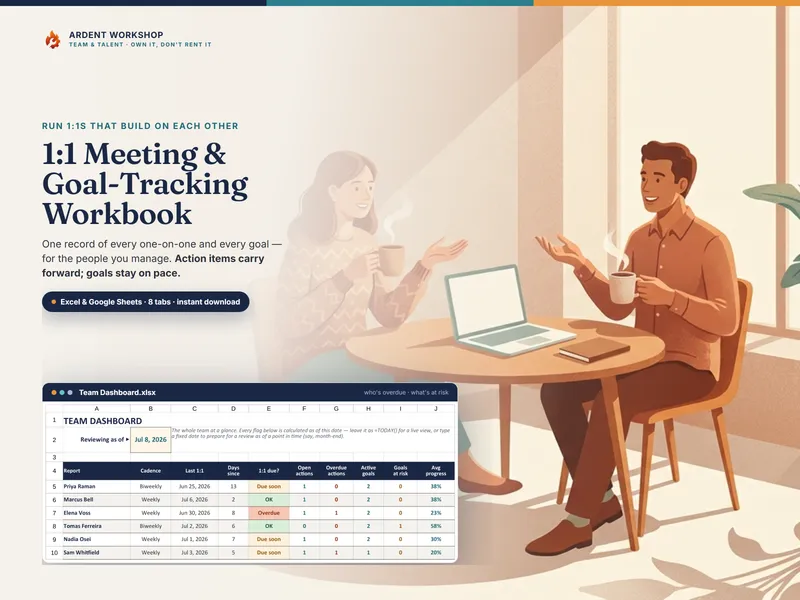
That last point is where a lot of good intentions evaporate. A coaching conversation that lives only in memory gets remembered two different ways. Running these check-ins on a repeatable structure — with the goals, agreements, and follow-ups captured in one place — is exactly what a one-on-one meeting and goal-tracking workbook is built for. It’s the difference between “we talked about it” and “here’s what we agreed on March 3rd, and here’s the progress since.” If you want a deeper playbook on the meeting itself, here’s how to run a one-on-one with your first employee without it getting weird.
Set a Clear Improvement Window
Coaching without a timeline is just hoping. After the conversation, set a concrete window — usually 30 to 60 days — with specific, observable checkpoints. This protects everyone: it gives the employee a fair, defined chance to turn things around, and it protects you from drifting into another six months of vague disappointment.
A good improvement window has three parts:
- One or two specific goals, written in terms you can both measure. “Improve communication” is not a goal. “Send a status update every Friday by noon” is.
- A visible cadence of check-ins — weekly or biweekly, short, focused on progress and obstacles. Don’t set the goal and disappear until the deadline; that’s a trap, not a chance.
- A stated outcome, so the stakes are honest. The person should know what “back on track” looks like and what happens if the gap doesn’t close.
If the window closes without real progress and a formal plan becomes the next step, how to write a performance improvement plan turns these same three parts into a written plan with measurable standards and dated check-ins.
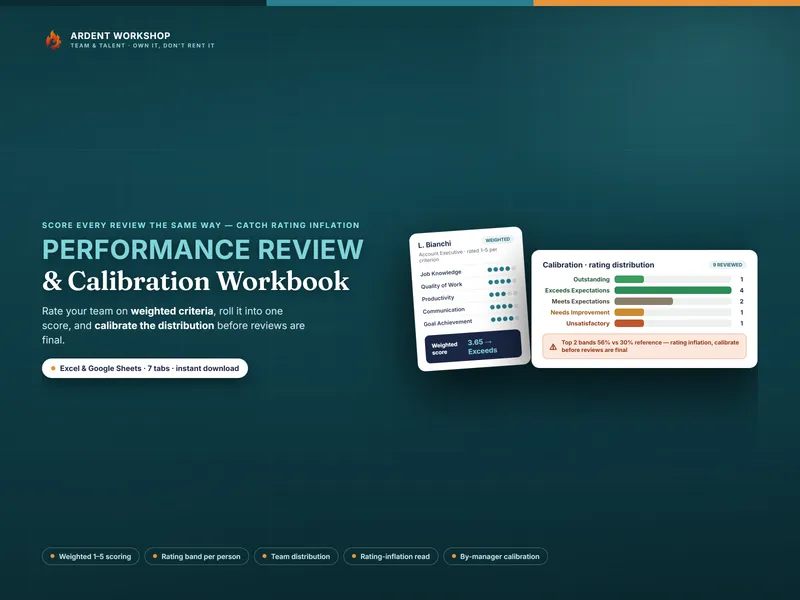
Keep the tone forward-looking, not punitive. You’re not building a case against them — you’re building a bridge and being clear about how long it stays up. Documenting each checkpoint as you go (what was agreed, what actually happened) does double duty: it keeps the coaching honest, and if the story doesn’t improve, you’ll have a fair, factual record instead of a feeling. A performance-review and calibration workbook gives that documentation a consistent, repeatable structure — so the record holds up if the story doesn’t improve, instead of coming down to your memory of a few conversations.
When It’s Actually Time to Let Them Go
Sometimes you do everything right and the gap doesn’t close. That’s real, and dragging it out helps no one — least of all the rest of your team, who see exactly who’s coasting and quietly wonder why you allow it. The line to stop coaching isn’t a bad month; it’s a fair, documented chance that didn’t change anything that’s within the person’s control to change.
Run through this checklist before you make the call. If every one of these is genuinely true, you’ve done right by them, and it’s time.
- I clearly defined the standard, in writing, and confirmed they understood it.
- I ruled out skill gaps, blockers, and outside-of-work factors — or addressed the ones I found.
- I had a direct coaching conversation and agreed on specific, measurable changes.
- I set a defined improvement window with real check-ins, and I showed up for them.
- I documented each checkpoint factually as it happened.
- The gap is in something they can control — effort, reliability, behavior — not something I failed to set up.
The distinction on that last box matters most. If the failure is capability and the role genuinely can’t be reshaped, that’s a fit problem, and a respectful move or exit is often kinder than years of feeling underwater. If the failure is a persistent effort or reliability problem after fair coaching and clear stakes, that’s a values problem, and no amount of coaching fixes it. Either way, you’re not “giving up” — you’re concluding a fair process. There’s a real difference, and both of you deserve to feel it.
The Bottom Line
The manager who fires fast looks decisive and quietly churns through people, retraining every few months and wondering why the team never gels. The manager who coaches first — diagnose, converse, set a window, decide honestly — keeps more good people, catches the fixable problems early, and makes the genuinely necessary exits cleaner and rarer.
Underperformance is almost never a verdict on the day you first notice it. It’s a symptom asking to be diagnosed. Run the diagnostic, have the honest conversation, give a fair and finite window — and then, if you have to, make the call knowing you did it right. Most of the time, you won’t have to.