Picture a baker — call her Renata, a composite of the solo makers we’ve watched cross this exact line. For three years she ran her whole operation alone: mixing at 5 a.m., answering messages at red lights, labeling boxes on the couch at midnight. The business grew until “alone” stopped working. So she did the brave, terrifying thing. She hired someone.
And then, on the first morning, she stood in her own kitchen with a second person in it and realized she had no idea what to tell them to do.
Everything she knew how to do, she knew with her hands. None of it was written down. Her new hire — eager, capable, wearing a brand-new apron — looked at her and asked, “Okay, where do you want me to start?” And Renata’s mind went completely, embarrassingly blank.
If you’ve ever worked solo and then hired your first person, you know this exact silence. Onboarding your first employee isn’t about handing someone an apron — it’s about transferring everything that’s been living in your head, on purpose, in an order that actually works. That’s harder than the hiring was. Here’s how it actually plays out, and how to do it without losing your rush in the process.
The morning your own expertise turns invisible
Here’s the cruel twist of being good at something: the better you are, the less you can explain it.
Renata didn’t have a “process” for frosting a dozen cupcakes. She had three years of muscle memory compressed into ninety seconds she’d never once narrated out loud. When her new hire asked how much frosting per cupcake, the honest answer was “you’ll just feel it” — which is a useless thing to say to someone on day one.
This is the first thing nobody warns solo owners about. The knowledge that makes your business work is mostly invisible, even to you. It’s in the order you do things, the shortcuts you take, the small judgment calls — “this batch needs another two minutes,” “that customer always wants extra packaging” — that you make a hundred times a day without thinking.
When you’re alone, invisible knowledge is fine. It’s all in one head and that head shows up every morning. The moment you add a second person, every invisible thing becomes a question you have to answer in real time, usually while you’re also trying to get an order out the door. That’s why the first week of having help so often feels worse than working alone.
It’s not a sign you hired wrong. It’s a sign you’ve hit the exact wall every growing operation hits — and the way through it is a system, not more hustle.
Why your first hire makes you slower before they make you faster
Brace for this, because it surprises almost everyone: for the first week or two, a new hire usually makes you less productive, not more. Every minute you spend showing, checking, and re-explaining is a minute you’re not producing. You’re now doing your job and teaching at the same time.
This dip is normal. Think of it as a J-curve — things get a little worse before they get a lot better. Owners who give up on a new hire too early often do so during the dip, right before the climb. The ones who push through reach the part where the second pair of hands finally multiplies what they can make.
The dip is also why a real onboarding plan matters so much. Most small operations don’t have one — they wing it — and it shows. Gallup finds that only 12% of employees strongly agree their organization does a great job onboarding new employees (opens in new tab). For a solo owner, that statistic is good news in disguise: a little structure puts you ahead of almost everyone, including businesses far bigger than yours.
You shorten the dip three ways: you prepare before day one, you train in stages instead of all at once, and you hand off the right work in the right order. Renata learned all three the hard way. You don’t have to.
Before day one: get what’s in your head onto paper
The work of onboarding starts before your new hire ever arrives. Spend a few hours writing down the things you do without thinking — that single act prevents most first-week chaos.
You don’t need a corporate handbook. You need a short, honest list of how your operation actually runs. Walk through a normal day and capture it as you go:
- The opening and closing routine. What happens first thing, what happens last thing, and in what order.
- Your two or three core processes. The recipes, the build steps, the packing sequence — the things you repeat constantly. Write them the way you’d explain them to a smart friend, including the “you’ll just feel it” parts you’d normally skip.
- The standards. What “done right” looks like, and what a reject looks like. A photo of a good one next to a bad one is worth a page of text.
- The judgment calls. The little decisions — substitutions, customer exceptions, when to throw something out — that you’ve never had to explain because you were the only one making them.
- Where everything lives. Supplies, tools, logins, the spare label roll. Solo, you just know. A new person doesn’t.
This is also the moment to handle the unglamorous paperwork side — worker classification, payroll, and insurance — before anyone clocks in, not after. The rules vary by where you are and how you structure the role, so it’s worth getting right.
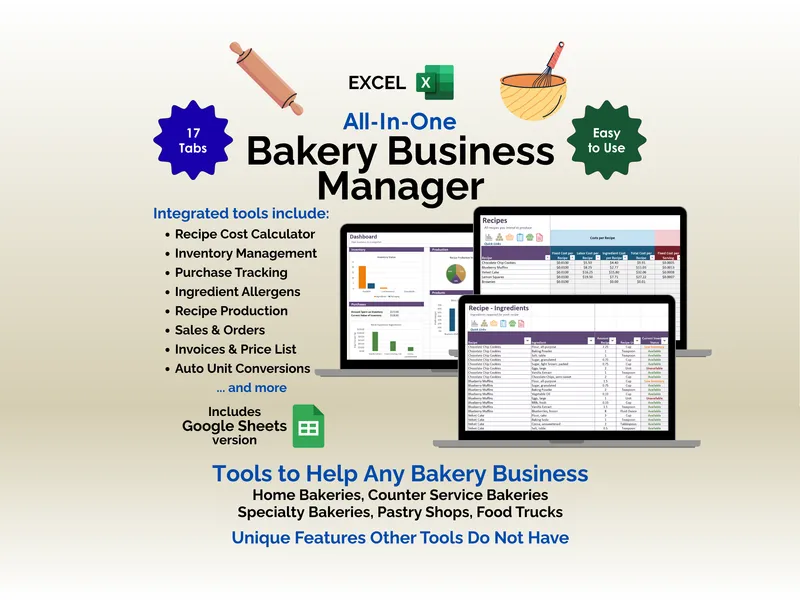
If your recipes and costs already live in a tool like the Bakery Business Manager, you’re ahead — half your “how we do it” is documented the day you open the file. If they don’t, this is the nudge to get them out of your head. A documented process is the difference between training someone once and re-answering the same question for a month. The same problem shows up the second you scale at all — the spreadsheets makers build at 2 a.m. are usually the knowledge that should have been written down years earlier.
The first week: a competency ladder, not a crash course
The biggest first-week mistake is trying to teach everything at once. Your new hire nods through a four-hour brain-dump, remembers maybe a fifth of it, and you both end the day exhausted and no further ahead.
Train one task at a time, and move it up a ladder of independence instead of declaring someone “trained” after a single demo. A simple way to track this, borrowed from manufacturing skills training, is the ILUO ladder — four stages every skill passes through on its way from “watched you once” to “could teach the next person.”
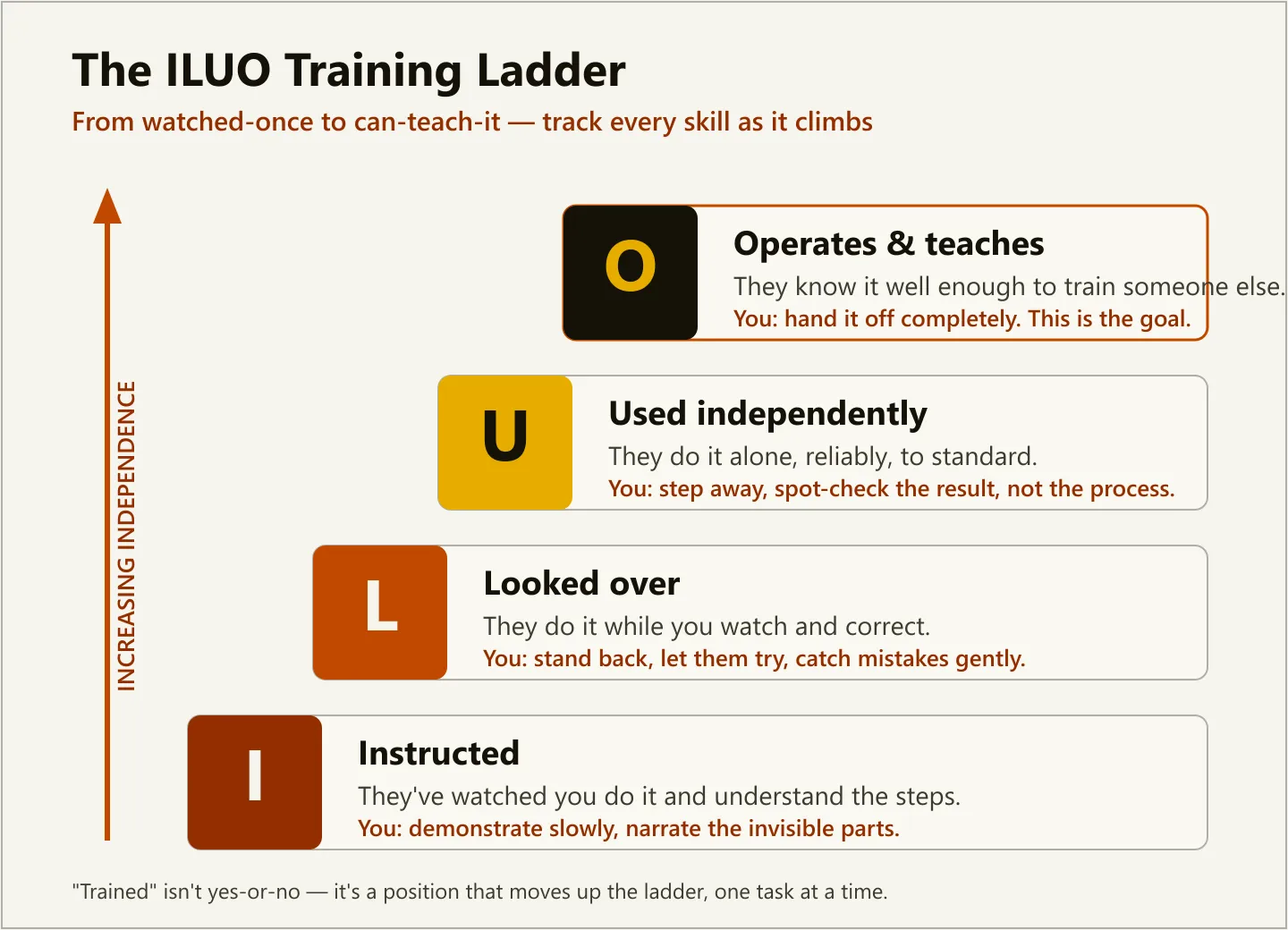
Here are the four stages in plain text, including what you do at each one — because the stages are the whole system:
| Stage | What it means | What you do |
|---|---|---|
| I — Instructed | They’ve watched you do it and understand the steps. | Demonstrate slowly. Narrate the invisible parts. |
| L — Looked over | They do it while you watch and correct. | Stand back. Let them try. Catch mistakes gently. |
| U — Used independently | They do it alone, reliably, to standard. | Step away. Spot-check the result, not the process. |
| O — Operates & teaches | They know it well enough to train someone else. | Hand it off completely. This is your goal for core tasks. |
The point of the ladder is that “trained” isn’t a yes/no — it’s a position that moves. On Monday a task might be at I. By Thursday it’s at L. Two weeks later it’s at U and off your plate. Naming the stage tells you both exactly how much you still need to hover, which kills the two failure modes at once: hovering over someone who’s ready, or abandoning someone who isn’t.
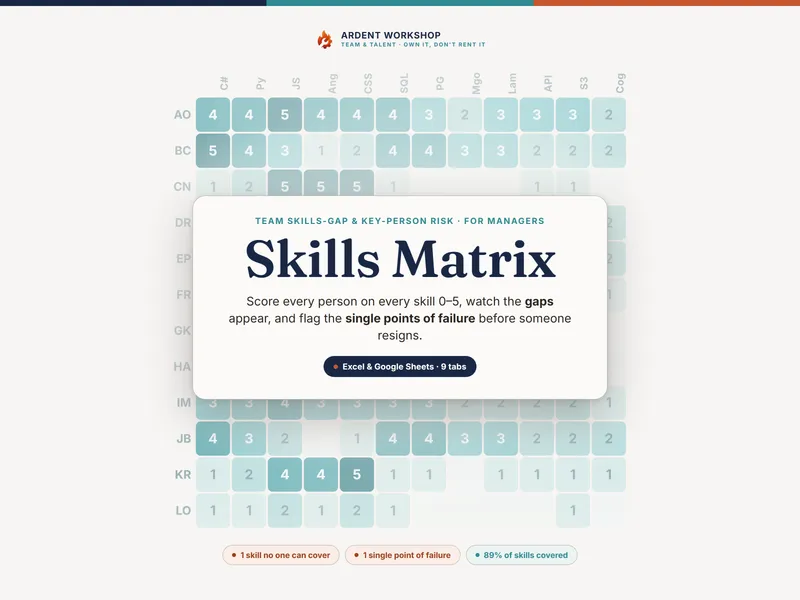
This is exactly what a training matrix is built to track — every person down one side, every task across the top, and each cell marked I, L, U, or O so you can see your whole operation’s capability on one page. For your first hire it might feel like overkill on day one. By your third hire, it’s the thing that keeps you from re-improvising onboarding every single time.
What to hand off first (and what to keep for now)
Not all work is equally safe to delegate early. Hand off tasks that are repeatable, low-stakes, and easy to check — and hold on to the ones where a mistake is expensive or hard to undo until trust is built.
A quick way to sort it:
- Hand off first: prep, packing, labeling, restocking, cleaning, order assembly, data entry. High volume, clear “right answer,” cheap to fix if it goes sideways. These are also the tasks eating the most of your hours, so the relief is immediate.
- Hand off soon, with a check: production steps to a standard, routine customer replies, inventory counts. Real responsibility, but a quick spot-check catches problems before they reach a customer.
- Keep for now: pricing decisions, custom-order quotes, handling an upset customer, anything touching money or your brand’s voice. These need your judgment until your hire has enough context to share it — and some of them stay yours for a long time.
Renata’s breakthrough came when she finally let her new hire own all of the packing and labeling — not “help with,” but own. It was repeatable, it was easy to inspect, and it was quietly stealing two hours of her every day. Handing it off completely freed her to do the one thing only she could do: make the product and grow the business.
A shared task tracker makes this handoff visible — who owns what, what’s done, what’s stuck — so “did you do the thing?” stops being a question you have to ask out loud five times a day. Delegation that lives only in your head isn’t delegation; it’s just you, worrying remotely.
The part nobody warns you about: letting it be done differently
Here’s the hardest part, and it’s not operational — it’s emotional.
Your new hire will not do things exactly the way you do. They’ll wrap a box differently. They’ll organize the shelf in an order that isn’t yours. And the first dozen times, every cell in your body will want to swoop in and fix it.
Resist that urge unless the result is actually wrong. There’s a difference between different and worse, and solo owners are notoriously bad at telling them apart at first, because for years “your way” and “the right way” were the same thing. They aren’t anymore.
This matters for a reason beyond your blood pressure. If you correct every small deviation, you teach your hire that there’s only one acceptable way — yours — and that they should stop thinking and just wait for instructions. That’s how you end up with help that can’t function without you standing there, which is the opposite of why you hired them. The goal isn’t a clone. It’s someone who can hold part of the operation on their own.
Save your corrections for results that miss the standard you wrote down. Let the rest go. The standard is the thing that has to be consistent — not the exact choreography of how they get there.
Six weeks later
By week six, Renata’s kitchen looked different. Her hire opened on their own. Packing and labeling were entirely off her plate and being done to standard — sometimes, she admitted, better than she’d done it. The training matrix on the wall had a satisfying column of Us, and one task had even crept up to O: her hire was now the one who showed a seasonal helper how to box an order.
The dip was real. For about ten days, having help genuinely felt slower and harder than going it alone, and she’d come close to deciding the whole thing was a mistake. Then the J-curve turned, the way it tends to for owners who prepared instead of winged it, and she got back something she hadn’t had in three years: a day off where the business didn’t stop.
That’s the actual payoff of onboarding done well. Not just “a second pair of hands.” A business that no longer lives entirely inside your skull.
What this means for you
If you’re a solo owner about to hire — or in the messy middle of it right now — here’s the whole thing in one breath:
- Your expertise is invisible. Before day one, write down what you do without thinking, in the order you do it.
- Expect the dip. A new hire makes you slower for a week or two. That’s the J-curve, not a hiring mistake. Push through it.
- Train one task at a time, up a ladder. Use the I → L → U → O stages so you both know exactly how much to hover. “Trained” is a position, not a verdict.
- Delegate in the right order. Hand off repeatable, low-stakes, easy-to-check work first. Keep money and brand-voice calls until trust is built.
- Let it be done differently. Correct results that miss the standard, not choreography that isn’t yours.
Onboarding your first employee well is the difference between hiring someone and actually gaining capacity. Do it on purpose, and the second person doesn’t just help you do the work — they make the business something that can run without you holding every piece of it.
As one hire becomes a small team and a wall chart stops scaling, a proper skills matrix keeps your whole crew’s capability — and your gaps — on one page; it’s also what stops your best person from quietly becoming your single point of failure, the bus-factor problem every small operation eventually has to solve. Outgrow spreadsheets entirely — inventory, production, and a growing team all needing one connected place — and Ardent Seller (opens in new tab) is the next step.