One-way door, or a door you can walk back through
The term describes a property of the choice, not its size. A decision is a one-way door when the state you were in before no longer exists to return to — you sold the business, you had the operation, you emigrated and gave up the residency. A decision is reversible — a two-way door — when you could undo it for a cost you could absorb without much thought: a rental, a trial period, a returnable order, a course inside its refund window. The pair of terms was popularized by Jeff Bezos in Amazon’s 2015 letter to shareholders, and they have stuck because the distinction is genuinely useful.
Most real decisions sit between those two, and it is worth naming where. A useful four-way split:
- Reversible (a two-way door). Undoing it costs almost nothing. These deserve far less deliberation than they usually get — trying it produces better information than any amount of thinking about it.
- Awkward. A lease, a used car, a year-long program. Getting out costs real money and some months. Worth genuine checking; not worth agonizing.
- Costly. A house move, a career change, a major renovation. Undoing it is possible and painful, and the pain is mostly transaction costs and lost time.
- A one-way door. The previous state is gone. These earn everything you can give them: the diligence, the delay, the pre-mortem, and the second opinion.
Why it matters more than how the decision feels
Anxiety tends to scale with attention rather than with stakes. A decision you have been turning over for months feels enormous; one you have not thought about feels routine. Neither of those has anything to do with what it would cost to be wrong. The predictable result is that people over-research the decisions that are nagging them and under-research the ones that are not — and the two sets are often different.
Pricing the unwind replaces a feeling with a number you can act on. Ask what it would take, in money and in months, to reverse the choice within two years. Do it for your top two options, because they are frequently very different, and that difference is itself a criterion you may not have written down.
Turning reversibility into an amount of checking
Once you have the unwind cost, you can turn it into a budget rather than a mood. How close the decision is sets how likely you are to be picking wrong; the unwind cost sets what picking wrong would cost. Their product is what checking the decision has earned.
The practical consequence is often counter-intuitive. A hard-to-undo decision that you have already exhausted yourself over is usually one you are under-checking, not over-checking — and a reversible one you have been agonizing about is usually one you should simply try. Exhaustion is not evidence in either direction.
A caution about decisions that are only technically reversible
A choice can be reversible on paper and not in practice. You can sell the house again, but you cannot un-move the children mid-year, and you cannot recover the eighteen months. When you price the unwind, price what it would actually take rather than what the transaction would cost. If part of it is something money genuinely cannot buy back, that part belongs on your criteria list as its own line, openly weighted, rather than hidden inside this calculation.
Where to start
The reversibility test, the framing questions that come before it, and the four prompts that force the option nobody listed are all in the free Frame the Decision mini-guide — eight pages, no email required. The method that turns an unwind cost into a diligence budget, and then spends that budget against a ranked list of checks, is in How to Make a Big Decision.
Templates that implement this
Tools for decisions you cannot easily undo
9 templates
The playbook that teaches the method, and the weighted scorers that apply it to specific one-way doors — a move, a career change, a business structure, a care arrangement.
- $14.95 PDF
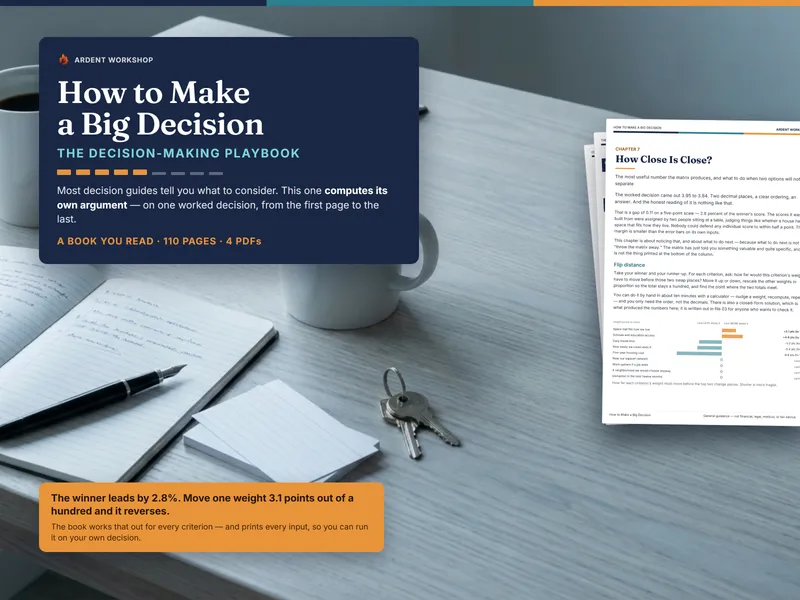
How to Make a Big Decision - The Decision-Making Playbook
How to make a big decision: weighted scoring done honestly, flip distance, the four ways you rig your own matrix, and what checking is really worth.
Big DecisionsView details - $11.95 Spreadsheet

Decision Journal & Outcome Tracker — Predict, Review, and Measure Your Calibration (Excel + Google Sheets)
A decision journal spreadsheet that scores your process the day you decide, then measures how overconfident you actually are once the results are in.
Big DecisionsView details - $2.95 Excel
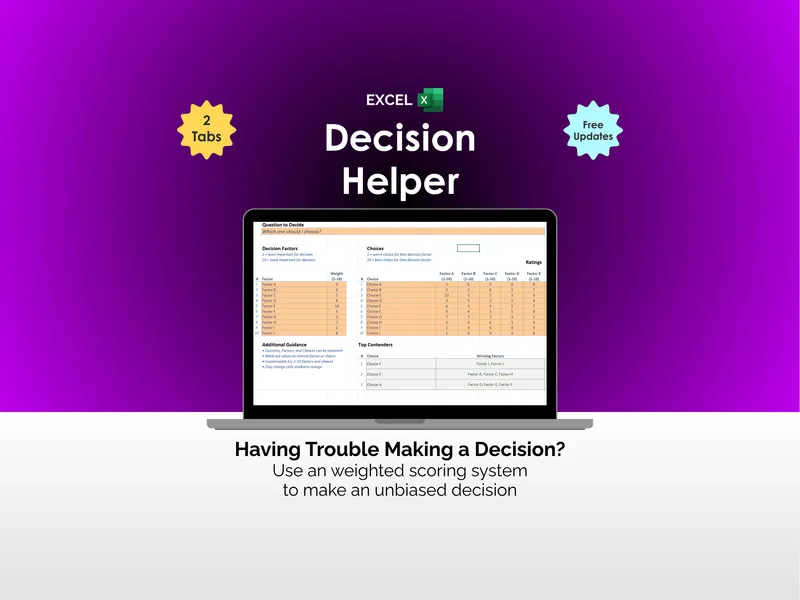
Decision Helper - Excel
Stuck on a big choice with five tabs open and zero clarity? This excel decision helper is a weighted decision matrix template that ranks options for you.
Big DecisionsView details - $14.95 Spreadsheet

Buy-vs-Rent (Home) Decision Helper - Break-Even Year, Readiness Gates & Weighted Scoring (Excel + Google Sheets)
Settle whether to buy or keep renting. Computes your break-even year, runs six readiness checks, and weights 16 criteria to your household.
Big DecisionsView details - $14.95 Spreadsheet

Career-Pivot Decision Helper — Weighted Scorecard for Job vs Self-Employment, with the Tax & Benefits Math Done (Excel & Google Sheets)
Score staying in your job against going self-employed — with the self-employment tax, the benefits you lose and the unpaid hours worked out, not guessed.
Big DecisionsView details - $18.95 Spreadsheet

Business-Entity Decision Helper — Compare LLC, S-Corp, Sole Proprietorship & C-Corp (Excel & Google Sheets)
Compare LLC, S-Corp, sole proprietorship & C-Corp with a weighted scorecard and a self-employment-tax estimator — find your best-fit structure.
Big DecisionsView details - $18.95 Spreadsheet

Franchise Decision Helper — Weighted Decision Matrix to Compare Franchise & Business Opportunities (Excel & Google Sheets)
Compare franchise & business opportunities with a weighted decision matrix — score investment, ROI, support, brand & lock-in, and rank them by overall fit.
Big DecisionsView details - $16.95 Spreadsheet

Where-to-Retire Decision Helper — Weighted Scorecard to Compare Retirement Locations on Cost, State Taxes, Healthcare & Family (Excel & Google Sheets)
Compare up to five places you might retire to — including staying put — with a weighted scorecard that computes each one's true annual cost and tax bill.
Big DecisionsView details - $14.95 Spreadsheet

Elder-Care Decision Helper — Weighted Scorecard to Compare Assisted Living, Memory Care & In-Home Care (Excel & Google Sheets)
Compare elder-care options — assisted living, memory care, nursing homes & in-home care — with a weighted scorecard that ranks them by cost, care & fit.
Big DecisionsView details