Most decision guides tell you what to consider. This one computes its own argument instead — a single worked decision runs from the first chapter to the last, and every figure in the book is calculated from it rather than asserted.
That matters because of a particular kind of tiredness: the one that comes from a decision you have been carrying for weeks, having had the same conversation eleven times, knowing every argument on both sides so well that none of them move you any more, and suspecting — correctly — that you are no closer to an answer than you were a month ago. This is a book about getting out of that. Not by being decisive, which is a personality trait and not a method, and not by finding the one consideration everybody has missed, because usually there isn’t one.
What makes this different from other decision-making guides
Most decision-making advice is a list of things that are true and do not help. Consider the long term. Beware of bias. Trust your gut, except when you shouldn’t. None of it tells you what to do on a Tuesday evening with two options in front of you and a deadline in three weeks.
The worked decision is a household with three real options and nine weighted criteria, and it is carried from the framing chapter to the outcome review without ever being swapped for a fresh example. Every input to it is printed in the arithmetic reference — the weights, the scores, the costs, the estimates — so you can check the working, disagree with any of it, and replace all of it with your own.
Five engines run on that one decision, and they chain into a single argument.
The matrix, and how close it actually is
Nine criteria, weights set before anything was scored, three options. The winner comes out at 3.95 against 3.84 — a lead of 2.8 percent, which looks like an answer and is not one.
So the book computes the flip distance: for every criterion, how far its weight would have to move before the ranking reverses. The nearest is 3.1 points out of a hundred — smaller than the amount most people would move a weight if asked to justify it out loud. And 4 of the 9 criteria cannot change the answer at any weight whatever — on three of them the two leading options score the same, and on the fourth the weight cannot fall far enough to matter. Every argument about those four is an argument that cannot change the outcome, which is a useful thing to know on a Tuesday evening.
Almost nobody computes this. It is the single most useful number a decision matrix produces.
The four ways you rig your own matrix
Revising a weight on the way home from a viewing. Adding a criterion that occurred to you late. Re-anchoring a scale that was compressing a real spread. Quietly merging away the criterion your favorite loses on.
Each is applied to the worked decision and the effect is computed. Two of the four reverse the winner. Nobody lies at any point — every one of these is a thing a careful person says out loud, to their partner, in a normal voice. The chapter’s finding is that the tell is sequence, not dishonesty: did you decide to make the change before or after you knew which option it would help?
Deciding with someone who weighs things differently
The same nine criteria, weighted twice, by two people who agree about what the options are like. They reach different winners.
Then, one criterion at a time, the book finds which differences are actually producing that — 3 of the 9. And the largest gap between the two pages, the one about money, is not one of them: moving it the whole distance from one person’s weight to the other’s leaves the winner standing. In the worked decision, most of what the two of them disagreed about could not change the answer — and the method shows you which part of yours can, so the conversation is an evening rather than a season.
What it is worth to find out
Twenty checks you could run before committing — a survey, a second opinion, a reference call, a trial period, the difficult conversation nobody has had — each with what it costs, how long it takes, how often it changes the call, and what being wrong would cost. Nine cost nothing but time and run in parallel; the eleven that cost money are ranked three ways that disagree with each other, which is the whole reason the chapter exists.
Then the budget. How close the decision is sets how likely you are to be wrong. What the unwind would cost sets what being wrong is worth. Their product is what checking has earned. For the worked decision that comes to 15,180 against a ledger costing 5,505 — so the answer is to buy the lot. Enter the same decision a reversible way and the budget falls to 792 and buys four checks. Same choice, same closeness, a completely different correct amount of work.
What is in the four files
The book is 15 chapters and 65 pages, in the order a decision actually happens: frame it, find a third option, separate the decision from the deadline, criteria before candidates, weights before scores, then test the matrix, price the unwind, buy the information, run the pre-mortem, compare weights, weigh the advice, ignore what you have already spent, write it down, and review it without rewriting the story. Each chapter ends with one exercise — fifteen in all, about six hours end to end, each needing nothing but paper.
The criteria library is the file you open before you have met any of your options, which is the one thing this method asks that almost nobody does. 57 criteria across 7 kinds of decision — a home, a job or career change, a school or program, a vehicle, care for someone, a contractor or supplier, and a financial commitment. Every one is marked as a screening gate (13 of them) or a scoring criterion (44). The 44 scoring criteria each carry how to measure them and what a 1 and a 5 actually look like; the 13 gates carry how to establish them instead. That distinction is the one most templates skip, and skipping it is how a fatal flaw gets outvoted by eight small conveniences.
It also carries the 12 decision traps, each written as what it sounds like inside your own head rather than as a textbook definition — because you will never catch yourself thinking ah, the sunk-cost fallacy, you will catch yourself thinking we have already spent so much on this. Each has the tell, the counter-move, and the chapter that defuses it.
The arithmetic reference is the working: every input, the weighted score line by line, the flip-distance derivation written out, all four rigging moves computed, the disagreement map, the twenty-check ledger with every column showing, and the diligence budget — then the whole method as ten numbered steps to run on your own decision.
Try the method before you buy
The front of it is free and ungated. The Frame the Decision mini-guide is eight pages covering the three moves that happen before any scoring — widening a yes-or-no, forcing the option nobody listed, and pricing what an unwind would cost. No email, no account.
And if your top two options both look good right now, that is a specific, solvable situation rather than a personal failing: what to do when both options look good walks it through, flip distance and all.
Who it is for
Anyone standing in front of a choice that is expensive to get wrong: a house, a job, a school, a move, a care decision, a business commitment. It works on a decision you are making alone and on one you are stuck arguing about with somebody else — Chapter 11 is written for the second case, and it is the one that turns a nine-way argument into a three-way one.
It is also genuinely gift-able. A graduation, a new job, a first house.
What it is not
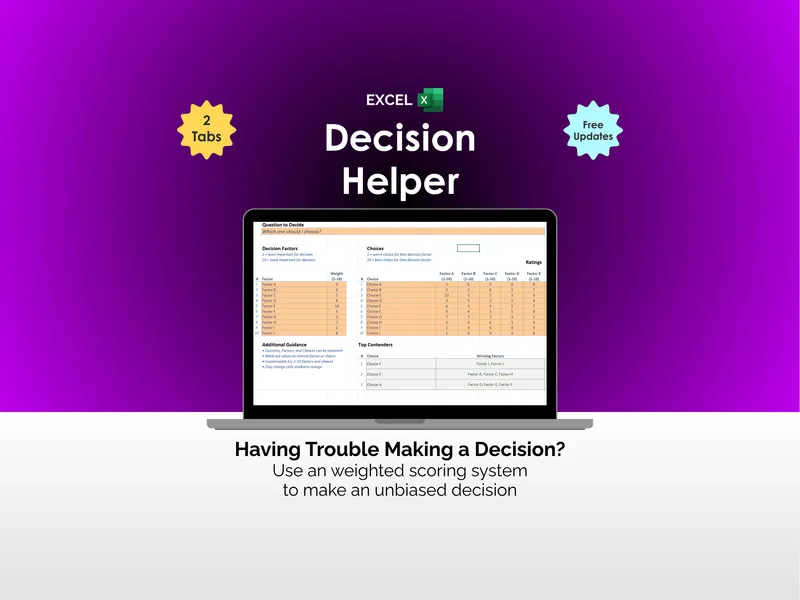
There is nothing to fill in. No spreadsheet, no form, no login — this is a book about a method, and the method runs on paper. If you would rather have the matrix already built, that is the Decision Helper, and if your decision is a house, a job, a car or a place to retire there is a helper with the criteria already written for it. This book explains what those tools are doing and where the method goes wrong; it does not replace them, and they do not contain it.
It is general decision-making guidance and not financial, legal, medical, or tax advice. Where a chapter reaches money, health, property or a contract, it says so and points you at someone qualified who knows your situation.
And every number in the worked decision is invented. The household, its three options, the scores, the weights, the costs, and above all the estimates of how often a check changes an answer — all of it is one made-up household’s planning estimates, written down so the arithmetic can be followed. None of it is research or a benchmark, and no reader should carry a figure out of the book into their own decision. The method travels; the figures do not. The book says so on its own pages, more than once.
A file you keep, not an app you rent
A big decision happens rarely, and then it happens again years later about something else entirely. Nothing here needs a seat, a subscription, or an active plan. It cannot be discontinued when a company decides the product is no longer strategic, and it will still open in ten years when your children are choosing between two places to live.
Print the chapters you use, write in the margins, and hand the marked-up copy on. That is the whole idea behind Ardent Workshop: structure you own outright, sitting between a blank page and a rented app.