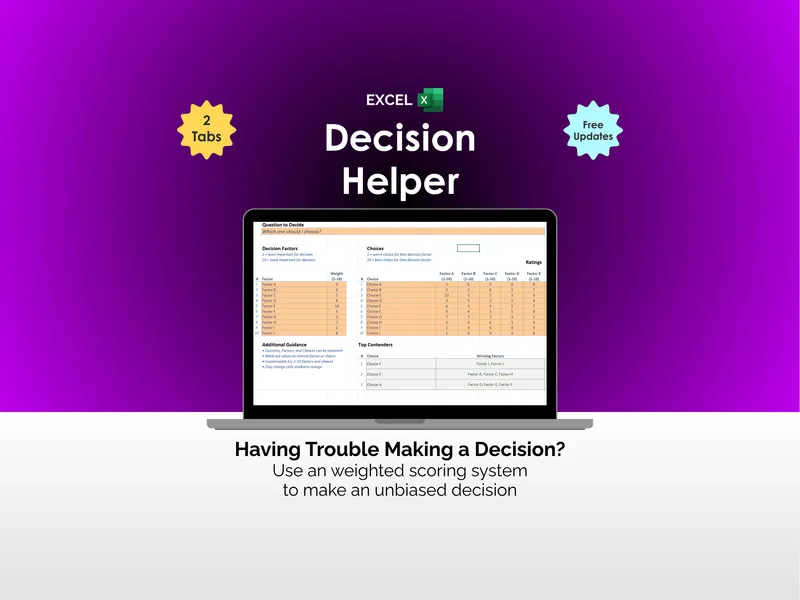
A decision matrix template is a grid: criteria down the side, options across the top, a weight against each criterion and a score in every cell. It multiplies, sums, divides and ranks. That is genuinely valuable — it is the difference between counting reasons and weighing them, and it is why a fifteen-dollar spreadsheet can out-decide a gut feeling.
What it cannot do is comment on itself. The grid will rank three options that finish a rounding error apart with exactly the same confidence as three that finish miles apart. It will faithfully compute a total from a weight you revised on the way home from a viewing. And it will hand a couple two different winners without telling them which of their nine disagreements is responsible.
The quick verdict
- A template is enough if you wrote your criteria down before you met any option, the weights have not moved since, and your winner finished clearly ahead.
- You want the method as well if the top two are close, you have revised something since the first viewing, you are stuck in a recurring argument with the person you are deciding with, or you cannot tell whether you have researched enough.
Side by side
| What matters | Decision matrix template | Decision playbook |
|---|---|---|
| What you get | A file you fill in. Criteria, weights, scores, a ranked result. | A method you read. Nothing to fill in. |
| Where the criteria come from | You. A blank template will accept any list, in any order, at any point. | A written-in-advance bank by decision type, plus the rule that the list is dated before you look at anything. |
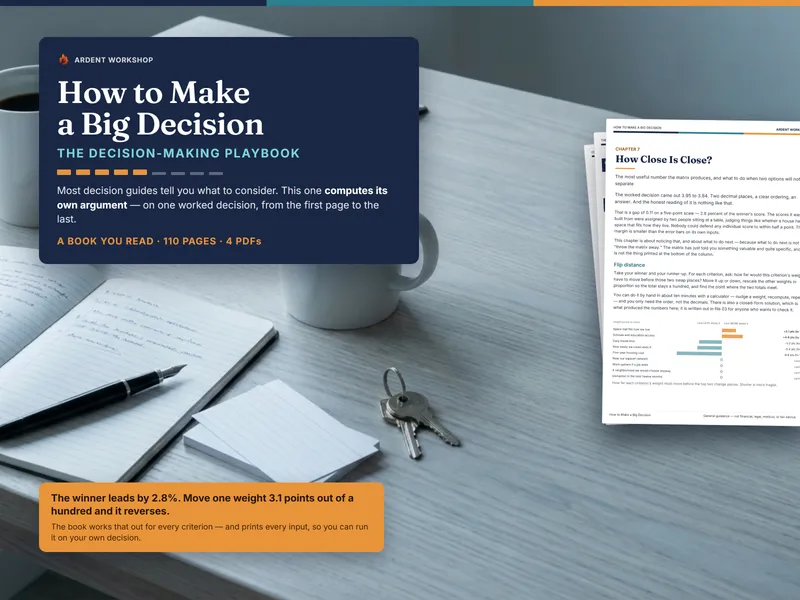
| Does it say how solid the answer is? | No. A two-point lead and a two-hundred-point lead look the same. | Yes — how far one weight must move before the ranking reverses, and which criteria cannot change it at any weight at all. |
| Does it notice you nudged it? | No. It computes whatever it is given. | It shows you what the common nudges do, applied to a worked decision, and gives you a two-line habit that makes the sequence visible. |
| Two people, two answers | Two files, and an argument about which is right. | One matrix, two weight sets, and a test for which differences actually change the winner. |
| How much research is enough? | Out of scope. | Derived from how close the decision is and what an unwind would cost, then spent against a ranked list of checks. |
| Time to first use | Minutes. | An evening for the front of the method; longer if you use all of it. |
What "close" actually means, and why a template cannot tell you
Suppose your matrix returns 3.95 against 3.84. Two decimal places, a clear ordering, an answer. But that gap is under three percent of the winner's score, and it was built from scores two people assigned at a table by judgment. Nobody could defend an individual score to within half a point. The margin is smaller than the error bars on its own inputs.
The method's response is not to throw the matrix away. It is to compute the flip distance: for each criterion, how far its weight would have to move before the top two swap places. If the smallest answer is a few points out of a hundred, the matrix has not chosen for you — it has told you that on everything you can articulate and measure, your top two are equivalent. That is a genuinely useful finding, and it is a different finding from "the first one won."
The honest case for buying only the template
Plenty of decisions do not need a method. If you are comparing three apartments on five criteria you already know you care about, and one of them wins by a mile, a decision matrix is the whole job. The method earns its keep on the decisions that are close, hard to undo, or shared — which is a minority of choices and a majority of the ones that keep people awake.
Where to start
The free Frame the Decision mini-guide is eight pages of the front of the method — widening a yes-or-no, forcing the option nobody listed, and pricing the unwind — with no email required. The full method, with every figure computed on one worked decision, is How to Make a Big Decision. The fillable grid it deliberately does not include is the Decision Helper.
Frequently asked questions
- Do I need the playbook if I already have a decision matrix template?
- Only if your matrix has stopped being convincing. A template does the arithmetic; it cannot tell you whether the result is solid. If your top two finished a couple of points apart, or you have quietly revised a weight since the first viewing, or you and the person you are deciding with keep having the same argument, those are the specific gaps the playbook fills. If your matrix produced a clear winner on criteria you wrote down before you looked at anything, you probably do not need anything else.
- Can a playbook replace the template?
- No, and it should not try. A book with nothing to fill in cannot hold your criteria, your weights or your scores. The two are complements: the template is where the decision lives, the playbook is what tells you whether to believe it. Our playbook deliberately ships no fillable matrix and points at the Decision Helper for that job.
- Which should I start with?
- If you have not yet met any of your options, start with the method — the single highest-return thing available is writing your criteria down and dating the page before the first viewing, and no template will make you do that. If you are already halfway through and have a front-runner, start with a template to get the comparison onto paper, then use the method to test how solid the answer is.
- What does a playbook add that a template cannot?
- Three things a grid has no way to express. How close the result actually is — how far one weight would have to move before the ranking reverses. Where the result came from — whether a criterion or a weight arrived before or after you knew which option it would help. And how much checking the decision has earned, derived from what an unwind would cost rather than from how anxious you feel.