Score the offer, don’t just chase the salary
A job offer is one of the biggest decisions you make, and it almost always lands time-boxed and emotional — a deadline on the table, a recruiter’s enthusiasm in your ear, and a salary number that drowns out everything else. The Job-Offer Decision Helper gets the decision out of your head and onto one page, so you can score it with a clear head instead of agonizing over it.
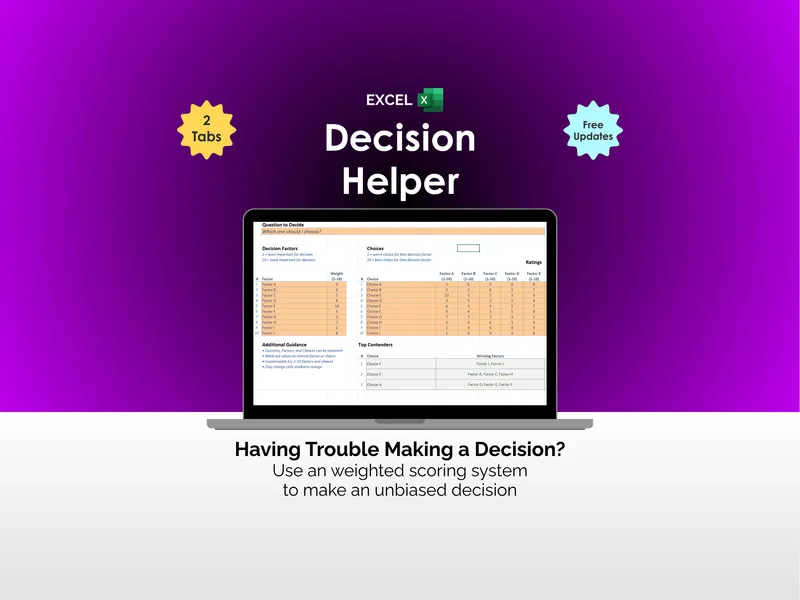
It’s a weighted decision matrix built as a workbook you own. You set a weight for each thing that matters to you — pay, benefits, growth, the work, the people, culture, commute, and stability — then rate each offer from 1 to 5. The workbook returns a single weighted score per offer and ranks them, so the strongest overall fit rises to the top instead of the loudest gut feeling.
Why a weighted score beats a pro/con list
A pro/con list treats every point as equal. It isn’t. A short commute might matter far more to you than a small raise — so this tool lets you weight it that way, and the math follows. The offer that pays the most and the offer that fits you best are often not the same offer, and a salary figure is very good at hiding that. Scoring the decision makes the trade-offs visible, in numbers you set yourself.
See your total compensation, not just the base
Base salary alone is a poor way to compare pay. The built-in Total-Comp Calculator folds the whole picture into one comparable annual number — base, target bonus, the annual value of equity, signing money, and the employer retirement match, minus what you’d pay for health coverage and the cost of the commute. The result is each offer’s effective annual value: a far fairer basis for comparison than the headline base. A higher base with a long commute and weak benefits can come out behind a lower base with great benefits and a short commute — better to learn that here than a year into the job.
Compare, rank, and negotiate your offers
- Compare up to four offers side by side on the criteria you choose and weight.
- Rank them automatically by a weighted score on a clean 1–5 scale.
- Turn money into one number with the Total-Comp Calculator, so pay is compared on equal terms.
- See the price of fit — the Results tab shows the best-fit offer next to the best-paid one and names the gap between them as a real dollar figure.
- Negotiate from the scorecard — your low ratings on your high-weight criteria are exactly what to ask to improve.
- Decide whether to move — score your current job as one of the options.
What’s inside
A 7-tab workbook (.xlsx) plus three PDF guides:
- Decision Scorecard — set a weight per criterion, rate each offer 1–5; the weighted score and ranking fill in automatically.
- Total-Comp Calculator — each offer’s money folded into one comparable effective annual value.
- Offer Facts — every offer’s terms (title, work style, commute, time off) side by side.
- Results & Ranking — offers ranked by score, with the best-fit/best-paid gap named in dollars.
- How to Score — the 1–5 scale, the eight criteria, and how to set your weights.
- Notes & Negotiation — your open questions, what to ask, and your final decision and its reasons.
- Read Me — how the tabs fit together, and where to start.
- Three PDF guides — a Start Here guide, a Scoring & Weighting guide with a fully worked example, and a Negotiation & Questions checklist with a printable scorecard.
Works in Excel, Google Sheets, and LibreOffice
Use the .xlsx in Microsoft Excel or LibreOffice Calc, or open the included one-click link and choose Make a copy for a ready-made native Google Sheets version in your own Drive — no importing, nothing to set up. It comes pre-loaded with three fictional example offers so you can see the method working before you enter your own.
Try it free first
Want to feel the method before you buy? The free Job-Offer Web Scorer weighs two offers across the five core criteria — pay, benefits, growth, culture, and commute — right in your browser, no sign-up. When you’re weighing more than two offers, want your own criteria, or want to keep the file, the workbook is the full version.
Own it, don’t rent it
This sits between a blank spreadsheet (free, but you build everything) and a subscription decision app (overkill and a recurring bill). It’s the structure you keep: a connected, owned workbook for the choices worth getting right — and you can reuse it for the next big decision, too.
Who it’s for
Anyone weighing two or more job offers, or one offer against staying put. Career changers and new graduates comparing offers that differ on far more than salary. Anyone who tends to over-index on pay and wants to see, in their own numbers, what the higher offer would actually cost them elsewhere.
A decision-making and planning template — not financial, career, legal, or tax advice. A weighted score is a tool for thinking, not a verdict you have to obey: it’s there to inform your decision and slow down a rushed one, never to make the call for you. The three example offers and all their numbers are fictional. The decision, and the responsibility for it, stay yours.