How weighted decision scoring works
The method has three moving parts, and the whole trick is keeping them separate:
- Criteria. The factors that matter about this choice — for a job offer, that's pay, benefits, growth, the work, the people, culture, commute, and stability.
- Weights. A number for each criterion saying how much it matters to you. This is where your priorities live, and setting the weights before you look at any option is the single most important habit in the method.
- Ratings. A score — usually 1 to 5, or 1 to 10 — for how well each option does on each criterion.
The weighted score for an option is the sum of (weight × rating) across every criterion, usually divided by the total weight so every option lands on the same scale. The option with the highest weighted score is your strongest overall fit. The arithmetic is simple; the value is that it forces your priorities out of your head and onto the page.
Weighted scoring vs. a plain score
The "weighted" part is what separates it from a pro/con list or a simple average. An unweighted score treats every factor as equally important — it says a short commute and a strong retirement match matter exactly as much as the base salary. They almost never do. Weighting lets you say "pay is worth twice what the commute is to me" and have the math respect that. Take the weights away and you've thrown out the one thing the method exists to capture.
Why it beats deciding by gut
Weighted decision scoring isn't really about computing the "right" answer — it's about surfacing the trade-offs. Run it honestly and the same few things tend to happen:
- You discover you've been weighting one factor far more heavily than you'd say out loud.
- An option you'd half-dismissed scores surprisingly well, and earns a second look.
- Your "favorite" scores lower than expected — and the score tells you exactly which criterion is dragging it down, which is precisely what you'd negotiate on.
None of that requires you to obey the number. A weighted score is a tool for thinking, not a verdict — if it disagrees with your gut, that gap is usually a sign a weight is wrong, not that the method failed.
Where you've already seen it
- Job offers. Comparing offers that differ on far more than salary is the textbook case — see the Job-Offer Decision Helper, or try the free job-offer web scorer first.
- Big purchases. Houses, cars, mattresses — anywhere there are several serious options and more than one thing that matters.
- Buying versus renting a home. Not which place, but which way of living — and the criteria that decide it (stay horizon, cash, flexibility, maintenance, roots) matter wildly differently from one household to the next, which is exactly what weighting is for. See the Buy-vs-Rent (Home) Decision Helper, or download the free buy-vs-rent quick check first.
- Elder care. Choosing among in-home care, assisted living, memory care, and a nursing facility is the same weighted choice — score the care, not the lobby. See the Elder-Care Decision Helper, or try the free elder-care web scorer first.
- Schooling. Public, charter, private, a hybrid program, or teaching at home is a weighted choice too — and the one where the criterion most people leave out is what a parent's own hours are worth. See the School-Path Decision Helper, or try the free school-path web scorer first.
- Where to retire. The same method, with a wrinkle worth knowing: cost of living and tax burden are criteria where lower is better, so rating them 1–5 by hand means silently inventing an exchange rate between dollars and a five-point scale. The Where-to-Retire Decision Helper computes those two rows from the money instead, and normalizes them onto the same scale as healthcare, family and climate. Try the free where-to-retire web scorer first.
- Staying in a job versus working for yourself. The case where the two sides aren’t even in the same unit: a salary carries only the employee half of payroll tax and usually hides a health premium somebody else pays. The Career-Pivot Decision Helper — job vs self-employment converts both to one effective hourly rate before scoring anything, then weighs that against ten judgment criteria. For the cash timing alone, try the free should-I-quit-my-job web calculator first.
- Which pet to adopt. The case where the alternatives usually aren’t documented at all: a shelter dog or cat is often of unknown or mixed ancestry, so scoring the breed means scoring a guess about a guess. The Pet-Adoption & Breed-Fit Decision Helper computes the weights for all twelve criteria from twenty-six household questions rather than asking you to invent them. Mark a candidate as an individual animal, and six of its ratings stop being breed-reference averages and become what you actually watched it do. Hours alone, grooming, shedding, lifespan and health outlook stay with the breed reference. Try the free pet-adoption web scorer first.
- Pet insurance. The case where two of the criteria cannot honestly be rated by looking at anything. What a policy costs you and how well it pays out are settled by arithmetic nobody has done yet: the deductible comes off once, then the reimbursement rate applies, then the annual cap bites, and a condition still inside its waiting period pays nothing at all. Rating “value” from a monthly premium is guessing at the answer. The Pet-Insurance Plan Decision Helper computes those two rows from the vet bills you choose to test — twice, once with the waiting periods still running and once with them served, because the cheapest plan is frequently not the same plan in both — and normalizes them onto the same 1–5 scale as coverage, exclusions and claims service. Try the free pet-insurance web scorer first.
- Mortgage and loan offers. The case where you have already been handed a weighted score, and somebody else set the weights. APR collapses the rate and the lender's costs into one number on a fixed assumption — that you keep the loan to the end of its term — so a borrower who moves in six years is reading an answer worked out for somebody else. Weighted scoring is that same move with the weights handed back to you: you decide what a shorter lock is worth against a lower rate, and what a named person answering the phone is worth against either. The Mortgage / Loan-Offer Decision Helper computes four of its eight ratings for you off the loan arithmetic, for you to carry up or overrule, and leaves the weighting entirely yours. Try the free loan-offer web scorer first.
- Hiring. Many structured interview scorecards are weighted decision scoring in disguise.
- Procurement. Vendor and software selection scorecards run on exactly this math — see the Vendor / Software Selection Scorecard, or try the free vendor-selection web scorer first.
- Choosing a contractor. The case that can break the method if you run it straight: weighted scoring assumes the inputs are comparable, and competing renovation bids may not be. Say one quote leaves the permit and the dumpster to you while the next one prices them in. Feed both numbers into the same cost criterion and the arithmetic quietly rewards the narrower scope. The Contractor-Choice Decision Helper settles the scope question first — five bids, 46 lines — so the cost criterion has something honest to read. To compare two quotes apples to apples, there is the free contractor bid comparison worksheet, which covers 16 lines and no scoring at all.
How solid is the score you got?
Weighted scoring will rank three options that finish a rounding error apart with exactly the same confidence as three that finish miles apart. So the question worth asking of any weighted result is how far one weight would have to move before the ranking reverses — its flip distance. Express the gap between your top two as a share of the winner’s score; under about five percent, treat them as tied until you have checked. (Those bands are a working convention the method uses, not a measured finding.)
Two things usually fall out of that check. Some criteria turn out to be a couple of weight points from reversing everything, which tells you where the decision actually lives. And any criterion your top two score identically on cannot change the answer at any weight at all — so an argument about how much it matters is an argument that cannot affect the outcome.
How to Make a Big Decision works that out on one decision carried through the whole book, along with the four ordinary revisions people make to a matrix after the fact — two of which reverse the winner — and how much checking a close, hard-to-undo choice has earned. If your top two both look good right now, what to do when both options look good walks that case through step by step. The free Frame the Decision mini-guide covers the steps that come before any scoring at all.
A weighted total quietly assumes there is one person doing the weighting. When a relocation is agreed by two or more people who want different things, averaging their weights before you score hides exactly the disagreement worth having. The Neighborhood / Relocation Decision Helper gives up to four household members a weight column each, blends them by an influence share you set, and reports the criterion the household disagrees about most — so the argument happens over the weights, in daylight, instead of over the answer. When the top two finish inside a stated margin it names no winner at all, and it names the smallest single weight change that would reverse the result. The free neighborhood scorer is the two-place, six-criteria version, with one shared weight column instead of one per person.
Related concepts
Weighted decision scoring is the technique; a decision matrix is the grid you run it in. When the choice is just "this or that," the simpler ancestor is a pro/con list — and whether to keep your scoring in an owned spreadsheet or a subscription app is its own question, covered in spreadsheet vs decision-making app.
Were your weights any good?
Weighted scoring makes a choice defensible on the day, but it cannot tell you whether the weights you set were the right ones — that only starts to show up later, in how the choice actually turned out, and only if you wrote down what you expected first. If you want to find out, write the decision down before you act: the option you picked, why the weights were set the way they were, how confident you are, and one prediction with a date on it. That is what a decision journal is for, and decision journal vs decision matrix covers how the two fit together on the same decision. You can start on paper with the free printable journal sheet.
Templates that implement this
Tools built on weighted decision scoring
12 templates
Weighted-scoring workbooks for the high-stakes choices people actually agonize over — job offers, houses, cars, and colleges.
- $14.95 PDF

How to Make a Big Decision - The Decision-Making Playbook
How to make a big decision: weighted scoring done honestly, flip distance, the four ways you rig your own matrix, and what checking is really worth.
Big DecisionsView details - $18.95 Spreadsheet

Business-Entity Decision Helper — Compare LLC, S-Corp, Sole Proprietorship & C-Corp (Excel & Google Sheets)
Compare LLC, S-Corp, sole proprietorship & C-Corp with a weighted scorecard and a self-employment-tax estimator — find your best-fit structure.
Big DecisionsView details - $14.95 Spreadsheet

Job-Offer Decision Helper — Weighted Decision Matrix to Compare Job Offers (Excel & Google Sheets)
Compare competing job offers with a weighted decision matrix — score pay, benefits, growth, commute & fit, and rank offers by overall fit.
Big DecisionsView details - $14.95 Spreadsheet

Buy-vs-Rent (Home) Decision Helper - Break-Even Year, Readiness Gates & Weighted Scoring (Excel + Google Sheets)
Settle whether to buy or keep renting. Computes your break-even year, runs six readiness checks, and weights 16 criteria to your household.
Big DecisionsView details - $18.95 Spreadsheet

Franchise Decision Helper — Weighted Decision Matrix to Compare Franchise & Business Opportunities (Excel & Google Sheets)
Compare franchise & business opportunities with a weighted decision matrix — score investment, ROI, support, brand & lock-in, and rank them by overall fit.
Big DecisionsView details - $19.95 Spreadsheet
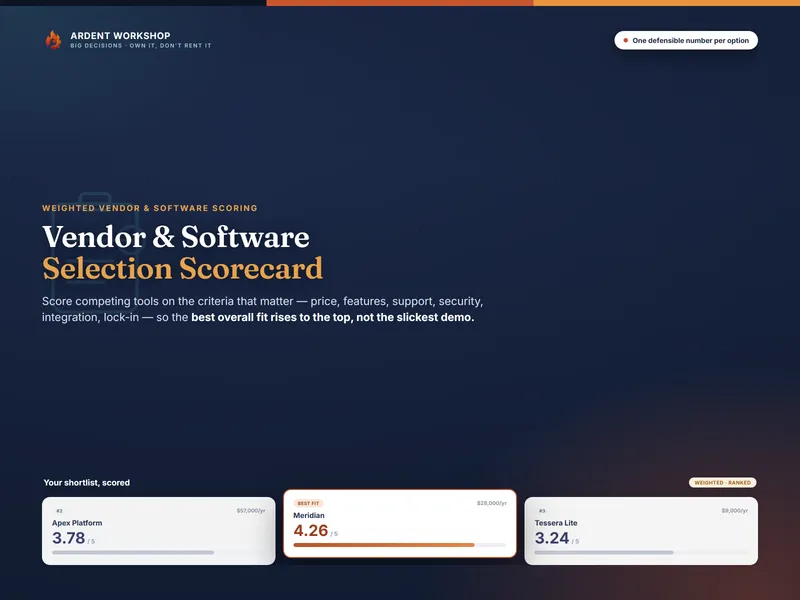
Vendor & Software Selection Scorecard — Weighted Decision Matrix to Compare Vendors & Score Software (Excel & Google Sheets)
Compare vendors & software with a weighted scorecard — score price, features, support, security & integration, and rank options by overall fit.
Big DecisionsView details - $14.95 Spreadsheet

Wedding-Venue Decision Helper — Weighted Scorecard to Compare Wedding Venues (Excel & Google Sheets)
Compare wedding venues with a weighted scorecard — score cost, capacity, location & the look, then rank by overall fit with an all-in cost calculator.
Big DecisionsView details - $2.95 Excel
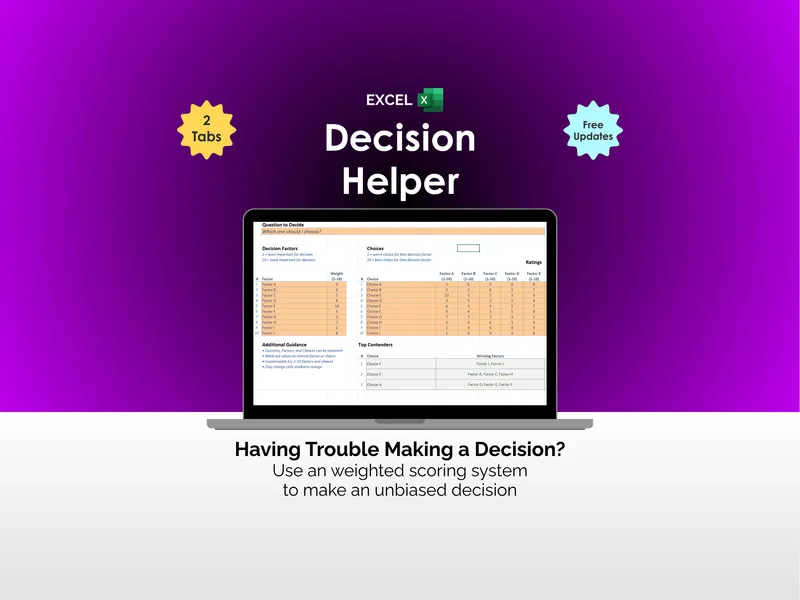
Decision Helper - Excel
Stuck on a big choice with five tabs open and zero clarity? This excel decision helper is a weighted decision matrix template that ranks options for you.
Big DecisionsView details - $11.95 Spreadsheet

Decision Journal & Outcome Tracker — Predict, Review, and Measure Your Calibration (Excel + Google Sheets)
A decision journal spreadsheet that scores your process the day you decide, then measures how overconfident you actually are once the results are in.
Big DecisionsView details - $2.95 Excel
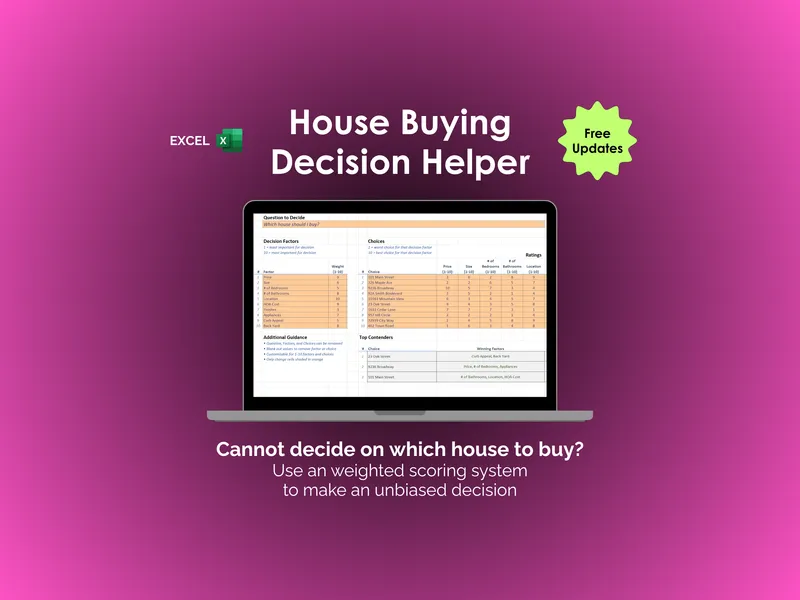
House Buying Decision Helper - Excel
Which house actually wins on the factors you care about? An excel house buying decision helper that scores up to 10 homes against 10 weighted factors.
Big DecisionsView details - $2.95 Excel
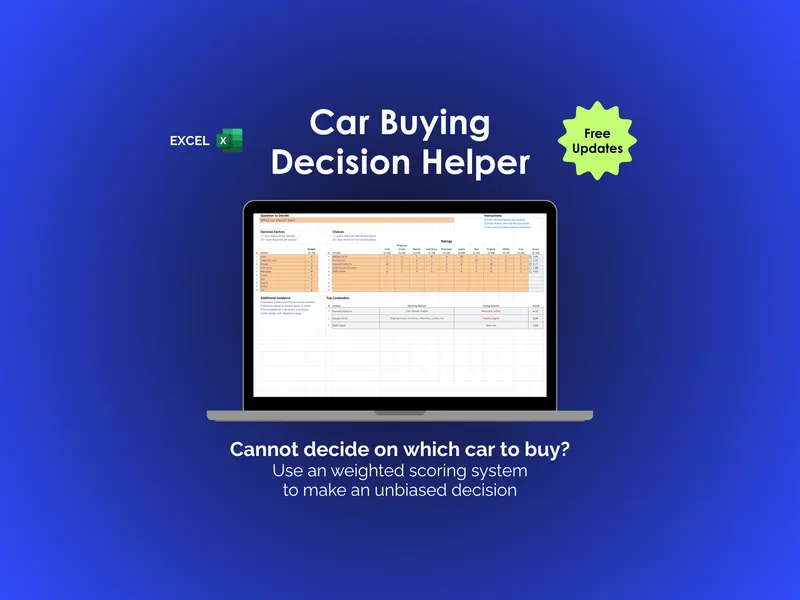
Car Buying Decision Helper - Excel
There are two kinds of car shoppers: the ones who score every option, and the ones who guess. This Excel car buying decision helper turns gut feel into weighted math.
Big DecisionsView details - $2.95 Excel
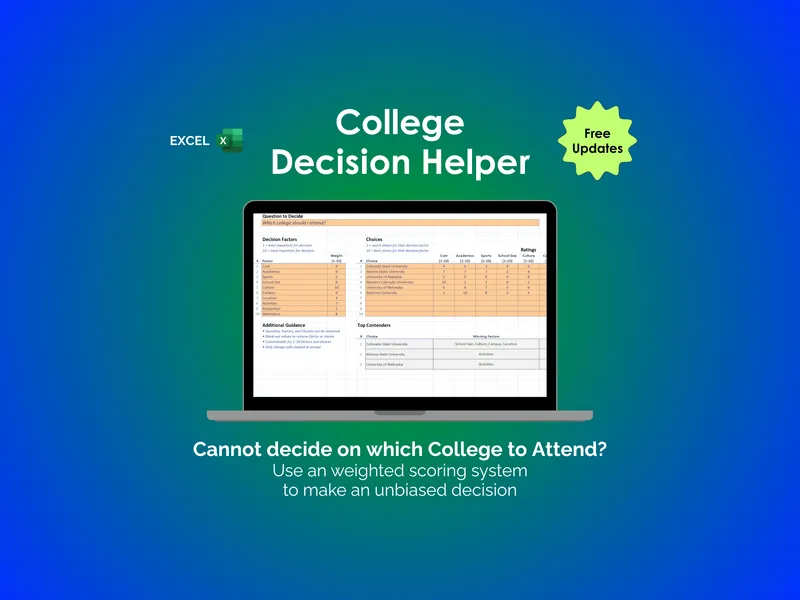
College Decision Helper - Excel
College choices come down to two camps: the gut-feel and the scored. This excel college decision helper is a college comparison spreadsheet with weighted factors and ranked contenders.
Big DecisionsView details