What a toolbox talk covers
A good toolbox talk does one thing well: it takes a single, concrete hazard the crew will face and makes it briefly, memorably real. The best topics are tied to the work in front of the crew that day and to the near-misses the team has actually seen.
- One hazard, kept short. Ladder safety, hearing protection, machine guarding, safe lifting, forklift pedestrian awareness — a single topic covered in five to ten minutes beats five rushed ones.
- Local and specific. Tie the topic to this crew's task and the incidents you've seen, so it lands instead of sounding like a poster read aloud.
- A short conversation, not a lecture. Ask a question, get one story from the crew, and agree one thing to do differently today.
Why toolbox talks are logged
A talk you didn't record is a talk you can't prove happened. In workplaces where safety training has to be documented, the log is what turns a five-minute conversation into evidence: a dated record of the topic, the crew, who ran it, and — crucially — the signed attendance sheet. The sheet is the proof; the log is the index that makes it findable.
A simple toolbox-talk log records one row per talk. A fuller safety-training record goes further, tracking not just talks but each person's certifications and refresher due-dates, so you can see at a glance who is current and who is overdue.
Toolbox talk vs. formal safety training
A toolbox talk is not a substitute for the formal, scheduled training a role requires — hazard communication, lockout/tagout, fall protection, forklift certification, and the like, each with its own refresher cadence. The two work together: formal training establishes competence on a schedule, and toolbox talks keep specific hazards fresh between those sessions. A complete safety record captures both.
How to run and track them
- Set a cadence you can keep. Weekly is common on active sites; every two weeks on steadier ones. Consistency beats length.
- Rotate topics. Work through a spread of hazards over a quarter — PPE, housekeeping, the equipment the crew runs, ergonomics, emergencies, and seasonal risks — rather than repeating the same three.
- Log every talk and keep the signatures. Record the date, topic, crew, presenter, and attendance, and file the signed sheet with the record.
Where do you get the talks themselves?
Writing one is the part that slides. A decent five-minute talk takes half an hour to write if it is going to be worth listening to, and half an hour is not available on a Monday morning — which is why crews so often end up cycling the same three topics and then stop. The Weekly Toolbox-Talk & Safety-Meeting Script Library is a year of them already written: 52 one-page talks across 11 hazard families, each with an opener to read out, three checks, two mistakes, three discussion questions and the sign-in slip on the same sheet — plus six computed 52-week rotations so the order is decided before Monday. Four of the talks are free and ungated if you want to run one this week and see whether the crew talks. See also what a near miss is, how to run a five-minute safety meeting, and a toolbox-talk library compared with a safety-training service.
Attendance is only worth recording if something reads it back. The Crew Safety & Training-Compliance Kit puts the talk log next to the certifications, the skills matrix and the apprentice hours. It joins those four records to answer the one question none of them answers alone: whether a given person is cleared to run a given station today. That join is free to try on ten rows as the Assignment Gate Starter.
This explainer is general information, not safety, legal, or compliance advice. What training and documentation your workplace is required to keep is set by the regulations that apply to you — confirm your obligations with your own program, regulator, and insurer.
Templates that implement this
The talks, and the record of them
4 templates
Two halves of the same job: a year of talks already written, one page each with the sign-in slip on the sheet — and the workbook that logs every talk delivered, who attended, and what is expiring.
- $19.95 Mix

Weekly Toolbox-Talk & Safety-Meeting Script Library — 52 Ready-to-Read Safety Talks, One Page Each, With a Sign-In Slip and Six Computed 52-Week Rotations
52 ready-to-read toolbox talks, one page each with the sign-in slip on the same sheet, plus six computed 52-week rotations. A year of safety meetings.
Team & TalentView details - $29.95 Spreadsheet
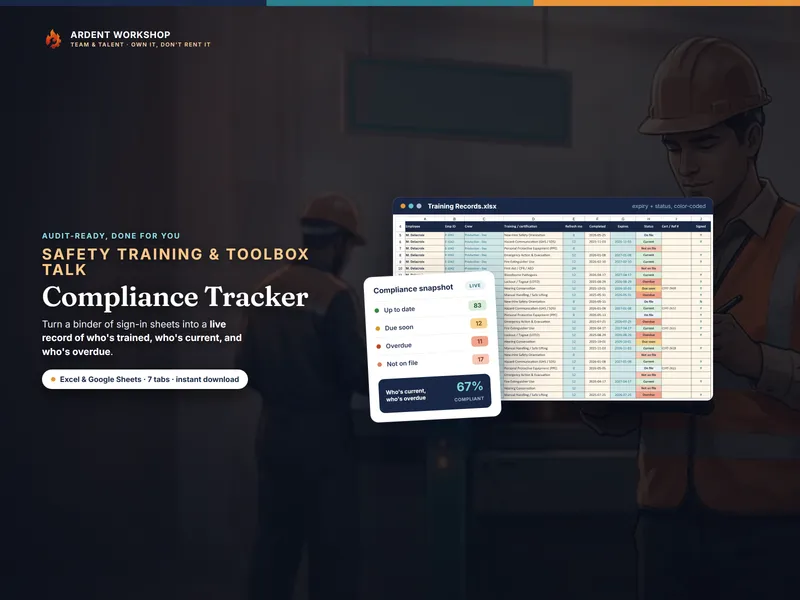
Safety-Training & Toolbox-Talk Compliance Tracker — Excel & Google Sheets
A safety-training & toolbox-talk tracker for Excel & Google Sheets — automatic refresher expiry, color-coded status, and audit-ready compliance dashboard.
Team & TalentView details - $19.95 Spreadsheet

Training & ILUO Skills Matrix — Coverage & Key-Person Risk (Excel + Google Sheets)
An ILUO skills matrix for Excel & Google Sheets — track each operator's level on every task, see coverage at a glance, and flag key-person risk.
Team & TalentView details - $69.00 Bundle

Trades & Service-Business Bundle — 7-Product Contractor Toolkit: Estimating, Flat-Rate Pricing, Crew Scheduling, Safety and Apprentice Records, Client Paperwork (Excel + Google Sheets)
Seven trades and contractor products in one bundle, plus a Control Panel for Excel or Google Sheets that works out what a billable crew hour costs.
Operator OSView details