The first time a helper asks “wait, am I getting paid for this hour?” you realize you never actually decided.
Not because you’re disorganized. Because when it was just you, there was nothing to decide. You worked when there was work. You took a break when you wanted one. “The rules” were whatever you happened to do that day, and they lived where every other decision in your shop lives — in your head.
Then you hired someone. And now two people are running on one person’s unwritten assumptions. That’s the moment a small shop needs an employee handbook. Not the 80-page corporate kind. A short, plain document that answers the questions a new hire will otherwise interrupt you to ask — or, worse, guess at.
A small-shop employee handbook is a short, plain document — a few pages, six sections — that spells out what it’s like to work here and what’s expected: hours, pay, time off, conduct, and safety. You can draft the first version in an afternoon. Here’s what goes in one, and how to write it.
What an employee handbook actually is (and what it isn’t)
An employee handbook is the written answer to one question: what’s it like to work here, and what’s expected of me? It covers the relationship — hours, pay, time off, conduct, safety, what happens when something goes wrong. It’s the rulebook for being an employee, not a customer or a contractor.
The fastest way to understand a handbook is to separate it from the thing it’s constantly confused with: your shop manual, or SOPs. Those two documents answer completely different questions, and a small shop needs both.
| Shop manual (SOPs) | Employee handbook | |
|---|---|---|
| Answers | How do I do the work? | What’s expected of me here? |
| Contains | How to pack an order, frost a cake, run the numbers | Hours, pay, time off, conduct, safety |
| Changes when | A process changes | A policy changes |
| Feels like | An instruction sheet | A short agreement |
Keep them separate. The manual is how the work gets done; the handbook is the terms of doing it. Mixing them creates a document nobody finishes reading — piping technique buried next to your sick-day policy.
A handbook also isn’t a contract, and for most small shops it shouldn’t read like one. In most U.S. states, employment is “at-will,” meaning either side can end it at any time — and handbooks usually include a line saying the handbook itself doesn’t change that. That’s exactly the kind of wording worth having a professional glance at, which we’ll get to at the end.
Why a three-person shop needs one before you think you do
The instinct is to wait. We’re too small for HR paperwork. But the handbook earns its keep long before you have a “team.”
- It stops you from making rules by accident. The first time you say yes to one person’s schedule request, you’ve set a precedent. Write the policy down and you’re applying a rule, not playing favorites — which matters enormously the day a second employee compares notes with the first.
- It answers the questions you don’t want asked at 6 a.m. Can I swap a shift? What do I do if I’m sick on a market day? Am I paid for cleanup after close? Every one of these is a text to you unless it’s on a page.
- It’s your first line of consistency and fairness. When “the rule” is written and applied the same way to everyone, you’re protected — and so is your helper. Undocumented, every decision looks like it could be personal.
- Some of it isn’t optional. Federal wage-and-hour law reaches even very small employers. The Department of Labor’s resources for new and small businesses (opens in new tab) lay out obligations that can apply as soon as you have an employee, and the FLSA recordkeeping rules (opens in new tab) require you to track hours and pay for every non-exempt worker. A handbook is where you tell your employee how those rules work in your shop.
You don’t need a legal department to clear that bar. You need a few clear pages.
What actually goes in a small-shop handbook
A handbook for a shop of three has six sections. That’s it. If yours is longer than a few pages, you’ve wandered into your shop manual — pull that back out.
- Welcome and the basics. One paragraph on what the shop is and how you work. Then the essentials: who to contact, where to find things, and the at-will statement (the “this isn’t a contract” line).
- Hours, scheduling, and time off. When shifts happen, how they get assigned or swapped, how to request time off, and what “on the clock” means — including whether prep and cleanup are paid. This is the section that prevents the most friction, because it answers the questions people are shyest about asking.
- Pay. How much, how it’s calculated, when payday is, and how overtime works. You don’t publish everyone’s wage, but you do state the rules that govern it — pay periods, overtime, how a raise gets considered.
- Conduct and expectations. The short list of what “good” looks like as a coworker, not a task: show up on time, tell me early if you can’t, handle customers this way, keep the recipes and supplier list confidential.
- Safety. For a food shop this is non-negotiable: hygiene rules, allergen handling, what to do about an injury or a fire, cleaning standards. This is also where a handbook overlaps with real compliance, so it deserves its own attention rather than a passing line.
- What happens when something goes wrong. How you handle mistakes, how someone raises a problem, and — plainly — what could lead to being let go. Writing this down before you need it is what keeps a hard conversation from becoming a personal one.
Notice what’s not here: no benefits jargon, no policies for departments you don’t have, no legalese you copied from a Fortune 500 sample. A small handbook is powerful precisely because a new hire will actually read all of it.
How to write it in an afternoon
You are not drafting a legal document. You’re writing down decisions you’ve already half-made. Here’s the fast path.
- Write each section as answers, not policy. Don’t write “The Company maintains a paid-time-off accrual schedule.” Write “You get X paid days off a year. Ask for them at least a week ahead when you can.” Plain beats polished. If a new hire can follow it, it’s done.
- Decide the gray areas now, on paper. The value of a handbook is that it forces you to answer the questions you’ve been dodging: Is cleanup paid? What’s the sick-day process on a busy Saturday? Make the call once, write it down, and stop re-deciding it every week.
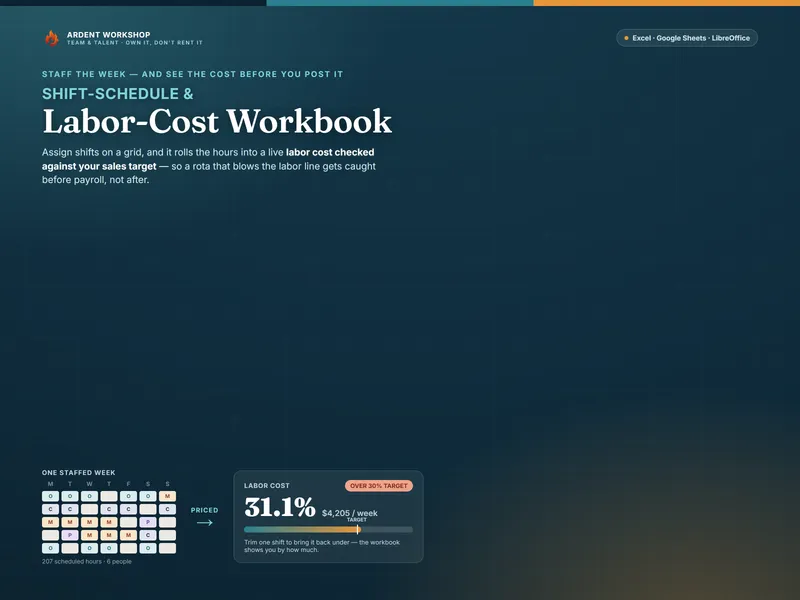
- Pull the pay and scheduling rules straight from how you already run. If you track hours and shifts in a workbook, your scheduling and overtime policy is really just describing what that tool already does. A shift schedule and labor-cost workbook gives you the hours-and-pay engine, so the handbook just points to the rules it already enforces.
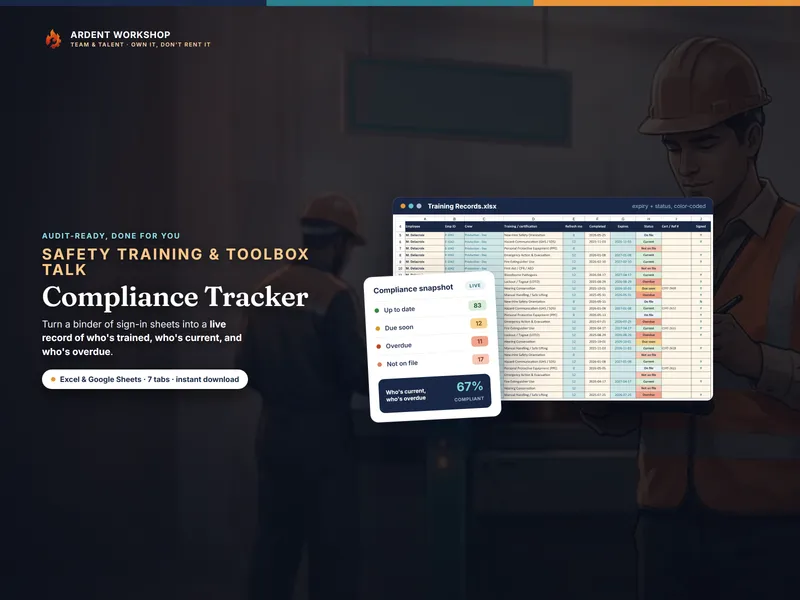
- Treat safety as its own build, not a paragraph. In a kitchen, the safety section is the one with real stakes — and real records behind it. Keep the handbook’s version short and human (“wash in, glove up, log the fridge temps”), and back it with an actual safety-training and toolbox-talk compliance tracker so you can prove the training happened, not just claim it.
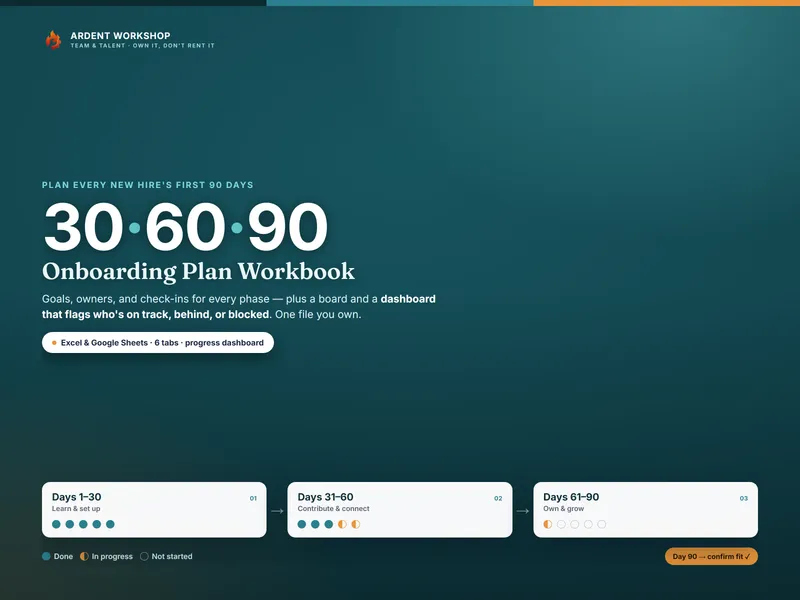
- Give it to the person on day one — and pair it with a plan. A handbook tells a new hire the rules; it doesn’t get them productive. That’s the job of a structured onboarding plan and a training matrix that tracks who can do what. Hand over all three together and your first day stops being a live performance you improvise. (If you’ve never onboarded anyone, start with onboarding your first employee — the handbook is one piece of that larger first-week system.)
- Have someone qualified read it before it’s official. The parts about at-will status, termination, and pay are the parts most worth a professional set of eyes. An hour with an employment attorney or your state labor office is cheap insurance on the exact language a handbook can get wrong.
Total time for a first draft: an afternoon. It won’t be perfect. It’ll be written, which is the entire point.
Own the rules, don’t rent a policy generator
There’s a version of this where you never write anything down and keep running the shop on assumptions — free and fast, right up until two employees discover they’ve been treated differently and neither can point to a rule that says otherwise.
There’s another version where you pay a monthly HR platform built for companies with a hundred employees, and spend more time configuring policies for departments you’ll never have than you’d have spent writing six plain pages.
The middle path fits a small shop: structure you own. A short handbook you keep in a document or a workbook, written for the way your shop actually works — sitting alongside the connected operating system that already holds your processes, your schedule, and your numbers. It’s yours whether or not you keep paying anyone, and it grows with you instead of boxing you in.
And when the team you’re now managing is running a business that’s outgrown its spreadsheets — orders, inventory, and production moving faster than a workbook can track — Ardent Seller (opens in new tab) is the next step for the operational side. The handbook keeps everyone working to the same rules; a real system keeps the work itself from falling behind.
The one thing to take away
You’ve been running an employee handbook in your head since the day you hired someone — you just never let anyone else read it. Writing it down doesn’t create new rules. It turns the ones you’re already enforcing into something fair, consistent, and answerable.
Block off an afternoon. Answer the six questions a new hire will otherwise ask you one text at a time. That’s your first draft — and the difference between a shop that runs on your mood and one that runs on your word.