Why the weekly talk slides
The reasons a weekly talk lapses are practical rather than attitudinal. They repeat, and each has a fix that costs nothing.
| What happened | What actually fixes it |
|---|---|
| Nobody wrote this week’s | Have it written in advance — and the next one, and the one after |
| The same three topics forever | A rotation that spreads hazard families deliberately |
| It became a lecture, then a signature | Three questions you genuinely stop talking after |
| The record has holes in it | One sheet: the talk you pass around is the sheet you file |
The first one is the big one. A talk worth listening to takes about half an hour to write, and half an hour is not available on a Monday morning to the person who came off a twelve-hour day with a quote still to get out.
The five minutes, block by block
A meeting that works has a shape, and the shape is the same every week so nobody has to think about it:
- Ten seconds — the opener, read out loud.
- One minute — why this hazard actually hurts people, in plain terms. Not what the rule says: what happens.
- One to two minutes — three things to check before the work starts.
- One minute — the two mistakes that cause most of the trouble, named.
- Two minutes or longer — the questions. This is where the value is; everything above it is setup.
- Fifteen seconds — one action for the week.
- Fifteen seconds — what this talk does not cover.
- One minute — signatures.
Everything except the opener and the closing action can be said in your own words. The two that are written to be read out are written that way for a reason: starting and finishing cleanly is most of what makes a short meeting feel deliberate rather than thrown together.
The middle two minutes are the whole thing
The difference between a meeting and a formality is almost entirely in the questions. Six habits decide it:
- Ask about your site, not about safety. “Where on this job is somebody most likely to be tempted by a too-short ladder?” gets an answer. “Any comments?” does not.
- Stop talking. The pause after a question feels far longer to you than to anybody else. Count to ten.
- Ask the quietest person by name. Not to catch them out — because the newest and quietest person on a crew is often the one who sees the most and volunteers the least.
- Never argue with the answer. If somebody says a control is unworkable, that is free information about what will not be followed. Write it down and deal with it.
- Admit the ones you break yourself. A supervisor who says “I did this last week and I should not have” gets more change out of a crew than any amount of policy.
- Finish on time. The crew learns these are short and stop bracing for them.
Where the record comes from
The talk sheet and the attendance record should be the same piece of paper. If the sign-in lives on a separate form, it lives in a different truck by Thursday — which is exactly how attendance records end up with holes in them.
Keep three things and you can answer any question about the year: the sheet itself with the notes written on it in pen, the date and site and who led it, and anything raised that needed following up. A one-line-per-talk log over the top of that is what you hand over when somebody asks what you have been covering. How long to keep them is set where you are, and some records must be kept for a very long time — find out rather than guessing.
Where a talk stops
This matters more in safety than in most subjects. A five-minute discussion builds habit and surfaces what the crew has been putting up with. It does not train anybody. Energy control, confined and enclosed spaces, aerial lifts and scaffolds, fall protection, excavation, respiratory protection, powered industrial trucks and work on electrical installations commonly carry formal training obligations, and in many jurisdictions doing that work on the strength of a talking-points sheet is both dangerous and unlawful. Check which apply to you.
The practical version: every talk should name what it did not cover, out loud, at the end. It takes fifteen seconds and it is the difference between a discussion that helps and one that quietly leaves people thinking they are covered.
Getting the talks written
If you want the writing already done, the Weekly Toolbox-Talk & Safety-Meeting Script Library is a year of them: 52 one-page talks in exactly the shape above, across 11 hazard families, each with its own sign-in slip and its own “where this stops” line — plus six computed 52-week rotations (a general master year and five weighted to construction, landscape, warehouse, facility and shop work) so the order is decided before Monday, and a hazard index for the week something happens and you want to run that talk instead.
Four complete talks are free and ungated — housekeeping, ladders, hand tools and PPE. No signup. Run one this week and see whether the crew talks.
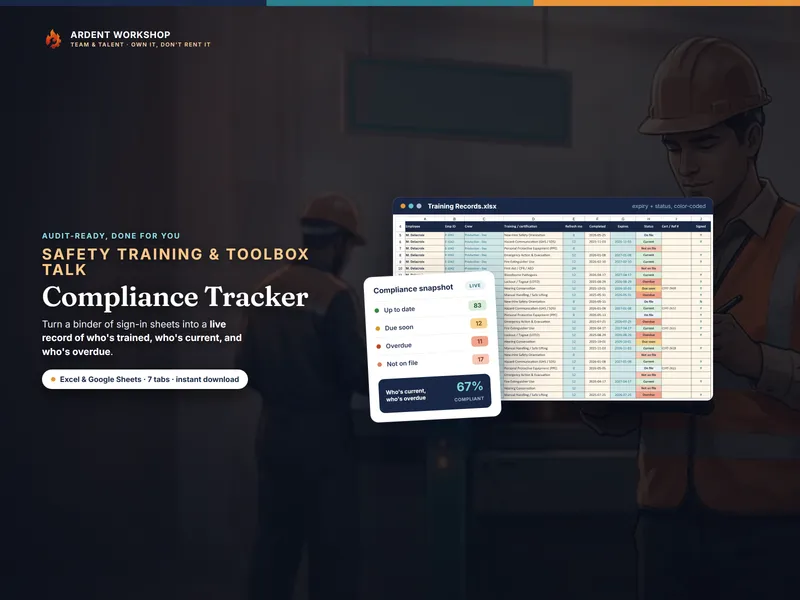
For the record side — talks delivered, attendance, training expiries and a per-crew compliance view — see the Safety-Training & Toolbox-Talk Compliance Tracker, or the tutorial on documenting safety training for an audit. If the format itself is new, the glossary covers what a toolbox talk is and what a near miss is.