This is not really library-versus-service. They solve different problems, and a firm with regulated tasks and a hundred people may well need both. The mistake is paying a per-employee monthly fee to answer the question you actually have first — what are we talking about on Monday? — when that is content you can own outright.
What each one is for
- A toolbox-talk library is written content. One page per topic: something to read out, why the hazard matters, what to check, the mistakes that cause most of the trouble, questions that get the crew talking, and somewhere for everyone to sign. You print it, run five minutes, and file it. It answers "what do we cover, and in what order."
- A safety-training service is delivery and administration. Hosted courses, completions and certificates, sometimes a content feed, sometimes site visits and written program work. It answers "who is trained, on what, and can we prove it to somebody who asks."
Running a discussion and completing a course are not the same thing — which is why both sit under "safety" and still do not replace each other. If the format itself is new to you, the glossary covers what a toolbox talk is and what a near miss is.
Where a library wins
- It removes the weekly writing. A talk worth listening to takes about half an hour to write, and half an hour is not available on a Monday morning. A year already written is the whole value.
- The order is the hard part, and it can be solved once. Left alone, a crew's schedule collapses into ladders, housekeeping and PPE, and whole categories — chemicals, energy, vehicles, heat — never come up. A library that ships a computed rotation fixes that permanently: seasonal talks land in their season, and no hazard family comes round again inside four weeks.
- Nothing to log into on site. A printed page works in a yard at seven in the morning with no signal. A platform needs a device, an account and a connection, in that order — though some services hand you printable sheets too, so check before assuming.
- You keep it. Files you own do not stop working when the renewal lapses or the pricing changes, and you can cross things out and write your own site's hazards in the margin.
- One-time cost, no headcount meter. Print as many copies as your crews need, for as long as you have them.
Where a service earns its fee
- Formal training with assessment. Many jurisdictions require documented, evaluated training for tasks such as energy control, confined-space entry, powered industrial trucks and respiratory protection. Where yours does, that is a training obligation rather than a discussion, and no library satisfies it.
- Somebody who will look at your actual site. A written hazard assessment, a permit system, a program document. Those are specific to your workplace and nobody can write them from a distance.
- Scale and administration. Multiple sites, hundreds of records, renewal deadlines across a workforce, an auditor who wants a system rather than a folder.
The honest way to combine them
Buy the content once, keep the record yourself, and pay for a service only where you need training delivered or a professional to see your site. In practice that looks like: a written talk each week that the crew actually talks in, the signed sheet filed, a simple log so you can answer "what have you covered?", and a training provider engaged for the specific tasks that require one.
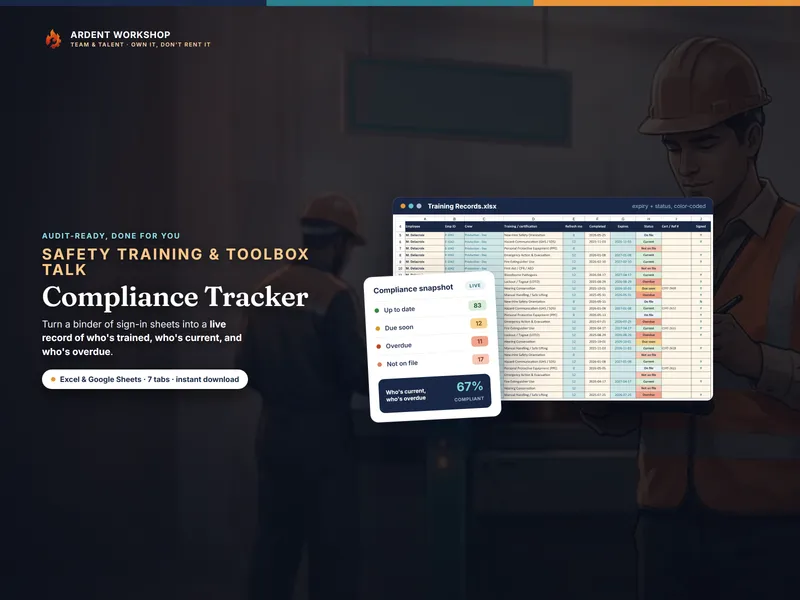
The Weekly Toolbox-Talk & Safety-Meeting Script Library covers the first half — 52 one-page talks across 11 hazard families, six computed 52-week rotations, a hazard index for running a talk out of order the week something happens, and the printable forms. Every talk carries a line naming what it does not cover and what needs proper training instead. The Safety-Training & Toolbox-Talk Compliance Tracker covers the second — talks delivered, attendance, and what is expiring, in a workbook you own.
Four complete talks are free and ungated if you would rather try the format before deciding anything. No signup.
This comparison is general information, not safety, legal, or compliance advice. What training, assessment, supervision and records your operation is required to provide is set by the rules that apply to you and varies sharply by jurisdiction and industry — confirm your obligations with your own program, your regulator, and your insurer.
Frequently asked questions
- What is the difference between a toolbox-talk library and a safety-training service?
- A toolbox-talk library is content you own: written talks you print, read out to the crew, and file with the signatures. A safety-training service is a subscription — commonly some mix of hosted courses, tracked completions, a content feed, and sometimes a consultant who visits. The library solves the weekly blank page. The service is aimed at training delivery and program administration. They overlap less than the shared word “safety” implies. If your immediate problem is the weekly blank page, the library is the cheaper thing to fix first — a service is aimed at a different job.
- Can a library of written talks replace safety training?
- No, and it should not try to. A five-minute crew discussion is not training, and several subjects — energy control, confined spaces, aerial lifts, fall protection, excavation, respiratory protection, powered industrial trucks and electrical work — need proper, documented training that a talking-points sheet cannot substitute for. A good library says so on every relevant page. What a library does replace is the half hour somebody spends writing this week's talk from scratch, which is the reason the weekly meeting lapses in the first place.
- How much does each cost?
- An owned talk library is a single one-time cost for files you keep and print for as long as you have crews. A safety-training subscription is a recurring fee, often priced per employee per month, which means it scales with your headcount rather than with how much you use it. For a four-person crew that mainly needs somebody to have already written the talks, the recurring model charges for a platform where the actual need is content.
- When is a safety-training service the right answer?
- When you genuinely need what it delivers: formal course delivery with assessment and certificates, competency records tied to specific regulated tasks, multi-site administration, or an outside adviser who will walk your site and write the hazard assessment you cannot write yourself. Those are real jobs and a printable library does not do them. The question worth asking is which of them you actually have — and whether you are subscribing to solve the weekly talk, which is the cheapest part to fix.
- What about the record — who keeps that?
- You do, either way. A library with the sign-in slip printed at the foot of each talk means the sheet you pass around is the sheet you file, and a talk log gives you an index over the year. A service usually keeps a digital record inside its own system, which is convenient while you subscribe and awkward when you stop. If you want the record in a spreadsheet you own, that is a separate, simple file — talks delivered, attendance, and what is expiring.