A year of weekly safety meetings, already written
The weekly toolbox talk is the obligation nobody argues with and almost nobody keeps up. Not because anyone stopped caring — because somebody has to write it, every week, forever, and that somebody is usually the person who has just come off a twelve-hour day with a quote still to get out tonight.
So the first month goes well, the second month is three talks, and by March the record has a gap in it. The crew notices, which is worse than the gap: a safety meeting that only happens after somebody gets hurt teaches everybody exactly what it is for.
This library removes the writing. Fifty-two finished pages, one per week, each ready to pick up and read.
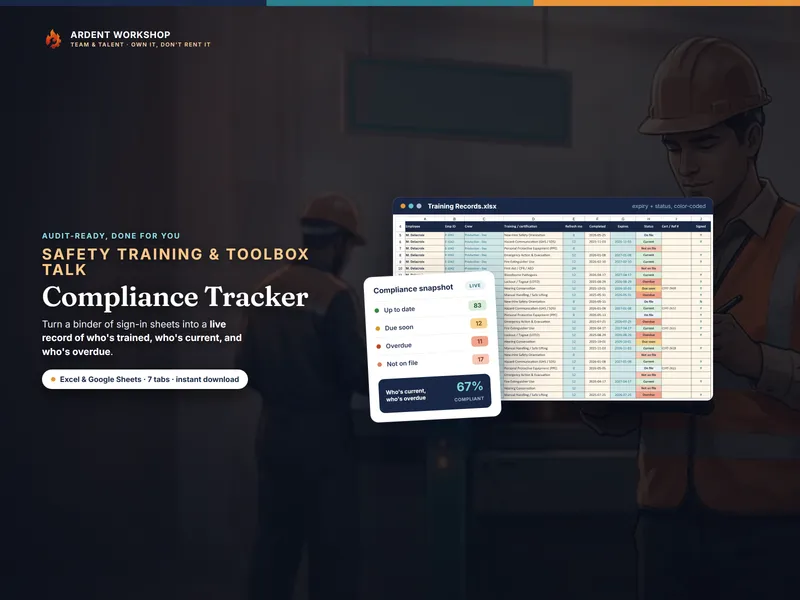
Looking for the spreadsheet instead? This is the written talks and the schedule that orders them. If what you need is the record — talks delivered, attendance, training expiries — that is the Safety-Training & Toolbox-Talk Compliance Tracker, and the two are built to sit side by side.
Try before you buy: four complete talks are free and ungated — no email, no signup.
What is on every talk page
The same nine blocks, in the same order, on all fifty-two — the order a five-minute meeting actually runs in:
- Read this out — one sentence written to be spoken, not paraphrased.
- Why it matters on this job — what the hazard actually does to people, in plain terms.
- Three things to check before you start — three, deliberately. A list of ten is a list of none.
- The two mistakes that cause most of the trouble — named, so people recognize themselves in one of them.
- Ask the crew — three questions written to get an answer about your site rather than a nod.
- What came up on our site — ruled space, because what the crew says back is the part that otherwise never gets written down.
- This week — one action. A talk that ends in agreement changes nothing.
- Where this stops — what the talk deliberately does not cover, and what needs proper training instead.
And then the sign-in slip, at the foot of the same sheet. What you pass around is what you file. There is no second document to remember, which is how attendance records end up with holes in them.
The order is computed, not typed
Fifty-two talks is a library. The hard part is the order — and left to itself, a crew’s schedule collapses into ladders, housekeeping and PPE, because those are the three anybody can talk about without preparation.
So the rotation planner carries six full 52-week schedules, each generated under the same rules rather than typed out:
- Seasonal talks land inside their season. The heat talk is never scheduled for February; the ice talk is never scheduled for July.
- No hazard family comes round again within four weeks, so the crew is not hearing about ladders three meetings running while nothing has been said about chemicals since spring.
- The talks your kind of work needs most are pulled as early in the year as the calendar allows.
- All fifty-two are used exactly once. Nothing dropped, nothing repeated.
There is a general master year plus five weighted to the work — General Construction & Remodel, Landscape & Grounds, Warehouse & Shipping, Facility Maintenance & Janitorial, and Shop & Fabrication — and each carries a first-twelve-weeks starter set for a crew beginning from nothing, spread across hazard families rather than opening on a month of ladder talks.
Run one out of order the week something happens
The best talk you will run all year is about the thing that nearly happened on Tuesday. The hazard index finds it across eleven families — falls and access, housekeeping and walking surfaces, tools and hands, PPE, lifting and the body, electrical and energy, vehicles and mobile equipment, chemicals and dust and air, heat and cold and weather, fire and hot work, and crew habits and reporting. Run that talk this week and pick the schedule up afterwards; the four-week spacing rule means one talk out of order costs you nothing.
There is also a quarterly coverage matrix showing the year is genuinely spread rather than clumped, and the whole year on one page to pin up and cross off.
New to the format? What a toolbox talk is and what a near miss is cover the basics, how to run a five-minute safety meeting is the method in full, and toolbox-talk library vs. safety-training service compares this with a subscription.
Every talk says where it stops
A five-minute discussion is not training, and several of these subjects are ones where acting on a talking-points sheet would be dangerous. Energy control, confined spaces, aerial lifts and scaffolds, fall protection above the threshold, excavation and utility strikes, respiratory protection, powered industrial trucks, electrical work, hazard communication, and first aid and emergency response all appear here as awareness only — each with a line on its own page naming what it does not cover — and the playbook collects every one of them in a route-to-real-training table you can check your crew against.
For the same reason, no regulatory thresholds, exposure limits, approach distances, retention periods or permit timings appear anywhere in the bundle. Those differ by jurisdiction and change, and a discussion sheet is the wrong place to learn them. Where a talk gives a rule of thumb, it is common practice offered to start a conversation, not a statement of what any rule requires.
The paperwork half, already made
- A long sign-in sheet for crews bigger than the slip on the talk page holds.
- A twelve-month talk log, so you can answer “what have you covered?” without going through a folder.
- A blank talk page in the same shape, for the hazards only you could write about.
- A near-miss slip anybody can fill in without asking.
All in US Letter, with an A4 edition of the forms — the file you actually feed through a printer in quantity.
Own it, don’t rent it
These are files you keep. No seat, no per-crew fee, no safety platform that decides one day to change its pricing and takes your talk library with it. Print as many copies as your own crews need, cross things out, write your site’s hazards in the margin, and use the blank talk page for the ones nobody else could have written for you.
If you also want the record kept in a spreadsheet — talks delivered, attendance, training expiries, a per-crew compliance dashboard — that is the Safety-Training & Toolbox-Talk Compliance Tracker, built to be used alongside this one. If you already own it, you have a topic list, a printable sign-in sheet and a short guide to running a talk; what is new here is the written talks themselves — a finished page per topic instead of a line of key points — and the computed year that decides which one you run this week.
Try four of them free
Four complete talks — housekeeping, ladders, hand tools and PPE, each with its sign-in slip — are free and ungated. No email asked for. Run one on Monday and see whether the crew talks.
What this library is not
This is a library of general talking points written to structure a short crew discussion. It is not a safety program, not training, not a hazard assessment of your workplace, and not legal or regulatory advice. What your operation is required to provide by way of training, assessment, equipment, supervision and records is set by national, state or provincial and sometimes local law, by your industry, and by your contracts and insurers — and it varies sharply. A signature on a sign-in slip records attendance at a discussion; it does not certify that anybody is trained, competent or authorized to do anything.