The weekly safety meeting rarely dies because a crew stopped caring. It dies on a Sunday night, when whoever runs it realizes they have to come up with this week’s toolbox talk topic, again, and grabs whatever comes to mind — which is ladders, for the fourth time since spring. If you would rather never have that Sunday night, the Weekly Toolbox-Talk & Safety-Meeting Script Library has all 52 talks below written out, one printable page each, with the sign-in slip on the same sheet. The list itself is here in full, free, either way: the year opens on PPE fit, ladders, housekeeping and near-miss reporting in January, puts the cold talk in February and the heat talk in June, and never repeats a hazard family inside four weeks.
A toolbox talk is a short safety briefing — usually five to fifteen minutes on one hazard — held with a crew at the start of a shift or task. This post is about what to talk about and in what order. For the mechanics of running the meeting itself, see how to run a five-minute safety meeting.
How to choose toolbox talk topics for a whole year
A good year of toolbox talk topics follows three rules: seasonal hazards land in their season, no hazard family comes back too soon, and the topics your trade most needs come first. A list written in the order the topics occurred to someone tends to break all three.
- Put seasonal talks in their season. A heat talk in February is noise. A cold-and-grip talk in July is worse, because it teaches the crew that the Monday meeting is not about this week’s work.
- Space out the hazard families. Group the topics into families (falls, tools, chemicals and so on) and do not let a family return within four weeks. Three ladder talks in a row while nobody has mentioned chemicals since spring is a typical failure of a hand-picked list.
- Front-load your trade’s hazards. A roofing crew and a warehouse crew should not open the year on the same talk. Pull the hazards your work actually carries as early as their season allows.
The list below applies all three. It is the library’s master rotation, the general-purpose year built for mixed crews. Weeks are grouped into months four-four-five per quarter, week 1 is the first working week of January, and the seasons are set for the northern hemisphere. In the southern hemisphere, add 26 to each week number and wrap around, which moves the summer and winter talks into the right months.
The 52 toolbox talk topics, month by month
January to March: winter ground, cords and first habits
| Week | Month | Toolbox talk topic | Hazard family |
|---|---|---|---|
| 1 | January | PPE — fit is the whole point | PPE |
| 2 | January | Ladders — the two minutes before you climb | Falls & access |
| 3 | January | Housekeeping — the floor is a tool | Housekeeping & walking surfaces |
| 4 | January | Near misses — the free lesson nobody reports | Crew habits & reporting |
| 5 | February | Electrical basics — cords, plugs and ground fault protection | Electrical & energy |
| 6 | February | Reading a chemical label | Chemicals, dust & air |
| 7 | February | Hand tools — the right one, in good order | Tools & hands |
| 8 | February | Cold — layers, extremities and the grip you lose | Heat, cold & weather |
| 9 | March | Wet, oily and icy — walking on surfaces that move | Housekeeping & walking surfaces |
| 10 | March | Driving for work — the trip starts before the truck moves | Vehicles & mobile equipment |
| 11 | March | Lifting and carrying — plan the path before you bend | Lifting & body |
| 12 | March | Power tools — guards, triggers and what happens when it grabs | Tools & hands |
| 13 | March | Three points of contact | Falls & access |
The year opens on PPE fit rather than a hazard, because it is the talk every other talk leans on. Underrated pick: week 4, near misses. Putting it in the first month means every talk after it has a way to feed back what the crew actually sees.
April to June: spring work, energy and the new-hire season
| Week | Month | Toolbox talk topic | Hazard family |
|---|---|---|---|
| 14 | April | Hot work — sparks travel farther than you think | Fire & hot work |
| 15 | April | Safety data sheets — where they are and what to read first | Chemicals, dust & air |
| 16 | April | Lockout awareness — stored energy does not care that it is off | Electrical & energy |
| 17 | April | Gloves — matching the glove to the hazard | PPE |
| 18 | May | Backing up | Vehicles & mobile equipment |
| 19 | May | Stop-work — who has it, and what happens after | Crew habits & reporting |
| 20 | May | Knives and blades — cut away | Tools & hands |
| 21 | May | Inspecting a ladder — and actually pulling it out of service | Falls & access |
| 22 | June | Overhead and buried services | Electrical & energy |
| 23 | June | Heat — water, rest, shade and the new person | Heat, cold & weather |
| 24 | June | The first week — why new people get hurt | Crew habits & reporting |
| 25 | June | Ladder, scaffold or lift — picking the right way up | Falls & access |
| 26 | June | Dust — silica, wood and the stuff you stop noticing | Chemicals, dust & air |
Weeks 23 and 24 sit together on purpose: in many trades, the first hot spell and the summer hiring wave arrive at the same time, and they compound. OSHA’s guidance on protecting new workers from heat (opens in new tab) says almost half of heat-related deaths happen on a worker’s first day on the job or first day back after an extended absence. Do not skip: week 22, overhead and buried services, lands right as digging and equipment season starts.
July to September: summer outdoors and the loads on the truck
| Week | Month | Toolbox talk topic | Hazard family |
|---|---|---|---|
| 27 | July | Awkward, long and two-person loads | Lifting & body |
| 28 | July | The two-minute walk before you start | Crew habits & reporting |
| 29 | July | Pinch points — the hazard you cannot see coming | Tools & hands |
| 30 | July | Edges, openings and the hole that was covered yesterday | Falls & access |
| 31 | August | Cords, hoses and leads — the trip hazard we create ourselves | Housekeeping & walking surfaces |
| 32 | August | Sun, insects and the things that live on the job | Heat, cold & weather |
| 33 | August | Working alone — and the check-in that would have mattered | Crew habits & reporting |
| 34 | August | Loading, securing and losing things off the truck | Vehicles & mobile equipment |
| 35 | September | Eyes and face — the injuries that do not heal back | PPE |
| 36 | September | Calling it — wind, lightning and weather stoppages | Heat, cold & weather |
| 37 | September | Extension cords, generators and temporary power | Electrical & energy |
| 38 | September | Grinders, discs and wheels — speed, guards and the first minute | Tools & hands |
| 39 | September | “It was only four feet” — stools, buckets and low falls | Falls & access |
Underrated pick: week 39. It is easy to respect a two-story fall and shrug off a step-stool fall, and a low fall is still a fall. Week 36 is timed for storm season, when the call to stop work is hardest to make.
October to December: shorter days, fatigue and winter air
| Week | Month | Toolbox talk topic | Hazard family |
|---|---|---|---|
| 40 | October | Fire extinguishers — right type, right distance, right decision | Fire & hot work |
| 41 | October | Rushing, fatigue and the end-of-day injury | Crew habits & reporting |
| 42 | October | Hearing protection — getting the seal | PPE |
| 43 | October | On foot around machines — forklifts, loaders and mowers | Vehicles & mobile equipment |
| 44 | November | Mixing, decanting and storing chemicals | Chemicals, dust & air |
| 45 | November | Getting in and getting out — keeping the way clear | Housekeeping & walking surfaces |
| 46 | November | Tool batteries — charging, storing and the one that got dropped | Tools & hands |
| 47 | November | Compressed air and pressurized lines | Electrical & energy |
| 48 | December | Fumes, solvents and working in a space with no air moving | Chemicals, dust & air |
| 49 | December | The first ten minutes after something happens | Crew habits & reporting |
| 50 | December | Overhead, repetitive and kneeling work | Lifting & body |
| 51 | December | Fuel, rags and flammable storage | Fire & hot work |
| 52 | December | Head and foot protection — the gear that gets old quietly | PPE |
Week 41, rushing and fatigue, runs as the days shorten and the end-of-year push begins. Week 48 moves the ventilation talk indoors just as work does, when the doors get shut against the cold. The year closes on inspecting head and foot protection, which is a sensible thing to do before new gear is ordered in January.
Toolbox talk topics by hazard family
The 52 topics fall into 11 hazard families, and a family view is the fastest way to find a talk when something specific happens on site. Counts are the number of talks in each family:
- Falls & access (6): ladder setup, three points of contact, ladder vs scaffold vs lift, edges and openings, low falls, ladder inspection
- Housekeeping & walking surfaces (4): housekeeping, slippery surfaces, cords and hoses, access and egress
- Tools & hands (6): hand tools, power tools, knives and blades, pinch points, grinders and discs, tool batteries
- PPE (5): PPE fit, gloves, eyes and face, hearing, head and foot
- Lifting & body (3): lifting and carrying, awkward loads, repetitive and kneeling work
- Electrical & energy (5): electrical basics, lockout awareness, overhead and buried services, temporary power, compressed air
- Vehicles & mobile equipment (4): driving for work, backing, loads and securement, pedestrians around machines
- Chemicals, dust & air (5): chemical labels, safety data sheets, dust, fumes and ventilation, chemical handling
- Heat, cold & weather (4): heat, cold, weather stoppages, sun and insects
- Fire & hot work (3): hot work, extinguishers, flammable storage
- Crew habits & reporting (7): near misses, new hires, stop-work, the pre-task walk, working alone, fatigue and rushing, the first ten minutes after an incident
Crew habits is the largest family on purpose. Most talks are about a hazard; these seven are about the behaviors that decide whether the other 45 get used.
Where to start for your trade
Use the master order above if your crews do mixed work; otherwise weight the year toward the hazards your trade carries. The library computes five trade-weighted years alongside the master, each using the same season and spacing rules:
| Trade | Pull these families forward |
|---|---|
| General construction & remodel | Ladders, edges and openings, power tools, silica dust, overhead and buried services, truck loads |
| Landscape & grounds | Heat, sun and insects, machines around people on foot, driving and trailers, chemical handling, weather calls |
| Warehouse & shipping | Housekeeping, lifting and awkward loads, forklifts, knives and banding, access around stacked stock |
| Facility maintenance & janitorial | Ladders and low falls, electrical and lockout, chemicals and ventilation, working alone, clear exits |
| Shop & fabrication | Guarding and lockout, grinders, hot work and flammable storage, dust and fume extraction, housekeeping |
If you are starting from nothing mid-year, do not just begin at this week’s row. Pick twelve talks spread across at least six families, run those first, then join the rotation. Twelve weeks that open with a month of ladder talks teach the crew that the meeting is about ladders.
To try the format before committing to a year, four starter toolbox talks are free to download, laid out the same way.
When to break the order
Break the rotation the week something nearly happens. A near miss on Tuesday is a better topic for next Monday than anything a schedule planned in January. Run the matching talk out of order, then pick the rotation back up where you left it. The talk you displaced moves to the gap.
Three other reasons justify breaking the order:
- A new hazard arrives on site — a new machine, a new chemical, a new subcontractor working overhead.
- Several new people start in the same week. Pull the first-week talk forward, whatever the calendar says.
- The weather turns early. Move the heat or cold talk to the first real hot or cold spell, not the week on the plan.
When you break the order, log it. A record that shows a near miss on the 3rd and a matching talk on the 9th is a better record than a perfect rotation.
What a five-minute talk cannot replace
A toolbox talk is a reminder and a conversation, not training. Several of the topics above sit next to subjects that need proper instruction, and the talk should say so out loud.
Those subjects also show up in enforcement. Federal OSHA’s list of its most frequently cited standards (opens in new tab) for fiscal year 2025 is led by fall protection, and also includes hazard communication, ladders, lockout/tagout, respiratory protection, scaffolding, powered industrial trucks and eye and face protection. Each of those has a related talk in this list, and none of them is covered by the talk alone.
Treat these as awareness only in a five-minute talk, and route the real training elsewhere:
- Energy control and lockout
- Confined spaces
- Lifts and scaffolds
- Fall protection systems
- Excavation and trenching
- Respirators and fit testing
- Powered industrial trucks
- Electrical work
- Hazard communication and chemical labeling programs
- Emergency response
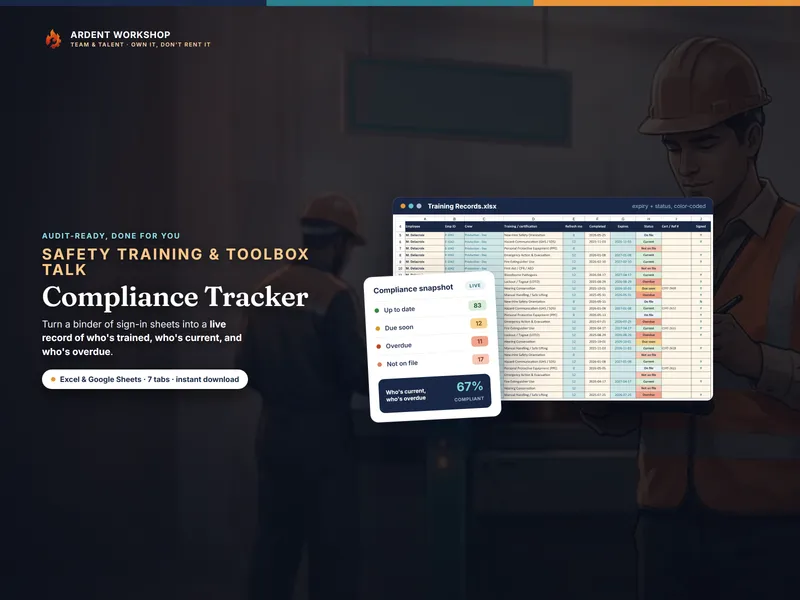
If you also need to show that the formal training happened, the Safety Training & Toolbox-Talk Compliance Tracker tracks each person’s training records and refresher due dates in the same workbook as the talks delivered. For the neighboring question of how trade training hours are counted, see how many apprenticeship hours your trade requires.
Common questions about toolbox talk topics
How many toolbox talk topics do you need for a year?
Fifty-two, if you hold one talk a week and never want to repeat inside the year. A crew that meets weekly and draws from a shorter list starts hearing the same talk every two or three months, and a talk heard that often risks becoming the one people stop listening to.
Can you repeat a toolbox talk topic?
Yes — and the high-risk ones should come around every year. The rule to keep is spacing, not novelty: no hazard family inside four weeks of its last talk, and no family left off the schedule for most of a year.
How long should a toolbox talk last?
The talks in this list run five to eight minutes each, inside the five-to-fifteen-minute range toolbox talks usually run. A single-topic talk rarely needs the top of that range, and a long one can turn into one person reading while the crew waits.
What should a toolbox talk sign-in sheet record?
The date, the site or crew, who led the talk, the topic, and the name and signature of everyone who attended. Keep the sign-in on the same page as the talk so the sheet you pass around is the sheet you file. Note that a signature records attendance, not competence.
A year of Mondays, already written
The list above is the hard part of the schedule. The other hard part is writing 52 talks a crew will actually listen to. The Weekly Toolbox-Talk & Safety-Meeting Script Library has every one of them as a single printed page: an opener to read aloud, why the hazard hurts people, three checks, two common mistakes, three questions for the crew, one action for the week, a “where this stops” line, and the sign-in slip. It also includes all six computed yearly schedules. It is a one-time download with no per-crew fee, so the file is yours to keep.
Disclaimer: This post is for informational purposes only and does not constitute safety, legal, or regulatory advice. Toolbox talks are discussion aids, not a safety program or training, and the requirements that apply to your work depend on your jurisdiction, industry and site — consult a qualified safety professional and your local occupational safety regulator before relying on this content.