Near miss, incident, and hazard — the difference
The three words get used interchangeably and mean different things. Keeping them apart is what makes a report useful to whoever reads it later.
- A hazard is a condition with the potential to cause harm — the unsecured floor cover, the frayed cord, the shelf stacked too high. It exists whether or not anybody goes near it.
- A near miss is an event: somebody went near it and it very nearly went wrong. The cover moved under a boot; the cord sparked in a hand; the stack shifted as somebody reached past it.
- An incident is the same event with an outcome — an injury, an illness, or damage. Whether an event lands in this row or the one above it is often nothing but timing.
That last point is the whole argument for collecting near misses. The circumstances that produce them are the circumstances that produce injuries; the difference is which one you find out about.
Why near misses go unreported
Rarely because people do not care. Commonly for one of four reasons, and each has a fix that costs nothing:
- It looks like admitting a mistake. If the first question is "who did that?", reporting stops. Whoever brings one in gets thanked, out loud, in front of the crew — including when they caused it themselves.
- Nothing visibly happens. A report that produces no fix, no change and no mention teaches everybody that reporting is paperwork. Close the loop where the crew can see it.
- Reporting is harder than forgetting. A form somebody has to request, in an office they are not in, at the end of a long day. A slip in the truck and on the wall that anybody can fill in, unprompted and unsigned, gets used.
- People only report the dramatic ones. The valuable reports are the boring repeated ones — the same trip, the same awkward reach, the same cord. Repetition is the signal.
What a useful near-miss report contains
Short enough that somebody will actually fill it in, specific enough to act on. Five fields do it:
- When — the date and roughly the time of day.
- Where — exactly where, not "on site".
- What happened — described as a situation rather than a character judgment. "The cover was not secured and I stepped on the edge of it" tells you something to fix; "I was careless" tells you nothing.
- What it could have been — the outcome if the timing had been different. This is the field that gets a report taken seriously.
- What would stop it happening again — the reporter is usually the person who knows.
A name is optional. An anonymous report you receive beats a signed one you never do.
Turning them into next week's safety talk
The best toolbox talk you will run all year is about the thing that nearly happened on Tuesday. A handful of near misses you actually hear about tells you more about what is likely to go wrong next than a clean incident record does — so the pattern worth building is: collect them on a slip, look at what repeats, and run the talk that matches.
The Weekly Toolbox-Talk & Safety-Meeting Script Library is built for exactly that loop: 52 one-page talks indexed by hazard family so you can look up whatever happened and run that talk this week, a printable near-miss slip to keep in the truck, and a talk on near-miss reporting itself — the one that decides whether you hear about any of the others. Four of the talks are free, no signup. For the record side — talks delivered, attendance, what is expiring — see the Safety-Training & Toolbox-Talk Compliance Tracker. And if you are new to the format, what a toolbox talk is covers the basics.
To keep the near misses themselves, the Workplace Incident, Near-Miss & Injury Log Workbook puts every near miss, first-aid case and recordable injury in one log, tracks a fix with an owner and a due date for each one, and works out how many near misses you log for every recordable case. It also calculates your TRIR from the hours you log each month. The Free TRIR Calculator & Near-Miss Report Pad needs no signup.
This explainer is general information, not safety, legal, or compliance advice. Whether a particular event must be recorded or reported to a regulator — and how quickly — is set by the rules that apply to you, and those definitions and timeframes vary by jurisdiction. Internal near-miss reporting is separate from, and does not replace, any legal reporting obligation. Confirm yours with your own program, regulator, and insurer.
Templates that implement this
Where near misses turn into a talk
4 templates
A printable near-miss slip anybody can fill in, a year of crew talks including one on reporting them, and the workbook that keeps the training record.
- $19.95 Mix

Weekly Toolbox-Talk & Safety-Meeting Script Library — 52 Ready-to-Read Safety Talks, One Page Each, With a Sign-In Slip and Six Computed 52-Week Rotations
52 ready-to-read toolbox talks, one page each with the sign-in slip on the same sheet, plus six computed 52-week rotations. A year of safety meetings.
Team & TalentView details - $29.95 Spreadsheet
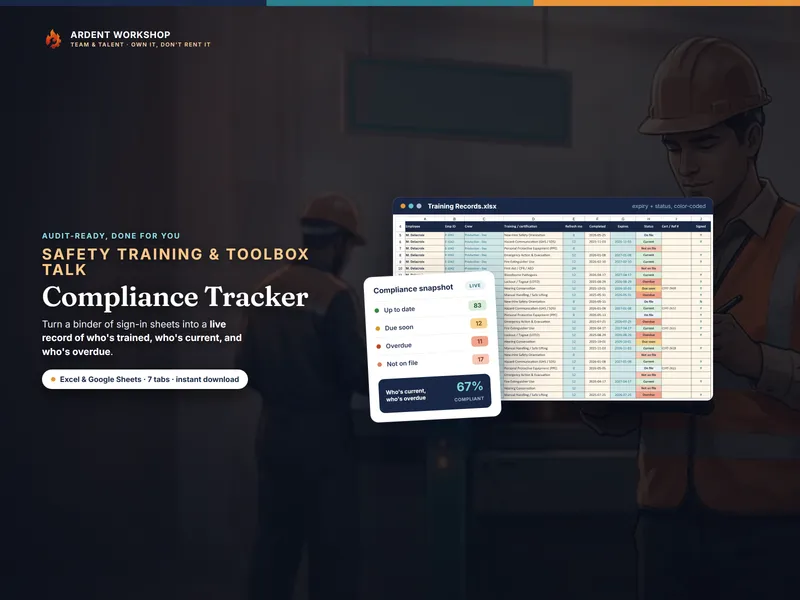
Safety-Training & Toolbox-Talk Compliance Tracker — Excel & Google Sheets
A safety-training & toolbox-talk tracker for Excel & Google Sheets — automatic refresher expiry, color-coded status, and audit-ready compliance dashboard.
Team & TalentView details - $19.95 Mix
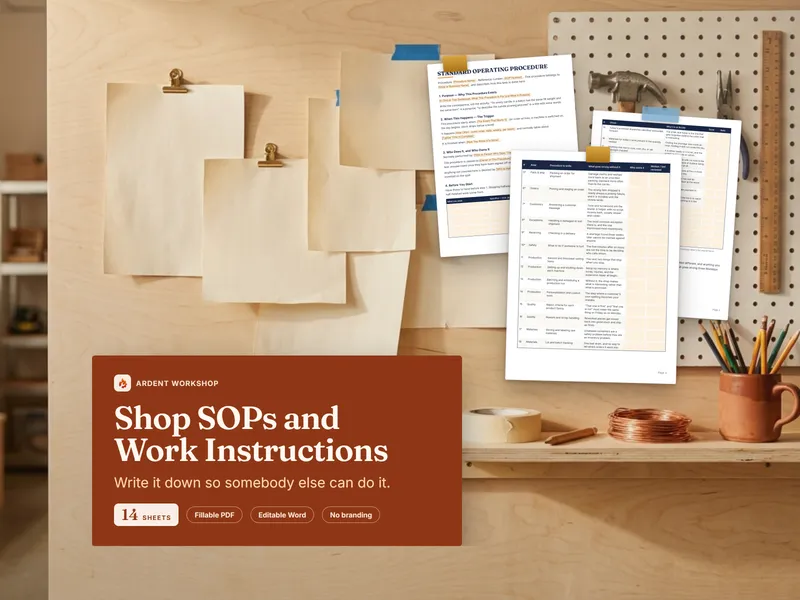
Shop SOP & Work-Instruction Template Pack — 14 Fillable Procedure Sheets for a Small Production Shop: SOP, Work Instruction, Opening & Closing Checklists, Reject Criteria, Packing Standard, Training Sign-Off
Fourteen fillable sheets for writing down how your shop runs — SOPs, work instructions, checklists, reject criteria and a training record, in PDF and Word.
Operator OSView details - $29.95 Spreadsheet
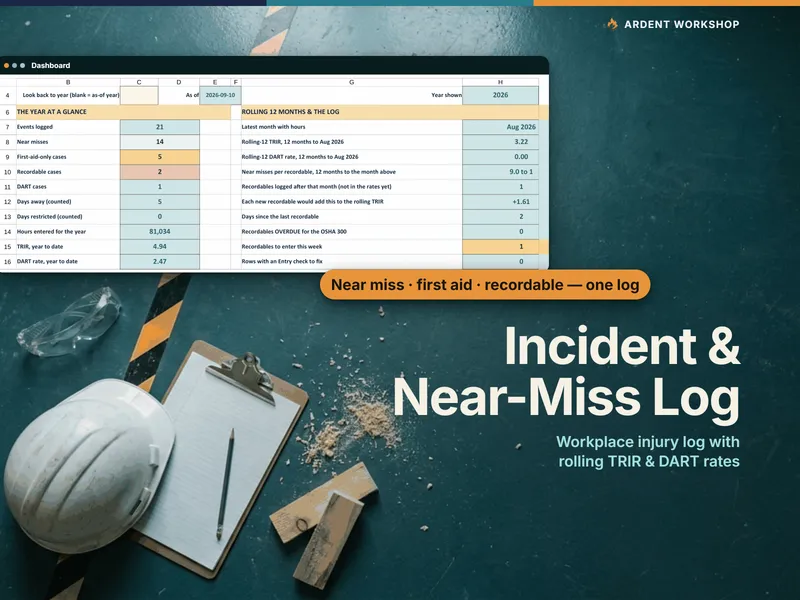
Workplace Incident, Near-Miss & Injury Log Workbook - Rolling TRIR & DART Rates (Excel + Google Sheets)
Incident and near-miss log for Excel & Google Sheets: one log for every event, rolling TRIR and DART rates, linked fixes and 300A-shaped totals.
Team & TalentView details