

Life Admin 11 min read
Why a Home Inventory
Turn household chaos into clarity with a home inventory spreadsheet that protects, organizes, and brings peace of mind.
A curated set of 9 spreadsheets — and the guides that go with them — for the months after a fire, flood, or storm. Value what you lost, follow every claim from filed to paid, keep the receipts and the living-expense log, and put every deadline somewhere it cannot be missed.
In the first week right now? Start free with the After-the-Disaster First Steps Checklist — the calls to make, what to photograph before anything moves, and the figures to find on your declarations page. No signup.
Nobody prepares for the six months afterward: the adjuster who does not call back, an inventory of every object you owned, receipts you were too shocked to keep, and deadlines nobody explains until one has passed. These templates hold the details so they are ready when an adjuster, a contractor, or a tax preparer asks.
Start with the two numbers that decide most of what a household gets paid, because almost nobody is told how either one works before it is used on them. The first is actual cash value — what your things were worth allowing for age and wear — and the depreciation an insurer holds back until you actually replace each item and send in the receipt. That second payment is the one that is easiest to forget, because nothing prompts you to claim it. The second is additional living expenses, which pay the increase over what you were already spending, not the whole bill. The Disaster-Recovery Claims & Rebuild Binder computes both, line by line.
The single highest-value hour of a recovery happens before anyone thinks about a claim: photographing every room and every damaged item before anything is moved or thrown away. It cannot be repeated later.
For any part of a home still intact — or for a family member preparing somewhere else — the same argument runs forward: build a home inventory before it is needed, and read why a home inventory is worth the evening. The Emergency / Evacuation Readiness Binder is the "before" half of the same job, and the two are built to be used together.
Learn what a proof of loss is before you sign one, and what an insurance adjuster does — including the difference between the one your insurer sends and the one you would hire. Compare an owned claims binder against a hosted claims app, or follow the step-by-step tutorial on documenting a home insurance claim to build the file.
And if a deadline is close, or has already passed, call today rather than assuming it is over. After a large declared disaster, insurers and agencies often extend deadlines by bulletin, and the Federal Emergency Management Agency (FEMA) can waive the flood proof-of-loss period for an affected area — those extensions are announced, so ask whether one applies to you. Never assume a missed date will be forgiven. Whatever a template tells you, always work from the deadline printed on the letter in your hand.
An honest word. These templates organize and record; they do not file anything, value your loss, adjust your claim, or guarantee any result, and they are not insurance, legal, tax, or public-adjusting advice. Ardent Workshop is not affiliated with, endorsed by, or connected to FEMA, the Small Business Administration, any insurance company, or any government agency.
Recommended templates
9 templates
A claims-and-rebuild binder that values every loss and counts every deadline, the readiness binder that is its 'before' half, a home inventory to build while everything is intact, and the household records a claim keeps asking for — in Excel and Google Sheets.

A post-disaster insurance claim organizer for Excel & Sheets — work out each item's cash value, compute claimable living expenses, track every deadline.
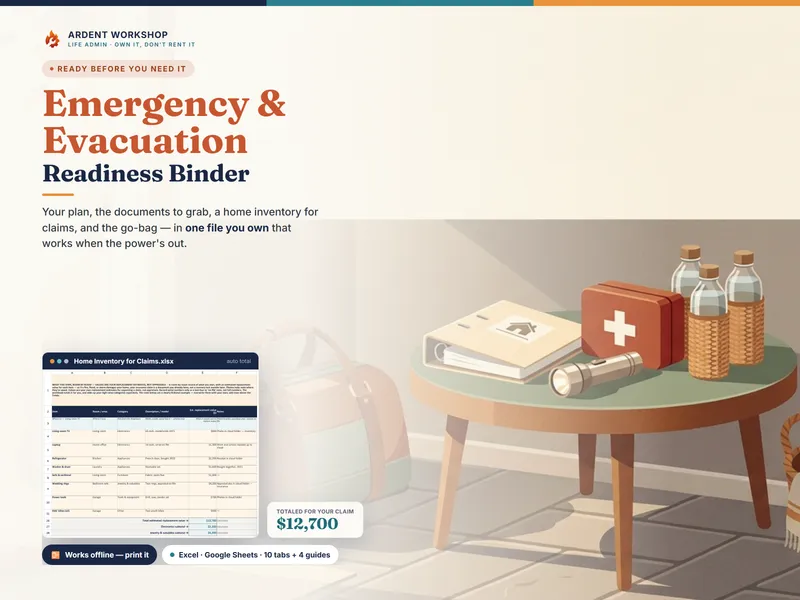
An emergency & evacuation readiness binder for Excel & Google Sheets — your plan, documents to grab, home inventory & go-bag in one file you own.
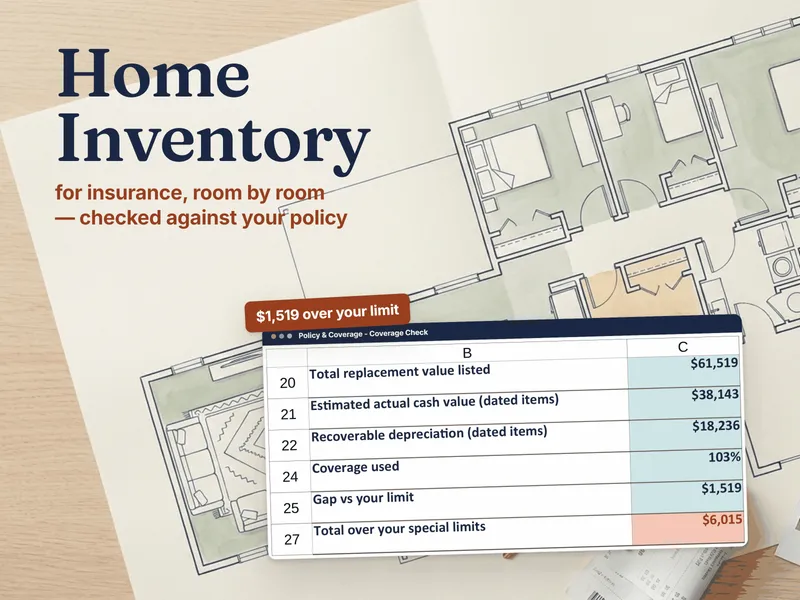
Excel home inventory for insurance: log what you own room by room, score your proof, check it against your policy limit and build a claim schedule.
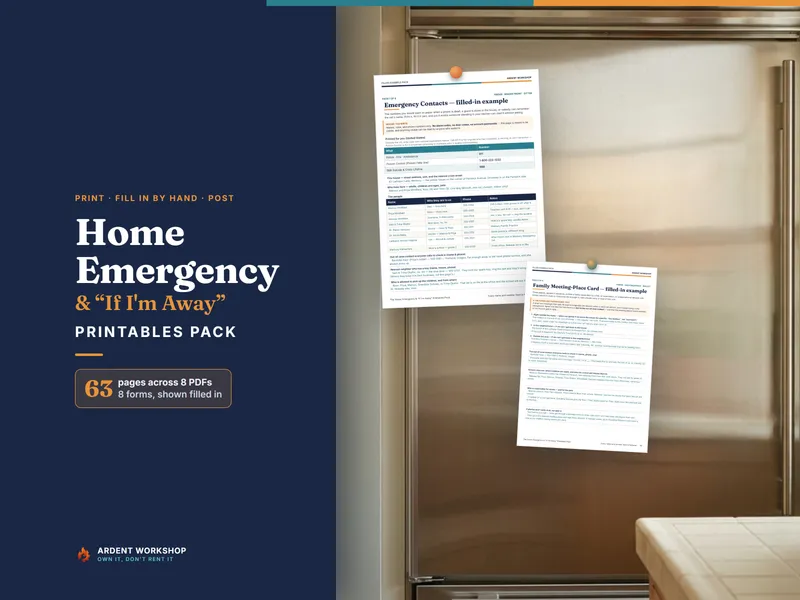
63 pages across 8 PDFs — eight print-and-fill forms, 12 cut-out cards and two guides, with every form shown already filled in. US Letter and A4.
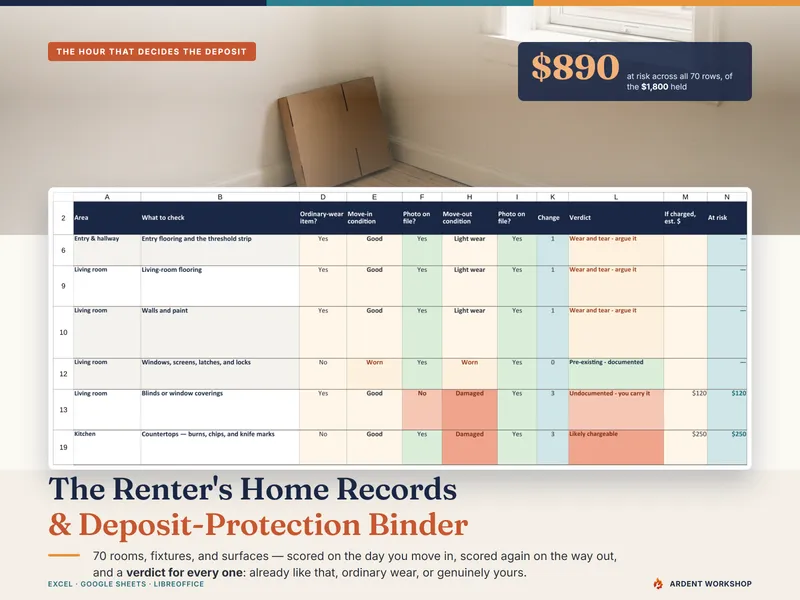
Score 70 things on move-in day and again on the way out. The binder compares them and shows what your own record has as pre-existing, wear, or at risk.
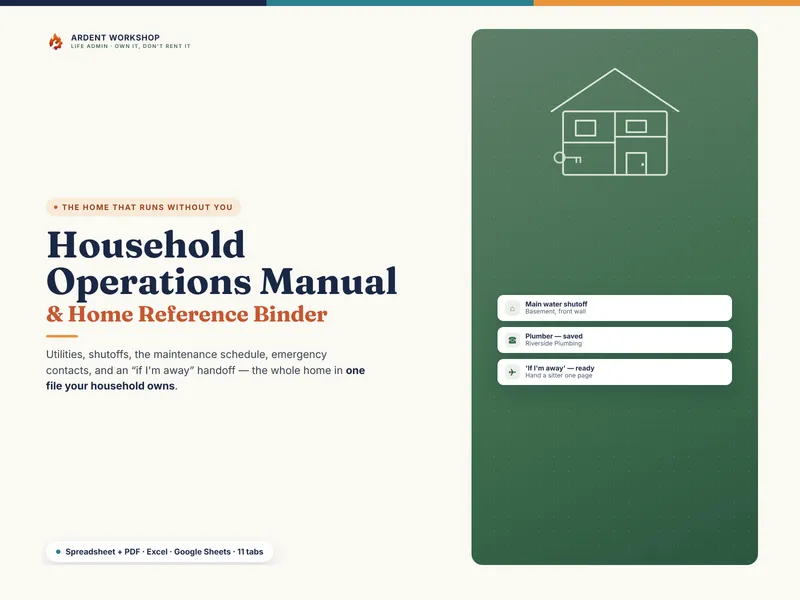
Run your whole home from one file — utilities, shutoffs, the maintenance schedule, emergency contacts, and an 'if I'm away' handoff, all in a file you own.
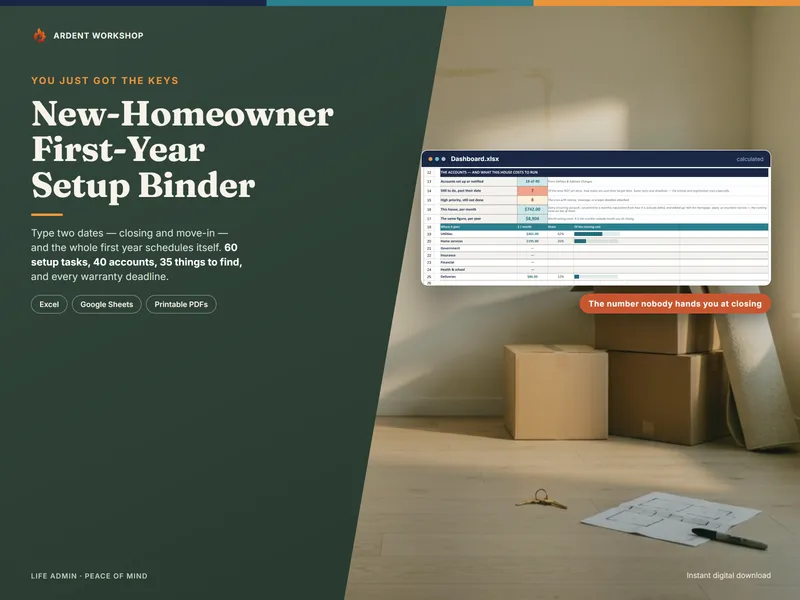
Type two dates and the first year in a new house schedules itself: 60 setup tasks, 40 account transfers, warranty deadlines, and the monthly running cost.

Keep every vehicle's records in one spreadsheet you own — and it works out what's actually due, by date and by mileage, whichever comes first.
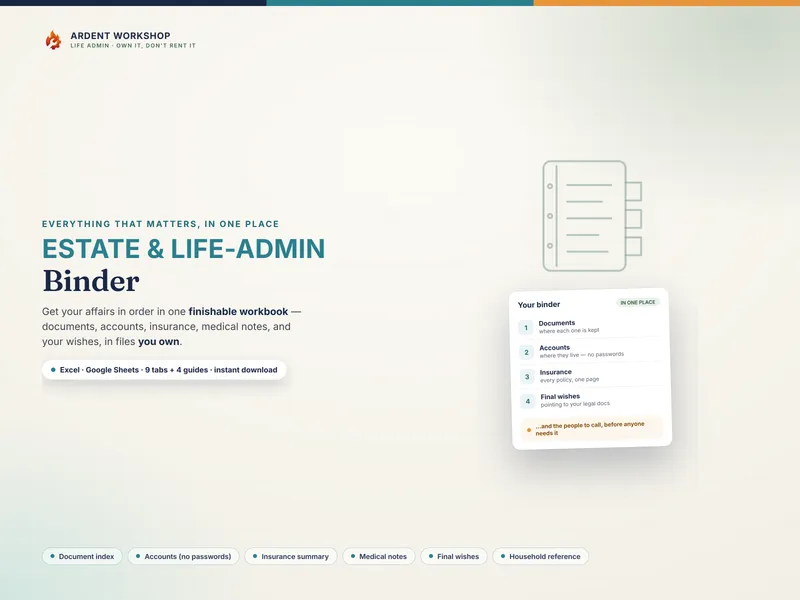
An estate & life-admin binder for Excel & Google Sheets — organize important documents, accounts, insurance, and final wishes in one file you own.
Where we fit
Compare the setup effort, collaboration, and automation you need. Ardent Workshop sells ready-made templates; a custom spreadsheet or software platform may fit better depending on the job.
Build the structure around your own process, with time set aside for formulas, layout, and maintenance.
Owned, structured, connected workbooks — a one-time price, yours to keep.
Consider a platform when you need shared workflows, automation, or integrations. Check the specific plan, permissions, and export options.
Reading list
Why a home inventory earns its evening, what belongs in a family emergency binder, and how to build the room-by-room record a claim will ask you for.
Turn household chaos into clarity with a home inventory spreadsheet that protects, organizes, and brings peace of mind.

A family emergency binder keeps every critical document, account, and contact in one place. Here's what to include and how to build one this weekend.

A home inventory protects your family's finances. Here's how to build one room by room without spending an entire weekend on it.