The Hidden Value of Household Organization
There’s something oddly satisfying about knowing exactly what’s in your home. From the couch you binge-watch on to the blender that makes your morning smoothies, every item has value. But when it comes to insurance claims, moving day chaos, or even just calculating the net worth of your household assets, relying on memory alone is a recipe for stress. That’s where a home inventory spreadsheet comes in—a simple, powerful tool that turns household organization into a superpower.
A Smarter Way to Track Assets
Think of it as your personal asset tracker. Instead of digging through drawers for receipts or scrolling endlessly through old emails, a home inventory spreadsheet keeps everything in one place. You can log purchase dates, categories, costs, and even notes about warranties or sentimental value. Suddenly, your belongings aren’t just scattered objects—they’re part of a clear, organized system that’s ready to work for you.
What to Actually Record for Each Item
“Log your stuff” is where most home inventories die, because nobody knows how much detail is enough. Here’s the answer: enough that a stranger could identify and price the item without your help. That’s the whole test.
| Field | Why it earns its column | Example |
|---|---|---|
| Item name | The thing itself, specific enough to price | 55” LED TV, not “TV” |
| Room / location | Groups the list for a move and for a room-by-room claim | Living room |
| Category | Lets you total by type and spot policy sub-limits | Electronics |
| Make & model | The single most useful field for a replacement quote | Brand + model number |
| Serial number | Proves ownership; how police list recovered property | On the back panel |
| Purchase date | Drives depreciation math on a claim | March 2022 |
| Purchase price | What you actually paid | $1,200 |
| Estimated replacement cost | What an equivalent costs today — the number that matters | $900 |
| Receipt / photo | Turns your word into evidence | Photo attached |
| Warranty expiry | Catches free repairs you’d otherwise pay for | March 2027 |
| Notes | Sentimental value, appraisals, condition, quirks | Inherited; appraised 2023 |
Two of those are doing most of the work. Serial number is what turns “a TV was stolen” into “this TV was stolen.” Estimated replacement cost is what turns a list of old receipts into a number your policy can act on — and it drifts, which is why an inventory is a living document rather than a weekend project you file away.
You don’t need all eleven fields on day one. Item, room, make/model, and a photo will get you 80% of the value in an afternoon. Add the rest as you go.
Insurance Claims Made Easier
Insurance companies love documentation. When filing an insurance claim after theft, fire, or water damage, the process moves much faster if you can provide a detailed list of what was lost. A home inventory spreadsheet acts like a ready-made insurance claim organizer. With itemized details and values, you’re not left scrambling to remember whether that TV was 42 inches or 55, or whether the dining table was oak or walnut. The spreadsheet does the remembering for you, and that can mean faster payouts and fewer headaches.
Replacement Cost vs. Actual Cash Value
This is the distinction that decides what actually lands in your account, and most people meet it for the first time in the middle of a claim — the worst possible moment.
- Replacement cost value (RCV) pays what it costs to buy a comparable new item today.
- Actual cash value (ACV) pays replacement cost minus depreciation — what the used item was worth the moment before it was destroyed.
Which one your policy uses for personal property is printed on your declarations page. Here’s why it’s worth the two minutes it takes to look, using illustrative arithmetic rather than any real quote:
Say a five-year-old TV cost $1,200 new, and an equivalent model sells for $900 today. Suppose the insurer depreciates electronics over ten years — so after five years, the item has lost half its useful life.
| Replacement cost policy | Actual cash value policy | |
|---|---|---|
| Comparable new TV today | $900 | $900 |
| Depreciation applied (5 of 10 years) | none | −$450 |
| What you’d receive | $900 | $450 |
| Out of pocket to actually replace it | $0 | $450 |
Same TV, same loss, same paperwork — and a $450 gap. Now multiply that across every appliance, every laptop, and every stick of furniture in a total loss and you understand why the distinction is worth more than the premium difference for most households.
Your inventory is what makes either number provable. Without a purchase date, the insurer’s depreciation assumption is the only one on the table. With one, you’re negotiating from a record instead of a memory.
The move: Pull your declarations page, find whether personal property is settled at RCV or ACV, and write it at the top of your inventory sheet. Then record purchase dates like they’re worth money — because on an ACV policy, they literally are.
The Categories Your Policy Probably Caps
Here’s the second thing that surprises people. A homeowners or renters policy typically covers personal property up to an overall limit — but within that limit, certain categories carry much lower sub-limits. Jewelry, watches, furs, firearms, silverware, cash, collectibles, and business property are the usual suspects, and the specific caps vary by insurer and policy.
The practical consequence: you can be well under your total coverage limit and still be badly underinsured on one category. The engagement ring, the camera kit, the tool collection, the guitars — these are exactly the things people assume are “covered” because the overall number looks big enough.
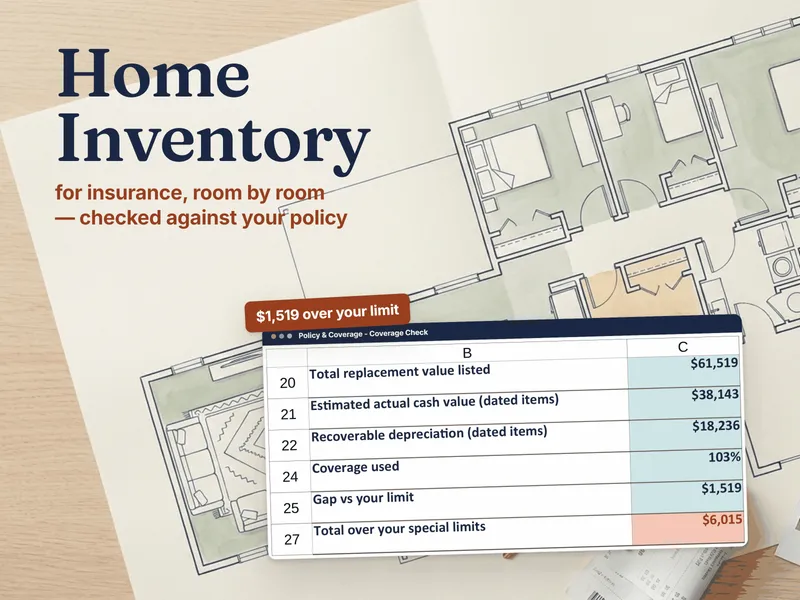
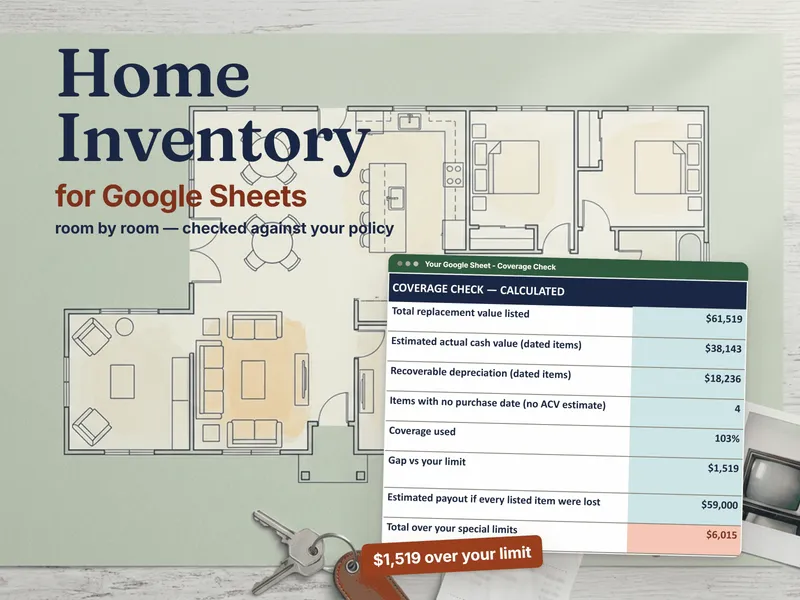
An inventory is how you find out before the loss instead of after. Total your list by category, then compare each category total against the sub-limit on your declarations page. Where a category is over its cap, you have a decision to make — a scheduled personal property endorsement (sometimes called a rider or floater) covers named high-value items individually, usually requiring an appraisal or receipt. That appraisal is one more thing your inventory should be pointing at.
This is precisely the kind of check that takes ten minutes when the list already exists and never happens when it doesn’t.
The Perfect Moving Checklist
Beyond insurance, a home inventory spreadsheet doubles as a moving checklist. Anyone who has packed up a house knows how easy it is for things to get misplaced. By organizing belongings by room or category, you can track what’s been boxed, what’s been loaded, and what’s been delivered. It’s like having a moving day assistant who never forgets a single lamp or set of dishes.
A Tool for Financial Awareness
There’s also the financial side. A well-maintained home inventory spreadsheet can act as a net worth calculator for your household assets. By tallying up the value of furniture, electronics, appliances, and even collectibles, you get a clearer picture of your financial standing. This isn’t just useful for insurance—it’s also a smart way to track depreciation, plan for upgrades, or simply appreciate the value of what you’ve built over time.
Customizable and Flexible
The best part is how customizable these spreadsheets can be. Want to track by category, like Furniture, Electronics, or Dishware? Easy. Need to add notes about serial numbers, warranties, or replacement values? Done. A home inventory spreadsheet adapts to your lifestyle, whether you’re a minimalist with a few prized possessions or a collector with shelves full of treasures.
If you’d rather break out the kitchen as its own system — pantry stock, expiration dates, small appliances — the Kitchen Inventory (Excel) is a focused companion to the whole-house inventory and is especially useful for households that cook in volume or run a home-based food business.
How to Build a Home Inventory in One Weekend
The reason most people don’t have an inventory isn’t that they doubt the value. It’s that “document everything you own” sounds like a month of evenings. It isn’t. Here’s the version that finishes.
- Do a video pass first, before you type anything. Walk every room with your phone recording, narrating as you go — “living room, 55-inch TV, soundbar, two lamps, the sectional.” Open closets, cabinets, and drawers. Twenty minutes for a whole house. This alone is more documentation than most households have, and it’s your safety net if you never finish step 3.
- Photograph the identifiers. Go back for close-ups of serial numbers, model plates, and maker’s marks on anything worth more than a couple hundred dollars — TVs, appliances, computers, power tools, bikes, instruments. The plate is usually on the back or underside.
- Type up one room at a time, worth-most-first. Set a 20-minute timer per room and start with the rooms holding the expensive things: living room, home office, kitchen, garage. Item, room, make/model, purchase date, estimated replacement cost. Don’t chase perfection — a rough estimate beats a blank cell, and you can refine it later.
- Total by category and compare against your sub-limits. This is the step that turns a list into a decision. Jewelry, electronics, tools, collectibles. Where the total exceeds the cap, that’s a conversation to have with your agent.
- Store a copy off-site. An inventory that burns with the house is a rehearsal, not a record. Cloud storage, a copy emailed to yourself, a drive at a relative’s place — anywhere that isn’t the building the inventory describes. This is the step people skip, and it’s the one that makes all the others count.
- Set one annual reminder. Pick a date you’ll remember — policy renewal, tax day, the New Year — and spend fifteen minutes adding what came in and removing what went out. That’s the entire maintenance burden.
Six steps. One weekend for the first pass, fifteen minutes a year after that. Compare that to reconstructing the contents of a house from memory, under a deadline, after the worst week of your life.
Peace of Mind at Home
And let’s not forget peace of mind. Life throws curveballs, but knowing your household is documented and organized brings a sense of control. Whether you’re preparing for an insurance claim, planning a move, or just curious about the value of your assets, a home inventory spreadsheet is the kind of tool that pays for itself in time saved and stress avoided.
Common Questions About Home Inventories
Do I need receipts for everything?
No — and if that were the bar, nobody would have an inventory. A photo of the item plus its make, model, and serial number establishes that you owned it. Receipts help most for high-value items and for anything you’d want settled at full replacement cost. Where you have a receipt, attach it; where you don’t, a dated photo and a model number still carry real weight.
Does a video walkthrough count as an inventory?
It counts as evidence, and it’s far better than nothing — but it isn’t a claim document. A video proves the sectional existed. It doesn’t tell an adjuster the model, the purchase date, or what an equivalent costs today, and it can’t be totaled by category against a sub-limit. Shoot the video and keep the list; they do different jobs.
How often should I update it?
Once a year for the sweep, plus whenever something significant enters or leaves the house. A new appliance, a laptop, an engagement ring, a bike — those are the items that matter, and adding one takes ninety seconds at the moment of purchase, when the receipt is still in your hand.
I rent. Do I still need one?
Yes, and arguably more urgently. Your landlord’s policy covers the building, not your belongings — a renters policy is what covers your things, and it settles on the same RCV-versus-ACV terms as a homeowners policy. Renters also move more often, which is where the inventory’s second job earns its keep.
What’s a reasonable value threshold for listing something individually?
A common working rule is to list anything you’d be annoyed to replace out of pocket — for most households that’s somewhere around $100 and up — and to group the rest by category (“kitchen small appliances,” “books”). You’re not cataloguing spatulas. You’re making sure nothing meaningful gets forgotten in a room-by-room reconstruction.
The Tool That Does It All
So, why does every household need one? Because it’s more than just a spreadsheet—it’s a safety net, a financial planner, and a moving day lifesaver all rolled into one. It’s the quiet hero of household organization, ready to step in when you need it most.
For those ready to get started, the Ardent Workshop Home Inventory Tracker is available in both Excel and Google Sheets versions. Designed with a clean, professional layout and built-in formulas, it’s the perfect tool to keep your household assets organized, protected, and valued.