You cannot undo the fire, the flood, or the storm. What you can control is whether the loss was documented, whether the dates were written down, and whether the money you were owed was actually claimed.
Records help support the process, but coverage, safety and deadlines may need attention at the same time. Use the sequence that fits the situation.
Document safely before and during cleanup
Put safety before documentation. The NFIP claims checklist (opens in new tab) says you can report a claim before returning and should not reenter until safe. Photograph damage when possible, but do not retain hazardous items or delay disposal required by local law just to preserve evidence.
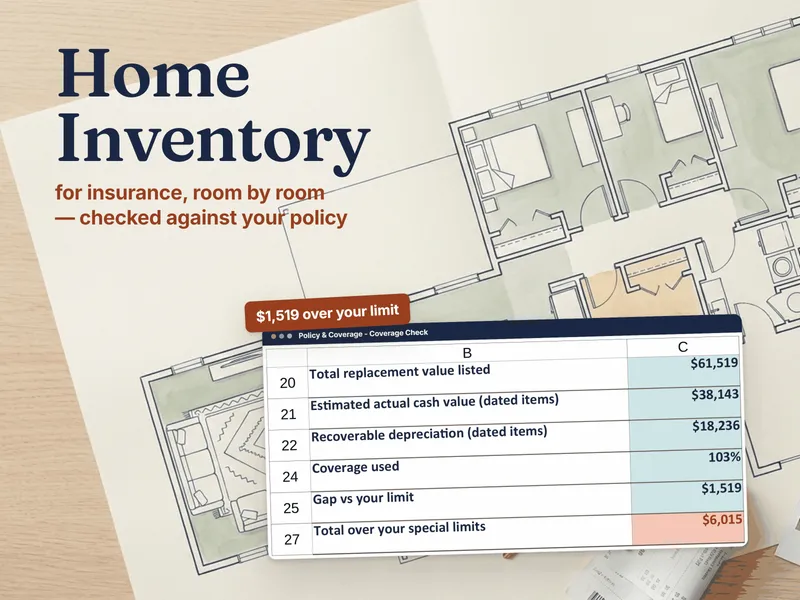
Record room views, item descriptions, approximate ages, model numbers and supporting receipts. Keep original images and a dated inventory. Ask about safe cleanup and inspection arrangements; record emergency work and its cost. A photograph supports a claim but does not establish coverage.
Valuation and living-expense records
Two useful records are the item valuation and additional living expenses. Neither is a promise of payment.
1. Actual cash value, and the money held back
California’s residential claims guide (opens in new tab) explains replacement-cost and actual-cash-value coverage as a state example. Whether depreciation is recoverable, and what replacement evidence is required, depends on the policy and applicable law. Ask for the insurer’s itemized valuation and explanation of deductions.
A planning example: an assumed $2,400 replacement price less $1,440 depreciation leaves $960 before other claim adjustments. The $1,440 difference is not automatically owed later. A workbook’s age-based rate or floor is an assumption to check, not the insurer’s valuation method.
For a specific counterexample, the NFIP dwelling form (opens in new tab) settles personal property at actual cash value. Do not assume replacement-cost treatment for the building also applies to its contents. Check special limits for valuables separately.
2. Living expenses pay the increase, not the bill
When applicable coverage pays eligible additional living costs, preserve both normal spending and actual spending for comparable periods. Food spending of $1,105 versus a normal $780 is a $325 increase to document, not an automatic $325 entitlement. A hotel or kennel bill is not automatically payable merely because it is new.
Check the covered cause of loss, expense eligibility, limits and time restrictions before committing to costs. NFIP coverage information (opens in new tab) expressly excludes temporary housing and additional living expenses. Separate any other policy or disaster-assistance claim from NFIP records.
Confirm each deadline and its source
For each action, record the policy or program, triggering event, notice and receipt dates, deadline source, due date and proof of submission. Review the full policy and applicable rules as well as correspondence; a letter may not list every deadline.
The NFIP dwelling form (opens in new tab) generally requires a signed and sworn proof of loss within 60 days after the loss, subject to applicable FEMA waivers or extensions. That is not a universal homeowners or private-flood deadline. FEMA assistance and SBA applications are separate programs with their own instructions.
Ask promptly about an extension when needed and keep written confirmation; a request is not approval. If a date is disputed or has passed, contact the insurer or relevant agency and consider help from the state insurance department or qualified counsel. The insurer is not the only source of information about your rights.
Keep the trail while you still have the phone in your hand
After a large event you may well speak to a different person almost every time. “Someone told me it was approved” is worth nothing. A note in the shape of “On the 14th, this adjuster confirmed the supplement was opened, reference [number]” is worth a great deal — and it takes thirty seconds to write down.
Follow anything important with an email summarizing what was said. It costs a minute and turns a conversation into a record.
An honest word
This is a records-organizing method, not insurance, legal, tax, or public-adjusting advice, and no guarantee of any result. Ardent Workshop is not affiliated with, endorsed by, or connected to FEMA, the Small Business Administration, any insurance company, or any government agency. What is covered, how it is valued, and when anything is due are set by your policy, by your state, and by the letters your insurer, FEMA, or the SBA send you.
If you are in the first week right now, start with the free After-the-Disaster First Steps Checklist — the calls to make and what to photograph, in order. Then read what a proof of loss is before you sign one, and what an insurance adjuster does. More tools are on the disaster recovery hub.